Dative Covalent Bonding (AQA A-Level Chemistry): Revision Notes
📚Revision Notes
1.4.4 Dative Covalent Bonding
Note
A dative covalent bond, also known as a coordinate bond, is a type of covalent bond where both electrons in the shared pair come from the same atom. It occurs when one atom donates a lone pair of electrons to form a bond with another atom that has an empty orbital.
How Dative Covalent Bonds Form
Lone Pair Donation
- In a dative bond, one atom (the donor) provides both electrons for the bond. This atom typically has a lone pair of electrons.
- The other atom (the acceptor) has an empty orbital and can accept the lone pair to complete its electron configuration.
Representation
- Dative covalent bonds are represented using an arrow (→) pointing from the atom donating the lone pair to the atom accepting it.
- After the bond is formed, it behaves like a regular covalent bond, meaning the shared electrons are equally attracted to both nuclei.
Note
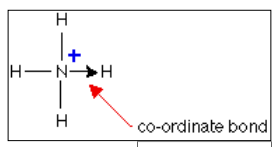
Example: Ammonium Ion () A classic example of dative bonding is the formation of the ammonium ion ():
- Ammonia () has a lone pair of electrons on the nitrogen atom.
- (a proton) has no electrons and can accept a lone pair.
- The nitrogen in ammonia donates its lone pair to the ion, forming a dative bond and producing (ammonium ion). This can be represented as:
In this reaction, the nitrogen atom provides both electrons for the bond between N and H⁺.
Properties of Dative Covalent Bonds
- Treated like a regular covalent bond: Once formed, a dative bond behaves exactly like a standard covalent bond and is indistinguishable from other covalent bonds in terms of reactivity and strength.
- Polarisation: In some cases, dative bonds may introduce polarity to the molecule, depending on the atoms involved.
Note
Summary
- Dative covalent bonds form when one atom donates both electrons in a shared pair.
- These bonds are represented using an arrow pointing from the electron donor to the acceptor.
- Once formed, dative bonds are treated as standard covalent bonds.