Dot & Cross Diagrams (AQA A-Level Chemistry): Revision Notes
📚Revision Notes
1.4.5 Dot & Cross Diagrams
Note
Dot and cross diagrams are a visual representation of the electrons involved in bonding between atoms in a molecule or compound. They are particularly useful for showing the transfer or sharing of electrons in ionic and covalent bonds.
Purpose of Dot & Cross Diagrams
These diagrams:
- Represent the valence electrons (outermost electrons) of atoms.
- Show how electrons are shared in covalent bonds or transferred in ionic bonds.
- Help illustrate the formation of ions and molecules, making it clear which electrons belong to which atom. Electrons from different atoms are represented by dots and crosses to differentiate between the sources of the electrons.
Representing Covalent Bonds
In covalent bonding, electrons are shared between atoms. A dot and cross diagram can represent this sharing clearly, with each atom contributing one or more electrons to the bond.
Note
Example: Water () In a water molecule:
- Oxygen has 6 valence electrons, needing 2 more to complete its outer shell.
- Each hydrogen atom has 1 valence electron, needing 1 more. The diagram shows two shared pairs of electrons (one between each hydrogen atom and oxygen atom), forming single covalent bonds:
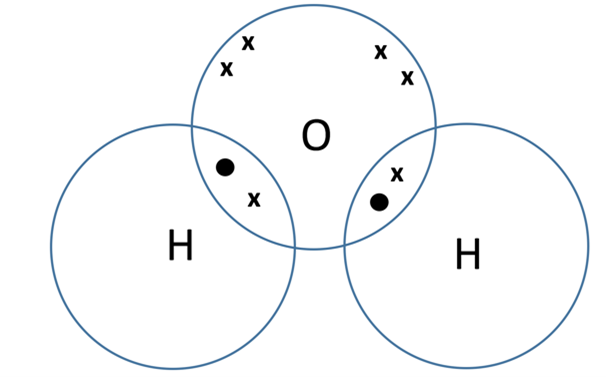
Here, dots represent oxygen's electrons, and crosses represent hydrogen's electrons.
Representing Ionic Bonds
In ionic bonding, electrons are transferred from one atom (usually a metal) to another (usually a non-metal), resulting in the formation of ions.
Note
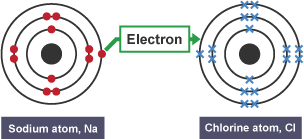
Example: Sodium Chloride (NaCl) In the ionic bond between sodium (Na) and chlorine (Cl):
-
Sodium (a Group 1 metal) loses one electron to become .
-
Chlorine (a Group 7 non-metal) gains this electron to complete its outer shell, forming . The dot and cross diagram shows:
-
The sodium ion () with no valence electrons.
-
The chloride ion () with a full outer shell of eight electrons.
Dative Covalent Bonds in Dot & Cross Diagrams
For dative covalent (coordinate) bonds, where both electrons in a bond are provided by the same atom, dot and cross diagrams can help clarify the origin of the electrons.
Note
Example: Ammonium Ion () In ammonium (), nitrogen donates a lone pair of electrons to bond with a hydrogen ion ():
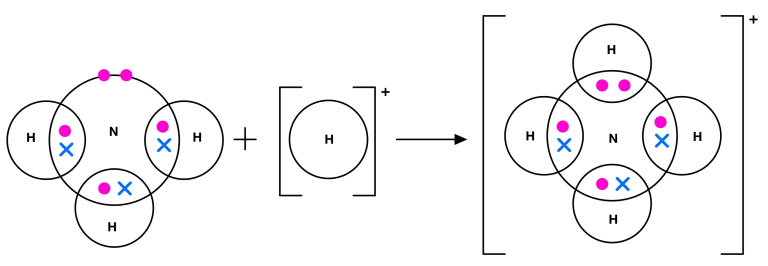
The electrons from the hydrogen atoms are shown as crosses and the electrons from the nitrogen atom are shown as dots. As it is an ion, square brackets are drawn around the diagram with the charge of the ion shown on the outside.
Key Points for Drawing Dot & Cross Diagrams
- Covalent bonds: Use a dot from one atom and a cross from another atom to show the shared electron pairs.
- Ionic bonds: Show electrons as being transferred from one atom to another, and place brackets around the ions to indicate their charges.
- Lone pairs: Non-bonding electrons (lone pairs) should be shown as individual pairs of dots or crosses around the atoms.
- Dative covalent bonds: Use an arrow to represent the direction of the bond, indicating that both electrons come from the same atom.
Note
Summary
Dot and cross diagrams provide a clear way to represent the transfer and sharing of electrons in chemical bonding. They illustrate the formation of ionic and covalent bonds and help visualise lone pairs and dative bonds. This technique is essential for understanding the molecular structure and bonding in compounds.