Properties of Covalent Substances (AQA A-Level Chemistry): Revision Notes
📚Revision Notes
1.4.8 Properties of Covalent Substances
Note
Covalent substances, depending on their structure, exhibit different physical properties such as melting point, boiling point, solubility, and electrical conductivity. These properties are influenced by the type of covalent bonding and the crystal structure of the substance.
Types of Covalent Structures
Covalent substances can exist as either simple molecular or macromolecular (giant covalent) structures. Each type has distinct physical properties.
Simple Molecular (e.g., Iodine)
- Structure:
- Simple molecular substances consist of small, covalently bonded molecules held together by weak van der Waals forces (intermolecular forces).
- Melting and Boiling Points:
- They typically have low melting and boiling points because the weak intermolecular forces are easy to overcome.
- An exception is water, which has a relatively high boiling point for a simple molecular substance due to the presence of hydrogen bonding.
- Conductivity:
- Simple molecular substances are generally poor conductors of electricity as they do not contain free-moving charged particles.
- Example: Iodine (I₂) is an example of a simple molecular substance. It forms solid crystals at room temperature but sublimes easily when heated.
Macromolecular (Giant Covalent) Structures
Macromolecular substances consist of atoms covalently bonded in a giant lattice. These structures are characterised by their strength and high melting points due to the vast number of covalent bonds holding the lattice together.
Examples of Macromolecular Structures
Diamond:
-
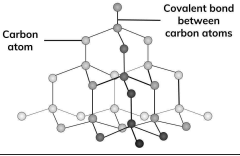
Structure: Diamond is a giant covalent structure where each carbon atom forms four strong covalent bonds to other carbon atoms, creating a rigid 3D lattice.
-
Melting and Boiling Points: Diamond has an extremely high melting point due to the strength of the covalent bonds.
-
Hardness: It is one of the hardest-known materials, making it ideal for cutting tools.
-
Conductivity: Diamond does not conduct electricity as it has no free electrons.
Graphite:
-
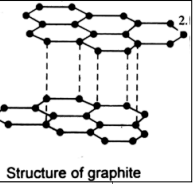
Structure: Graphite is another form of carbon, but in this structure, each carbon atom forms three covalent bonds with other carbons, creating flat layers of atoms. The layers are held together by weak van der Waals forces, allowing them to slide over each other.
-
Conductivity: Graphite is a good conductor of electricity because each carbon atom has one free electron that can move through the structure.
-
Lubrication: The ability of the layers to slide makes graphite useful as a lubricant.
-
Melting Point: It also has a high melting point due to the strong covalent bonds within the layers.
Properties of Different Covalent Substances
Melting and Boiling Points
- Simple molecular substances have low melting and boiling points due to weak intermolecular forces.
- Macromolecular structures like diamond and graphite have high melting points because of the extensive covalent bonding.
Electrical Conductivity
- Simple molecular substances are non-conductors of electricity because they do not have free-moving electrons or ions.
- Graphite can conduct electricity due to the free electrons between its layers.
- Diamond is a non-conductor of electricity as all its electrons are involved in bonding.
Solubility
- Simple molecular substances are often soluble in non-polar solvents.
- Macromolecular substances are generally insoluble in both polar and non-polar solvents due to the strong covalent bonds in the lattice.
Note
Summary
Covalent substances can exist as either simple molecular or macromolecular structures. Their properties, such as melting points, electrical conductivity, and solubility, are largely determined by the nature of the bonds and the structure in which they exist. Simple molecular substances have lower melting points and do not conduct electricity, while macromolecular substances, such as diamond and graphite, exhibit higher melting points, with graphite being an exception in conducting electricity.