Hess' Law (AQA A-Level Chemistry): Revision Notes
📚Revision Notes
1.6.5 Hess' Law
What is Hess' Law?
Hess' Law states that:
"The total enthalpy change of a reaction is the same, regardless of the route taken, provided that the initial and final conditions are the same."
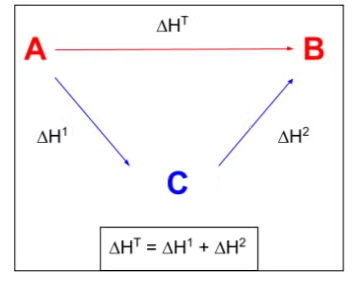
This law is based on the principle of energy conservation, meaning that energy cannot be created or destroyed in a chemical reaction. Therefore, if a reaction can proceed through multiple routes, the total enthalpy change () will be identical, regardless of the path taken.
Why is Hess' Law Important?
Hess' Law is useful for calculating the enthalpy changes of reactions that cannot be measured directly. By constructing a cycle (commonly known as a Hess Cycle) that connects different routes, we can calculate the enthalpy change of the overall reaction using known enthalpy values for intermediate reactions.
Using Hess' Law: The Triangular Cycle Method
One common method for applying Hess' Law is to use a triangular enthalpy cycle. This involves constructing a cycle of reactions, where:
- The arrows represent the enthalpy changes for different stages of the reaction.
- Direction of arrows: Indicates whether values should be added (for forwards reactions) or subtracted (for reverse reactions). These arrows are treated like vectors in terms of their direction. The cycle connects the reactants to the products through a series of intermediate steps, such as formation or combustion processes.