Kinetics (AQA A-Level Chemistry): Revision Notes
📚Revision Notes
1.7.6 Catalysts
What is a Catalyst?
A catalyst is a substance that increases the rate of a chemical reaction without being used up or changed in its chemical composition or amount. Catalysts are crucial in both biological systems and industrial processes as they enable reactions to proceed faster under milder conditions.
How Catalysts Work
Catalysts work by providing an alternative reaction pathway with a lower activation energy (Ea) than the uncatalyzed reaction. The activation energy is the minimum amount of energy required for reactant particles to successfully collide and form products.
- Without a catalyst: Only a small proportion of molecules have energy greater than or equal to the activation energy, leading to a slower reaction rate.
- With a catalyst: The activation energy is reduced, meaning more molecules have sufficient energy to react. This increases the rate of successful collisions and thus speeds up the reaction.
Explaining Catalysts Using the Maxwell-Boltzmann Distribution
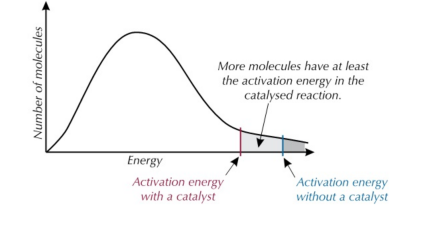
The Maxwell-Boltzmann distribution graph shows the spread of molecular energies in a gas at a given temperature. When a catalyst is introduced:
- The shape of the distribution curve remains unchanged because neither the temperature nor the number of molecules is affected.
- However, the activation energy (Ea) is lowered.
- The area under the curve beyond the new, lower activation energy is greater, meaning a larger proportion of molecules have enough energy to successfully react.
Key Points
- More molecules now have energy greater than or equal to the new, lower activation energy.
- This results in a higher rate of successful collisions and thus a faster reaction.
- The catalyst does not alter the distribution of energies, it only reduces the activation energy threshold.
Industrial and Biological Importance
Catalysts play a vital role in industry and biology:
- Industrial Catalysts: Catalysts are used in processes like the Haber process for ammonia synthesis, where they significantly increase production rates and reduce energy consumption.
- Enzymes: In biological systems, enzymes act as natural catalysts that speed up metabolic reactions necessary for life, often operating under mild conditions.
Note
Summary
- A catalyst increases the rate of reaction by lowering the activation energy, allowing more molecules to have enough energy to react.
- The Maxwell-Boltzmann distribution helps illustrate this by showing that, with a catalyst, the area under the curve beyond the new activation energy increases.
- Catalysts do not change the energy distribution of molecules but provide an easier pathway for reactions, making them essential in industrial and biological contexts.