Pollution Reduction Policies (AQA A-Level Geography): Revision Notes
📚Revision Notes
Pollution Reduction Policies
Understanding urban air pollution
Urban areas face significant challenges from air pollution. Historically, many cities experienced severe smog problems caused by industrial and domestic coal burning combined with foggy conditions.
Historical smog
Smog forms when fog combines with smoke particles in the atmosphere. This was a common problem in European cities during the 19th and early 20th centuries due to widespread coal burning. In Britain, the problem became so severe that particularly thick smogs were known as 'pea-soupers'. The most devastating example occurred in December 1952, when smog in London caused over 4,000 deaths.
Note
The term "smog" is a combination of "smoke" and "fog," reflecting its dual nature as both a meteorological and pollution phenomenon. The severity of historical smog events was directly linked to the widespread burning of coal for heating and industrial purposes.
Modern photochemical smog
Today, smog remains a serious concern in many global cities, though its composition has changed. The focus has shifted to photochemical smog, which poses significant health risks.
Important
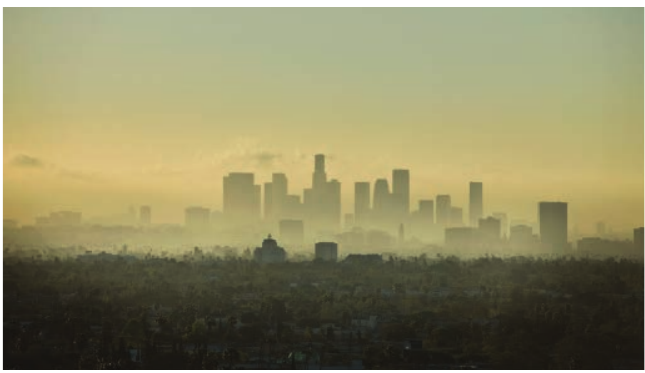
Photochemical smog forms when sunlight reacts with nitrogen oxides (NOx) and hydrocarbons in vehicle exhaust gases. This creates photochemical oxidants including ozone and peroxyacetyl nitrate (PAN). These substances damage plants and cause health problems in people, including headaches, eye irritation, coughs and chest pains.
The chemistry behind photochemical smog occurs when sunlight acts on nitrogen oxides and hydrocarbons from vehicle emissions, producing ground-level ozone. This should not be confused with the beneficial high-level ozone layer that protects Earth from ultraviolet radiation.
Cities like Los Angeles have struggled with photochemical smog for decades due to several factors:
- High vehicle density
- Frequent sunshine that drives the chemical reactions
- Basin topography that traps polluted air at low levels
Photochemical smog becomes particularly hazardous during anticyclonic weather conditions. When high pressure systems settle over an area, the air descends and remains relatively still due to weak winds. This stable atmosphere can persist for weeks during summer months, allowing pollutants to accumulate to dangerous levels.
Note
An inversion layer forms when warm air sits above cooler air near the ground, preventing vertical air movement. This atmospheric lid traps pollutants at ground level, where people breathe them in, rather than allowing them to disperse into the upper atmosphere.
Clean Air Acts in the UK
The catastrophic London smog of 1952 forced the UK government to take action. The death toll demonstrated that air pollution legislation was urgently needed.
The 1956 Act and smoke-free zones
The Clean Air Act of 1956 represented a turning point in pollution control. The Act introduced smoke-free zones in urban areas, requiring homes and businesses to stop burning coal or use smokeless fuel alternatives. This policy gradually cleaned up the air quality across British cities.
Strengthening regulations
The 1956 Act was reinforced by additional legislation over subsequent decades. During the 1990s, tougher regulations were imposed specifically targeting airborne pollutants, particularly PM10s (particulate matter measuring 10 micrometres or less).
Local councils across the UK now have legal responsibilities to:
- Monitor pollution levels in their areas
- Establish Air Quality Management Areas where pollution is likely to exceed safe limits
- Take action to reduce pollution in these designated zones
Recent improvements in London
London has implemented various measures to reduce pollution:
- Tree planting programme: 280,000 trees have been planted throughout the city. Their leaves and bark absorb pollutants – when bark from London plane trees flakes off, it removes accumulated pollutants
- Ultra Low Emission Zone (ULEZ): The world's first ULEZ was introduced in 2019, charging vehicles that don't meet strict emission standards
- Public transport upgrades: Increased use of hybrid and zero emission engine buses
- Electric vehicle infrastructure: 1,500 electric vehicle charging points were installed by 2020, with more being added
- Scrappage scheme: A £48 million fund helps owners replace polluting vehicles
- Construction site controls: Measures to reduce emissions from building sites have cut around 12% of the city's NOx emissions
- Dust suppressants: Industrial sites use these to reduce particulate pollution
Note
Measuring Success in London
These measures have achieved significant results. Before implementation in 2016, London's air exceeded the hourly legal limit for nitrogen dioxide for more than 4,000 hours annually. By 2019, this had fallen to just over 100 hours – a reduction of 97%.
Vehicle control and public transport strategies
Improving public transport provision and restricting polluting vehicles are amongst the most effective pollution reduction strategies available to cities.
London's transport policies
London has pioneered several innovative approaches:
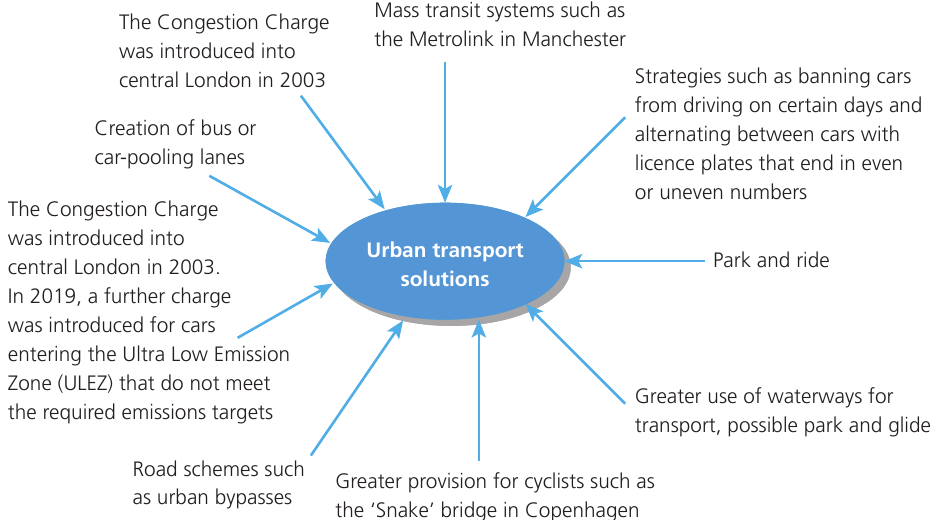
Congestion Charge: Introduced in central London in 2003, this daily charge applies to vehicles entering the zone. The scheme reduces traffic volumes and generates revenue for public transport improvements. In 2019, an additional charge was introduced for vehicles entering the ULEZ that fail to meet required emission standards.
Public transport investment: Creating attractive alternatives to private car use encourages modal shift and reduces overall emissions.
Range of urban transport solutions
Cities worldwide have adopted various strategies to reduce vehicle numbers and pollution:
- Mass transit systems: Modern tram and metro networks like Manchester's Metrolink provide fast, clean alternatives to cars
- Cycling infrastructure: Dedicated cycle lanes and bridges, such as Copenhagen's 'Snake' bridge, encourage active travel
- Car-pooling lanes: Priority lanes for vehicles carrying multiple passengers incentivise ride-sharing
- Park and ride schemes: Facilities on city outskirts allow commuters to park and complete journeys by public transport
- Urban bypasses: Road schemes directing through-traffic around city centres reduce urban pollution
- Alternating day schemes: Restricting which vehicles can drive based on licence plate numbers (odd/even number alternation)
- Waterway transport: Using rivers and canals for passenger and freight movement where possible
- Periodic car bans: Prohibiting cars on specific days to reduce pollution and encourage alternative transport
Note
The most successful cities combine multiple strategies rather than relying on a single approach. The combination of restrictions (like congestion charging), incentives (like improved public transport), and infrastructure (like cycling lanes) creates comprehensive solutions that address pollution from multiple angles.
Industrial zoning
Strategic planning of industrial locations helps reduce urban air pollution. Where possible, industries are located downwind of residential areas and planning regulations force companies to build taller factory chimneys. These measures use natural air movement to emit pollutants above the inversion layer, dispersing them away from populated areas rather than trapping them at ground level.
Note
Locating industries downwind takes advantage of prevailing wind patterns to carry pollutants away from populated areas. Combined with taller chimneys that release emissions above the inversion layer, this approach ensures pollutants disperse at higher altitudes rather than accumulating at ground level where people live and work.
Urban water pollution management
Whilst air pollution receives significant attention, water pollution is equally important for urban environmental quality.
Traditional drainage problems
Built-up areas must be drained effectively to remove surface water run-off. Traditionally, underground pipe systems were designed to convey water away as quickly as possible. However, these systems created several problems:
- They ignored amenity benefits of visible water features
- They provided no consideration for water resource management
- They offered no community facilities or landscaping opportunities
- They failed to support wildlife habitats
- Most critically, they contributed to water pollution
As water flows across urban surfaces and through drainage systems, pollutants from roads, buildings and other sources are washed into rivers or seep into groundwater. Once groundwater becomes polluted, it is extremely difficult to clean.
Sustainable Urban Drainage Systems (SUDS)
Important
Sustainable Urban Drainage Systems (SUDS) provide a more holistic approach to managing surface water. These systems aim to mimic natural drainage patterns wherever possible, managing both water quality and quantity.
Modern approaches recognise that urban development fundamentally alters the water cycle and water quality.
Understanding urban hydrology
Natural landscapes like forests, wetlands and grasslands trap precipitation and allow it to infiltrate slowly into the ground. In contrast, impermeable urban surfaces such as roads, car parks and rooftops prevent infiltration. Most precipitation remains above the surface and runs off rapidly in large volumes.
Urban areas are specifically designed to shed water quickly through features like:
- Sloping roofs
- Smooth, rounded guttering
- Cambered roads
Water is gathered in smooth storm sewer systems that act like high-density drainage networks. This gives water speed and erosional power as it travels underground. When the water eventually leaves storm drains and empties into streams, it arrives rapidly and in large quantities, causing flooding and erosion problems downstream.
Note
The Urban Water Cycle
The transformation from natural to urban surfaces fundamentally changes how water moves through an area. Natural landscapes act like sponges, gradually releasing water over time. Urban surfaces act like slides, rapidly channeling water into drainage systems. This change in timing and volume creates both pollution transport and flood risk issues.
Remember!
Summary
Key Points to Remember:
-
Smog has evolved: Historical coal-burning smog has been largely replaced by photochemical smog from vehicle emissions, which requires different policy responses
-
Legislation drives change: The UK's Clean Air Acts, beginning in 1956, demonstrate how targeted legislation can dramatically improve air quality over time
-
Multiple strategies work together: Effective pollution reduction requires combining approaches – vehicle restrictions, public transport investment, emission zones, and monitoring all play important roles
-
Case studies show success: London's measures reduced nitrogen dioxide exceedances from 4,000 hours to 100 hours annually, proving that determined policy implementation achieves results
-
Water pollution matters too: SUDS represent a shift from traditional drainage, recognising that urban water management affects overall environmental quality and pollution levels