Sustainable Urban Development (AQA A-Level Geography): Revision Notes
📚Revision Notes
Sustainable urban development
Introduction to sustainable urban development
Cities are at the heart of global sustainability challenges. Urban areas consume approximately three-quarters of the world's resources and generate the majority of global waste and pollution. Whilst the negative impacts of waste disposal, pollution and dereliction are most visible within cities themselves, the effects of urban growth are increasingly felt on a global scale. Cities draw energy and resources from around the world, and the pollution and waste they produce spreads far beyond their boundaries.
Important
Understanding sustainable urban development is essential because cities are key to building a more sustainable future for our planet.
Cities now face the challenge of managing rapid population growth whilst reducing their environmental impact. The Sustainable Development Goals (post-2015) recognise that making cities inclusive, safe, resilient and sustainable is fundamental to achieving global sustainability.
Ecological footprint
The environmental impact of cities can be measured using the concept of an ecological footprint.
Important
Ecological footprint - A measurement of the environmental impact of communities or individuals, defined as the total area of productive land and water needed to produce the resources a population consumes and to absorb the waste it produces.
Global ecological footprint statistics
Current global resource use is unsustainable:
- The world's ecological footprint should equal 1.7 hectares per person to live within our planet's means
- In 2019, humanity was using natural resources 1.75 times faster than ecosystems can regenerate
- This means we are depleting the Earth's natural capital rather than living off its sustainable yield
Note
These statistics reveal a critical imbalance: we are essentially borrowing from future generations by consuming resources faster than the planet can replenish them.
Variation in ecological footprints
Ecological footprints vary significantly both between countries and within individual nations:
- Urban vs rural: Cities typically have higher ecological footprints than rural areas
- Wealth disparity: Wealthier cities have higher ecological footprints than poorer cities
- Regional differences: Countries with higher living standards generally have larger footprints
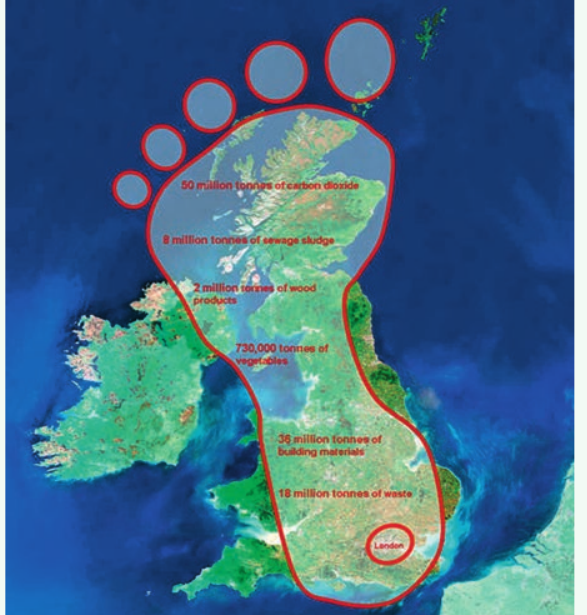
Example
Case Example - London's Ecological Footprint
Research by the Global Footwork Network (2011) found that London's ecological footprint covers an area almost twice the size of the UK. San Francisco's footprint was approximately six per cent higher than the average American's.
The higher average footprint in urban areas results from increased consumption and waste production by residents and services within cities.
Reducing the ecological footprint of cities has become a priority for achieving greater global sustainability.
Understanding sustainability dimensions
The concept of sustainability gained widespread recognition through the 1987 Brundtland Report, published by the UN World Commission on Environment and Development (WCED).
Important
Sustainable development - Meeting the needs of the present without compromising the ability of future generations to meet their own needs.
This definition emphasises intergenerational equity - ensuring that our current lifestyle choices do not harm the prospects of people living in the future.
What makes a city sustainable?
Important
Sustainable city - A city which provides employment, a high standard of living, a clean and healthy environment, and fair governance for all its residents.
A truly sustainable city must address three interconnected concerns:
- Social factors: quality of life, equality, community cohesion
- Economic factors: employment opportunities, economic stability
- Environmental factors: resource use, pollution levels, ecological protection
The four pillars of sustainable urban development
Achieving urban sustainability requires coordinated action across four key areas:
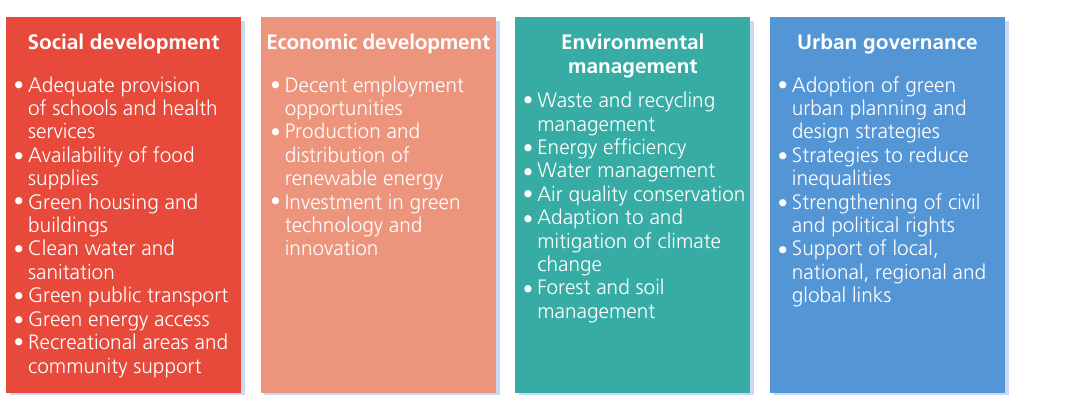
1. Social development
- Adequate provision of schools and health services
- Availability of food supplies
- Green housing and buildings
- Clean water and sanitation
- Green public transport
- Green energy access
- Recreational areas and community support
2. Economic development
- Decent employment opportunities
- Production and distribution of renewable energy
- Investment in green technology and innovation
3. Environmental management
- Waste and recycling management
- Energy efficiency
- Water management
- Air quality conservation
- Adaptation to and mitigation of climate change
- Forest and soil management
4. Urban governance
- Adoption of green urban planning and design strategies
- Action to reduce inequalities
- Strengthening of civil and political rights
- Support of local, national, regional and global links
Note
All four pillars are interconnected. Strong governance is needed to implement social programmes, economic policies must support environmental protection, and social development relies on environmental quality. Success requires coordinated action across all four areas.
Linear systems vs circular systems
Understanding cities as systems helps us identify the key differences between unsustainable and sustainable urban development.
The unsustainable linear megacity
Traditional cities operate as linear systems where resources flow in one direction:
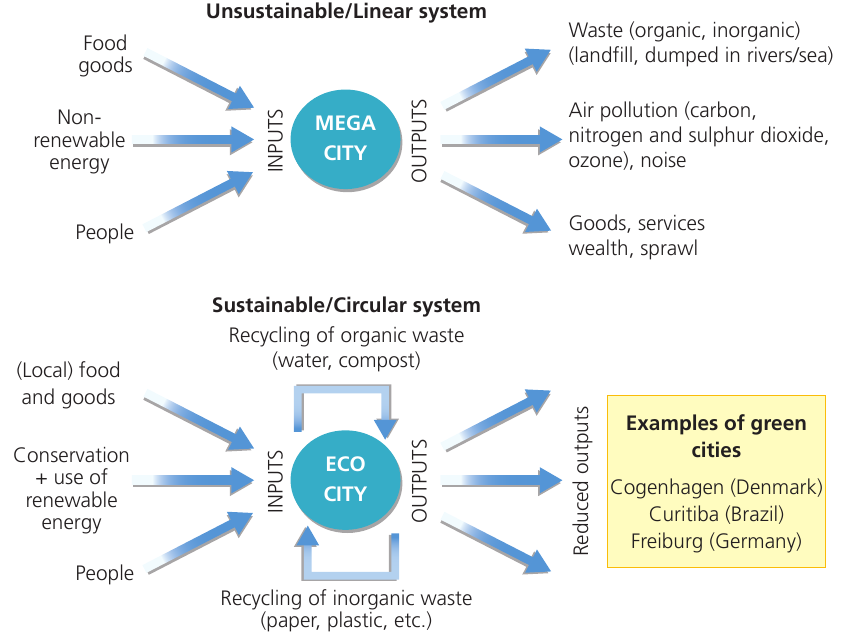
Inputs:
- Food and goods
- Non-renewable energy
- People
Outputs:
- Waste (organic and inorganic) sent to landfills or dumped in rivers/seas
- Air pollution (carbon, nitrogen dioxide, sulphur dioxide, ozone, noise)
- Goods, services, wealth and urban sprawl
This one-way flow leads to:
- Depletion of natural resources
- High pollution levels
- Accumulation of waste
- Unsustainable growth patterns
The sustainable circular eco-city
Sustainable cities function as circular systems with recycling loops:
Inputs:
- Local food and goods
- Conservation and use of renewable energy
- People
Circular processes:
- Recycling of organic waste (water, compost)
- Recycling of inorganic waste (paper, plastic, etc.)
Reduced outputs:
- Minimal waste
- Lower pollution levels
- Controlled, sustainable growth
Note
Examples of green cities:
- Copenhagen (Denmark)
- Curitiba (Brazil)
- Freiburg (Germany)
These cities demonstrate how the circular model reduces demand for new resources and minimises waste and pollution by treating outputs as potential inputs for other processes.
Key features of sustainable cities
Sustainable cities share common characteristics that enhance quality of life whilst reducing environmental impact.
Important
Liveability - The characteristics of a city which improve the quality of life for the people living there.
Liveability encompasses different priorities for different people, including natural amenities, cultural offerings, career opportunities, economic stability, political freedom, and safety. In the context of global liveability rankings, it relates to the overall quality of living conditions cities provide for their residents.
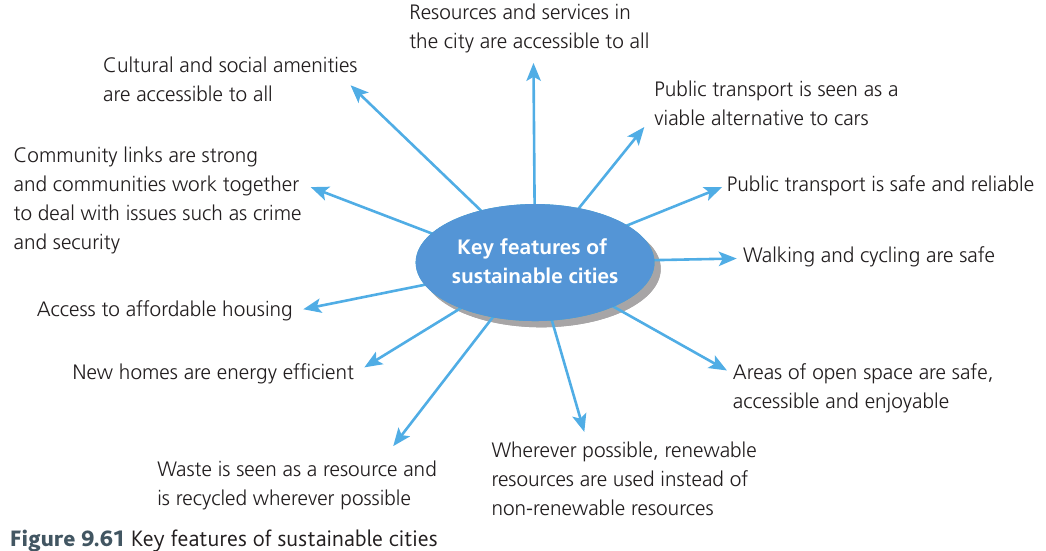
Core features of sustainable cities
Transport and accessibility:
- Public transport is seen as a viable alternative to cars
- Public transport is safe and reliable
- Walking and cycling infrastructure is safe and well-maintained
- Resources and services in the city are accessible to all
Housing and buildings:
- Access to affordable housing for all income groups
- New homes are energy efficient
- Buildings incorporate green design principles
Resource management:
- Waste is viewed as a resource and recycled wherever possible
- Renewable resources are used instead of non-renewable resources wherever possible
- Efficient use of energy and water
Community and environment:
- Areas of open space are safe, accessible and enjoyable
- Cultural and social amenities are accessible to all
- Community links are strong and communities work together to address issues such as crime and security
Urban resilience
Cities face both long-term challenges and sudden crises. The ability to cope with these threats is known as urban resilience.
Important
Urban resilience - The capacity of individuals, communities, institutions, businesses and systems within a city to survive, adapt and grow, no matter what kinds of chronic stresses and acute shocks they experience.
Types of urban challenges
Cities must prepare for two distinct categories of threat:
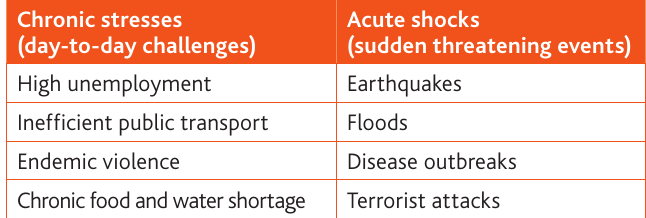
Chronic stresses (day-to-day challenges):
- High unemployment
- Inefficient public transport
- Endemic violence
- Chronic food and water shortage
These are persistent, ongoing issues that gradually weaken the urban fabric and reduce quality of life over time.
Acute shocks (sudden threatening events):
- Earthquakes
- Floods
- Disease outbreaks
- Terrorist attacks
These are sudden events that pose immediate threats to the safety and functioning of the city.
Building resilience
A sustainable city must be capable of managing both chronic stresses and acute shocks. This requires:
- Robust infrastructure that can withstand disasters
- Strong institutions that can coordinate responses
- Engaged communities that support one another
- Flexible economic systems that can adapt to change
- Effective governance that can plan for multiple scenarios
Note
Urban resilience is not just about responding to crises - it's about creating systems and communities that can adapt and thrive in the face of both ongoing challenges and unexpected events.
Contemporary opportunities and challenges in developing sustainable cities
Main obstacles to sustainability
The primary barrier to cities becoming more sustainable tends to be financial. In contexts of rapid urban population growth and limited budgets, city authorities often prioritise short-term 'cheaper' solutions over long-term planning.
Additional challenges include:
- Lack of access to basic services (water, electricity) in many growing cities
- Weak institutional capacity and governance structures
- Insufficient enforcement of building and planning regulations
- Poor existing infrastructure requiring costly upgrades
Challenges and opportunities by development level
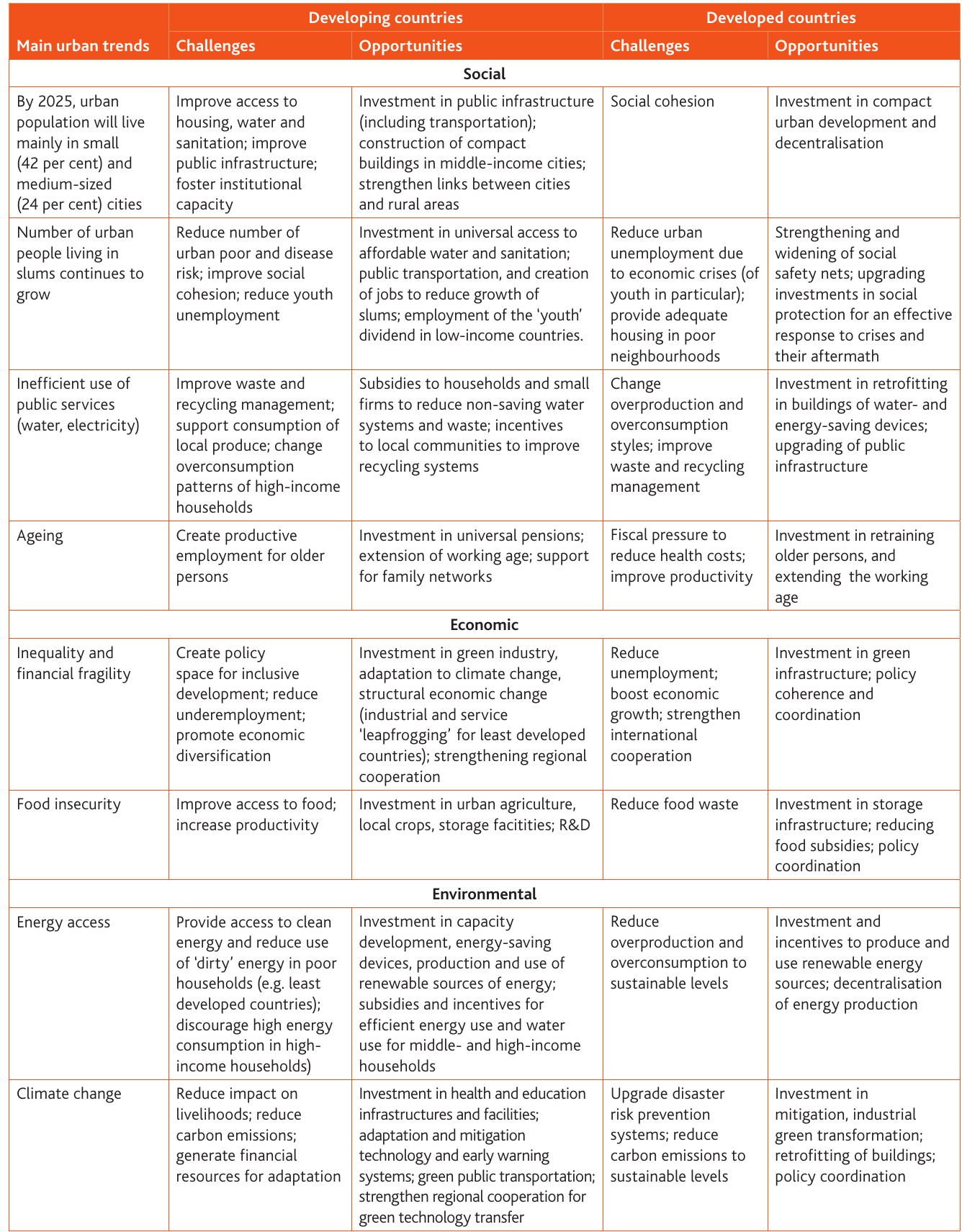
Different cities face distinct sustainability challenges depending on their level of economic development:
Note
Developing countries - Social challenges:
- Rapidly growing urban populations (42% in small/medium cities, 24% in large cities by 2025)
- Increasing numbers of people living in urban slums
- Need to improve access to housing, water, sanitation and public infrastructure
- High youth unemployment levels
Opportunities:
- Investment in public infrastructure including transportation
- Construction of compact buildings in middle-income cities
- Strengthening links between cities and rural areas
- Creation of jobs through affordable water, sanitation and public transport provision
- Employment opportunities for youth, particularly from 'youth dividend' in low-income countries
Note
Developed countries - Social challenges:
- Urban unemployment due to economic crises (especially affecting youth)
- Inadequate housing in poor neighbourhoods
- Pressure on services from ageing populations
Opportunities:
- Investment in compact urban development and decentralisation
- Strengthening of social safety nets
- Upgrading social protection systems for effective crisis response
- Investment in retraining older persons and extending working age
Economic challenges (both contexts):
- Inequality and financial fragility
- Food insecurity in urban areas
- Inefficient use of public services
- Overproduction and overconsumption patterns (developed countries)
Environmental challenges (both contexts):
- Energy access and efficiency
- Climate change adaptation and mitigation
- Waste and recycling management
- Reducing carbon emissions to sustainable levels
Case study: Copenhagen - Europe's most sustainable city
Example
Worked Example: Copenhagen's Comprehensive Approach to Sustainability
Copenhagen, Denmark's capital, regularly ranks among the world's most sustainable cities and received the title of European Green Capital in 2019. The city's climate action plan (2011) set the ambitious target of becoming a green, smart, carbon-neutral city by 2025.
Environmental management strategies
Copenhagen has implemented comprehensive measures to reduce its environmental impact:
Energy and emissions:
- Adding 100 new wind turbines
- Reducing both heat and commercial electricity consumption by 20%
- Installing 60,000 m² of new solar panels
- Meeting 100% of the city's heating requirements with renewables
Waste and recycling:
- Biogasification of all organic waste
- The Amager resource centre (opened 2019) is a waste incinerator that also incorporates hiking and running trails, a street fitness gym and an 85-metre climbing wall - the world's highest outdoor climbing wall
Water management:
- Harbour transformation from industrial zone to cultural and residential hub
- 100 overflow channels now carry wastewater into the harbour after heavy rains
- Investment in reservoirs and conduits means harbour water is clean enough for swimming
Green infrastructure:
- The Finger Plan 2007 protects Copenhagen's green belt
- Limits on urban sprawl through better use of existing city land
- In 2001, a large offshore wind farm was built at Middelgrunden, producing about 4% of the city's energy
Social development achievements
Copenhagen scores highly on social sustainability indicators:
Work-life balance:
- Only 2% of employees work more than 40 hours weekly
- This allows more time for family, friends, hobbies and recreational activities
- Associated with lower stress levels
Active transport infrastructure:
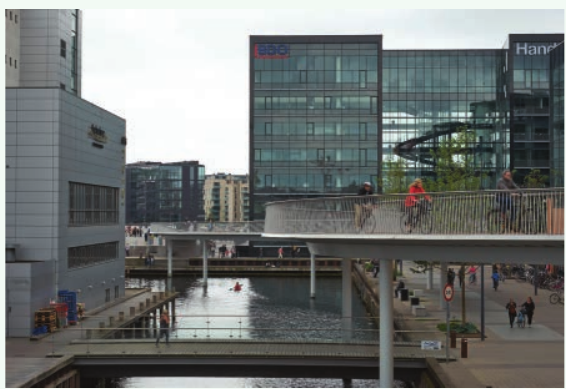
- 249 miles of cycle lanes make cycling easy and safe
- More than half of commuters travel to work or school by bike daily
- Residents have approximately one million fewer sick days simply because they cycle so much
The Cykelslangen (Cycle Snake), opened in 2015, is a two-way, 220-metre elevated bridge creating a less stressful atmosphere for cyclists, pedestrians and vehicle users alike.
Community and culture:
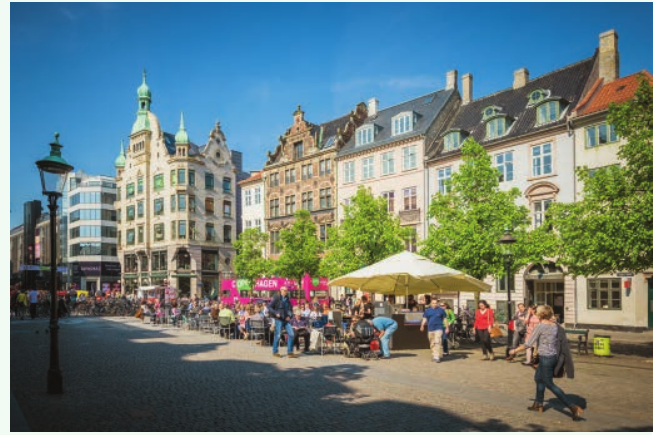
- Small independent boutiques and local coffee shops thrive
- Local businesses preferred over global chains
- Reasonable rents allow young start-up companies to flourish
Economic development strengths
Copenhagen demonstrates that sustainability and economic prosperity can coexist:
Economic performance:
- Economic and financial centre of Denmark
- Home to major international companies
- Successful business clusters in IT, biotechnology and pharmaceuticals
- Some of the highest wages in the world
- Low unemployment rates
Entrepreneurial culture:
- Danes maintain their independent shops and cafes
- Strong support for local, small-scale businesses
- Entrepreneurial spirit encouraged and supported
Urban governance
Denmark's governance model supports Copenhagen's sustainability:
Taxation and welfare:
- One of the highest taxation levels globally
- Provides very generous state welfare provision
- Reduces inequality significantly
Citizen participation:
- The Citizen's Dialogue Project involves direct public participation in planning
- Publicly financed scheme ensures diverse voices are heard
Social equality:
- Very high income equality
- High gender equality
- Perceived as a very fair and egalitarian society
Copenhagen demonstrates how strong performance across all four pillars of sustainability (social, economic, environmental and governance) creates a highly liveable and genuinely sustainable city.
Summary
Key Points to Remember:
-
Ecological footprints measure environmental impact - Cities consume about 75% of global resources and humanity currently uses resources 1.75 times faster than Earth can regenerate.
-
Sustainable development balances present and future needs - The four pillars (social, economic, environmental and governance) must all be addressed for genuine sustainability.
-
Circular systems are more sustainable than linear systems - Eco-cities that recycle waste and use renewable energy create closed loops, whilst traditional megacities follow unsustainable one-way resource flows.
-
Urban resilience means coping with both chronic stresses and acute shocks - Sustainable cities must handle day-to-day challenges like unemployment and sudden events like floods or disease outbreaks.
-
Challenges differ between developed and developing countries - Developing nations face rapid population growth and infrastructure deficits, whilst developed countries deal with overconsumption and ageing populations, but both have opportunities to invest in green solutions.