Thunderstorms, the Wind and Air Quality (AQA A-Level Geography): Revision Notes
📚Revision Notes
Thunderstorms, the Wind and Air Quality
Thunderstorms in urban environments
Thunderstorms form in hot, humid air masses and bring violent weather conditions with heavy rainfall, thunder and lightning. Urban areas experience a higher frequency of thunderstorms, particularly during late afternoon and early evening in the summer months. This happens because cities create ideal conditions for storm development.
The formation process begins with convectional uplift under conditions of extreme instability. As the sun heats urban surfaces, warm air rises rapidly to form towering cumulonimbus clouds. These clouds can reach the height of the tropopause, where an inversion layer creates stability and prevents further upward movement.
Note
The Storm Development Process
Inside the developing storm cloud, several processes occur simultaneously that build the energy needed for a thunderstorm:
- The central updraught causes rapid cooling and condensation of water vapour
- Water droplets, hail and supercooled water form within the cloud
- During condensation, latent heat is released, which adds more energy to fuel the convectional uplift
- As air splits in the updraught, positive electrical charge accumulates in the cloud
- When the charge becomes strong enough to overcome resistance, electrical discharge occurs as lightning
- The extreme temperatures created by lightning cause rapid air expansion, producing a shock wave heard as thunder
Wind in urban environments
Note
Important terms
Channelling – Wind that is redirected down long, straight, canyon-like streets where there is reduced friction. These street configurations are sometimes called urban canyons.
Venturi effect – The phenomenon where wind speed increases as air is forced through a narrowing gap, such as the space between two tall buildings.
Buildings fundamentally alter how wind moves through cities. Whilst it might seem that buildings would simply slow wind down by creating obstacles, the reality is far more complex. Urban designers and architects must carefully consider these wind effects to create comfortable and safe environments for people.
How buildings modify wind patterns
Cities experience four main wind effects that create challenging conditions for pedestrians and residents:
-
During calm, clear nights, the urban heat island effect is strongest. This temperature difference between the warm city and cooler surrounding areas causes convectional processes that draw in strong localised winds from the countryside.
-
Many city districts have developed clusters of high-rise towers that dramatically reshape urban skylines. Cities like La Défense in Paris demonstrate how tall buildings can increase or reduce wind speeds at street level, depending on how the surrounding streets are aligned.
-
Long, straight streets create channelling effects where wind is funnelled with less friction, significantly increasing wind speed. This can make walking uncomfortable and even dangerous in some locations.
-
The Venturi effect intensifies wind as it is forced through narrow gaps between buildings. This can create severe gusts at street level and make walking difficult, particularly affecting people with mobility challenges.
Wind behaviour around individual buildings
When wind encounters a single building, it creates distinct patterns on different sides of the structure.
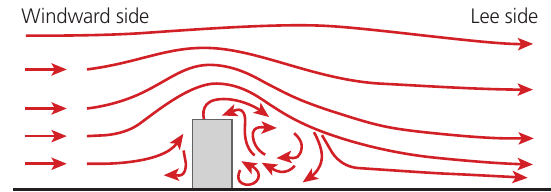
On the windward side (the side facing the wind), several effects occur:
- Overpressure builds up as wind hits the building face
- This pressure increases with building height
- Wind is deflected both upwards over the building and downwards towards the ground
- The descending flow on the windward side can be very strong
- When this downward-moving air reaches ground level, it creates a vortex that sweeps around the windward corners
On the lee side (the downwind side sheltered by the building):
- Low pressure develops, drawing air inward
- Complex vortices form as air circulates in the sheltered zone
- Multiple swirling patterns develop downwind of the structure
Effects of building spacing
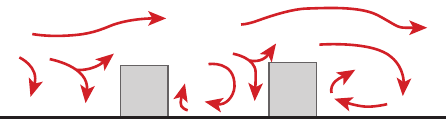
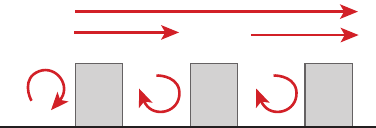
The spacing between buildings determines how their individual wind effects interact with each other. This significantly affects air flow patterns and pollution dispersal.
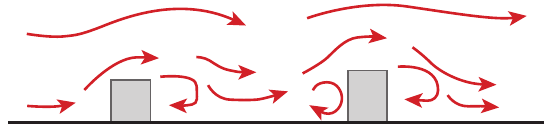
Widely spaced buildings act as individual obstacles. Each building creates its own pattern of wind flow with distinct windward and lee side effects. The wake from one building doesn't significantly interfere with airflow around the next building.
Narrower spacing causes the wake from one building to interfere with airflow around the next structure. Wind patterns become more complex as the buildings interact.
Important
Very close spacing creates a skimming effect. Wind flows over the tops of buildings rather than circulating around each one. This leaves 'dead air' pockets between buildings where pollutants and litter accumulate because there is insufficient wind movement to disperse them.
Wind patterns around tall buildings
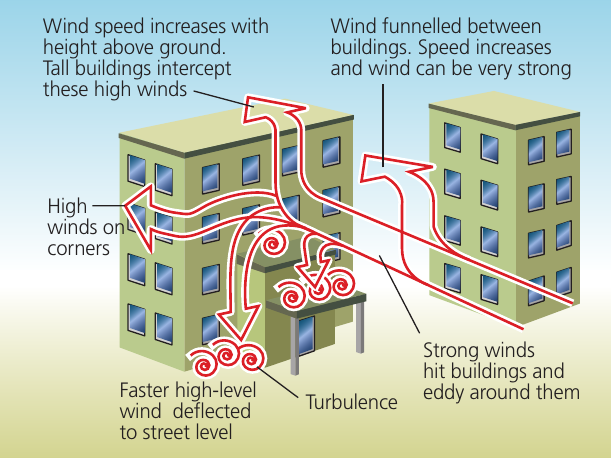
High-rise structures create particularly strong wind effects because wind speed naturally increases with height above ground level.
Note
Wind Effects Around Tall Buildings
Several processes occur around tall buildings:
- Wind speed is considerably higher at the top of tall buildings compared to street level
- Wind is funnelled between adjacent tall buildings, creating strong gusts
- High winds develop at building corners where air accelerates around the structure
- Wind from upper levels is deflected downwards to street level, creating uncomfortable or dangerous conditions for pedestrians
- Strong winds hit corners and accelerate, whilst turbulent eddies form around the structures
Important
When designing tall buildings, it is essential that pollution emitters such as chimneys are positioned high enough. This ensures that pollutants are released into the undisturbed airflow above the building rather than into the lee eddy or downward-flowing air near the walls, where they could affect people at ground level.
Urban design solutions
Careful planning and architectural features can reduce the negative impacts of urban winds. Different design approaches address specific wind problems.
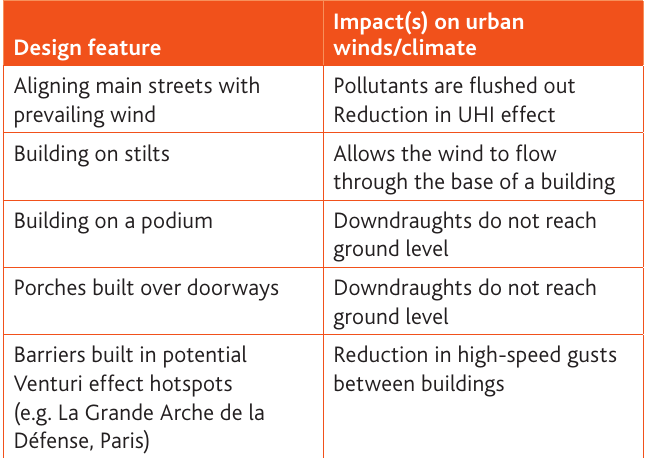
Street alignment: When main streets are aligned with the direction of prevailing winds, pollutants are more effectively flushed out of the urban area. This also helps reduce the urban heat island effect by allowing cooler air to flow through the city.
Building on stilts: Elevating buildings on support columns allows wind to flow freely through the base of the structure. This improves air circulation at ground level and prevents stagnant air pockets from forming.
Building on a podium: Placing buildings on raised platforms prevents downdraughts from reaching ground level where pedestrians walk. This design separates the strong wind effects from the areas where people spend time.
Doorway porches: Building porches or covered entrances over doorways protects people from downdraughts when entering or leaving buildings. This is particularly important for buildings that experience strong wind effects.
Wind barriers: In areas where the Venturi effect creates particularly strong winds, physical barriers can be installed to reduce wind speed and provide shelter. La Grande Arche de la Défense in Paris serves as an example of how barriers can be incorporated into urban design to protect pedestrians in high-wind zones.
Example
Case Study: Burj Khalifa, Dubai
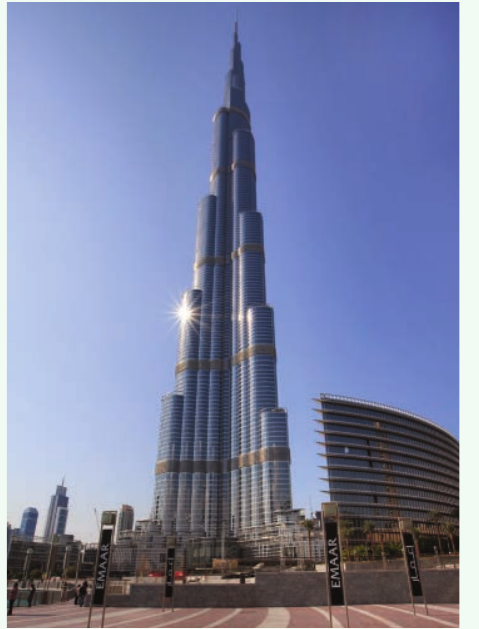
At over 828 m (2,716.5 feet) tall, the Burj Khalifa is the world's tallest building. At such extreme heights, wind stress becomes a major engineering challenge, particularly from wind vortices that can pull the building from side to side.
The design team had to ensure the structure could withstand wind gusts exceeding 240 kilometres per hour. A series of aerodynamic improvements were incorporated into the building design:
- The building's edges are softened rather than sharp, which deflects wind around the structure more smoothly
- This design prevents whirlpools or vortices from forming
- The entire tower was orientated relative to the prevailing wind direction to minimise wind loading
- The 206-storey building may still sway slowly back and forth by about 2 metres at the very top, but it doesn't suffer the severe problems experienced by earlier skyscrapers
For comparison, the 240-metre tall John Hancock building in Boston, USA, suffered motion sickness among workers in the 1970s due to wind-induced swaying. Even worse, moderate winds caused over 5,000 glass panels to blow out and shatter on the pavements below.
Example
Case Study: Masdar City, Abu Dhabi
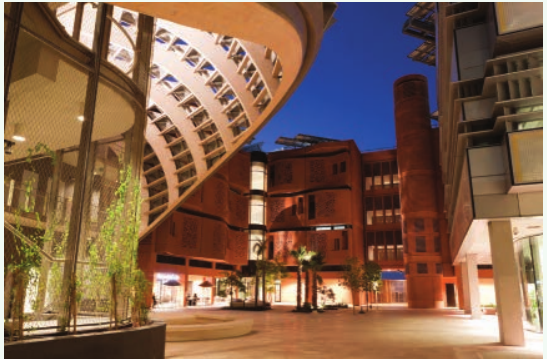
The Middle East's reliance on oil is unsustainable, so the Masdar Initiative in Abu Dhabi focuses on renewable energy as part of an attempt to diversify the future energy mix. The planned zero-carbon, zero-waste Masdar City is designed to house 40,000 residents when completed in the early 2020s, providing an ultra-modern example of sustainable urban living.
Solar energy provides plentiful power in Masdar City, but local winds have also been harnessed to save energy. Several innovative features utilise wind:
- In the central atrium of the Masdar Institute, a barajeel (wind tower) provides cool air and creates a fine water mist, reducing the need for air conditioning
- The Siemens headquarters building is positioned to face the prevailing wind direction
- A Venturi tunnel runs underneath the building to maintain a cooling airflow through specially designed wind channels
- This natural ventilation system directs air up to the roof of the building through atria in the building's structure, cooling public spaces without any energy costs
- The city grid was angled to help capture and funnel prevailing winds for cooling purposes
Air quality in urban environments
Urban areas typically experience poorer air quality than rural areas. Particulate air pollution results from the release of tiny particles and harmful gases into the atmosphere.
Types of urban air pollutants
Several major pollutants affect air quality in cities:
Carbon monoxide (CO) is a colourless, tasteless and odourless gas produced when fuels burn incompletely. Road transport generates an estimated 90% of all carbon monoxide emissions in the UK. Concentrations are highest close to busy roads. This gas is particularly dangerous because it affects oxygen transport around the body through the blood. Breathing in low levels of carbon monoxide can cause headaches, nausea and fatigue.
Nitrogen oxides (NOx) form when vehicles are exposed to sunlight. They react with hydrocarbons in the atmosphere to produce components of photochemical smog, including peroxyacetyl nitrates (PANs) and other secondary pollutants. Road transport generates approximately 50% of total nitrogen oxide emissions. Nitrogen oxides inflame the lining of the lungs, with impacts being more pronounced in people with asthma. They also accelerate weathering of buildings and contribute to acid rain. PANs damage plants as well as affecting human health.
Particulate matter (PM) consists of tiny solid or liquid particles suspended in the air. Particles mainly originate from power stations and vehicle exhausts, but other sources include metal and rubber from engine wear, dust, ash, sea salt, pollens and soil particles. Particles smaller than about 10 micrometres are referred to as PM. These can settle in the airway and deep in the lungs, causing serious health problems including respiratory disease.
Sulphur dioxide (SO) is a colourless gas with a sharp odour. It reacts readily with other substances to form harmful compounds such as sulphuric acid, sulphurous acid and sulphate particles. In the UK, the major contributors to coal and oil burning are power stations and refineries. Short-term exposure may cause coughing, tightening of the chest and narrowing of the airways. Sulphur dioxide can also produce haze, acid rain, damage to lichens and plants, and corrosion of buildings.
Temperature inversions and pollution trapping
Air pollution levels vary throughout the year depending on weather conditions. Concentration of pollutants may increase significantly during winter because temperature inversions trap them over the city.
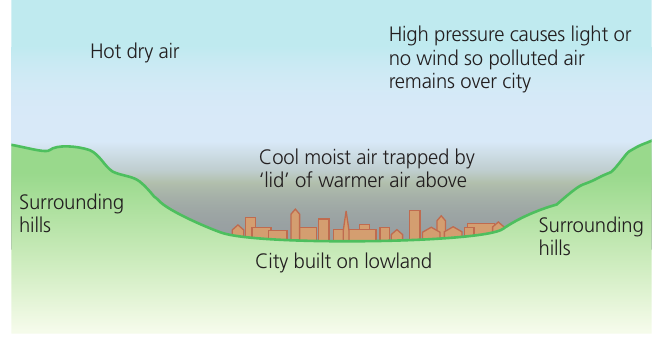
Under normal atmospheric conditions, air temperature decreases with altitude, allowing pollutants to rise and disperse. However, during a temperature inversion, a layer of warm air sits above cooler air near the ground, acting like a lid that prevents vertical air movement.
Important
How Temperature Inversions Trap Pollution
Temperature inversions develop particularly in cities built on lowland areas surrounded by hills:
- High pressure weather systems create stable atmospheric conditions with little to no wind
- Hot, dry air remains at high altitude above the city
- Cool, moist air is trapped at lower levels beneath the warm air layer
- The surrounding hills prevent horizontal air movement
- Polluted air becomes trapped over the city with no mechanism for dispersal
- Pollutant concentrations build up to dangerous levels
This situation is particularly severe in winter months when high pressure systems can persist for weeks, creating stagnant conditions with minimal wind to flush out polluted air.
Photochemical smog
The mixture of fog and smoke particulates produces smog. This was common in European cities throughout the nineteenth and first half of the twentieth centuries due to high rates of coal burning. Britain suffered particularly severely, with many smogs becoming so thick they were known as 'pea-soupers'. In December 1952, smog in London was responsible for more than 4,000 deaths.
Whilst traditional coal-based smog has largely been eliminated in developed countries, smog remains a feature of many cities worldwide. Headlines regularly highlight the negative impact smog has on human health. A particular concern has been the increase in photochemical smog.
Note
Formation of Photochemical Smog
Photochemical smog forms through a different process than traditional smog. Photochemical oxidants such as ozone and peroxyacetyl nitrate (PAN) are associated with damage to plants and cause a range of discomforts to people, including headaches, eye irritation, coughs and chest pains.
The formation process involves:
- Sunlight acts on nitrogen oxides (NOx) in the atmosphere
- Sunlight also reacts with hydrocarbons in vehicle exhaust gases
- This chemical reaction produces ozone at ground level
Important
Low-level ozone must not be confused with high-level ozone in the atmosphere, which protects Earth from damaging ultraviolet radiation. Ground-level ozone is a harmful pollutant, whilst stratospheric ozone is essential for life on Earth.
Example
Los Angeles Photochemical Smog
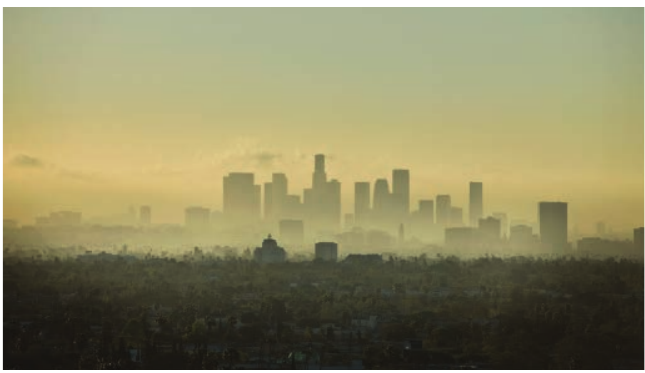
Los Angeles has experienced serious problems with photochemical smog for decades because of several factors:
- High density of vehicles creating substantial emissions
- Frequent sunshine providing energy for chemical reactions
- Basin topography that traps photo-oxidant gases at low levels
The chemical component PAN, linked to vehicle emissions, has been deemed particularly hazardous and connected to the famous Los Angeles 'eye-sting'. Numerous attempts have been made to improve public transport in the city, but Los Angeles is a large, sprawling metropolis and it is much easier to travel by car. Recent strategies have therefore included stricter city vehicle emission standards and the Clean Air Action Plan (CAAP) for the port of Los Angeles.
Photochemical smog poses a particular hazard during anticyclonic conditions. Once air has descended, it becomes relatively static due to the absence of wind. Such weather systems tend to be stable and can persist for weeks during summer months.
Pollution reduction policies
Reducing air pollution in cities has become increasingly important for national and local government. Different strategies have been adopted to tackle the problem.
Clean Air Acts
After the catastrophic London smog of 1952, the British government decided legislation was needed to prevent excessive smoke from entering the atmosphere. The Act of 1956 introduced smoke-free zones into urban areas, and this policy slowly began to clean up the air. The 1956 Act was reinforced by later legislation.
In the 1990s, for example, tough regulations were imposed on levels of airborne pollution, particularly on PMs. Local councils in the UK are now required to monitor pollution levels in their areas and to establish Air Quality Management Areas where levels are likely to be exceeded.
In London, various measures to clean up construction sites have been introduced. These changes are said to account for around 12% of the city's nitrogen oxide emissions. The use of dust suppressants at industrial sites has also been increased to reduce particulate emissions.
Vehicle control and public transport
Providing better public transport and imposing general restrictions on polluting vehicles can be very effective in reducing urban air pollution.
In London, a variety of measures have been introduced:
Note
London's Pollution Reduction Strategies
- 280,000 trees have been planted. Their leaves and bark absorb pollution. For example, when the bark of the London plane tree flakes off, it sheds pollutants trapped on its surface.
- The world's first Ultra Low Emission Zone came into operation in 2019, charging the most polluting vehicles to enter central London.
- Increased use of hybrid and zero-emission engine buses to reduce emissions from public transport.
Summary
Key Points to Remember:
-
Thunderstorms occur more frequently in urban areas due to convectional uplift enhanced by hot surfaces and the urban heat island effect, particularly during late afternoon and early evening in summer.
-
Buildings create complex wind patterns including channelling through straight streets and the Venturi effect through narrow gaps, which can significantly increase wind speeds and affect pedestrian comfort. Design features like building on stilts, using podiums, and installing wind barriers can mitigate these problems.
-
Urban air quality is affected by multiple pollutants including carbon monoxide, nitrogen oxides, particulate matter and sulphur dioxide, primarily from vehicle emissions and industry. These cause serious health problems and environmental damage.
-
Temperature inversions trap polluted air over cities by placing a layer of warm air above cooler air at ground level, preventing vertical mixing and dispersal, particularly during high-pressure weather conditions in winter.
-
Pollution reduction strategies including Clean Air Acts, vehicle emission standards, Ultra Low Emission Zones, improved public transport, and tree planting programmes have successfully reduced air pollution levels in many cities, though photochemical smog remains a challenge in some locations.