Global Population Futures (AQA A-Level Geography): Revision Notes
📚Revision Notes
Global population futures
Introduction to population futures
There is considerable debate about what will happen to the global population during the twenty-first century. Following the rapid population increase in the twentieth century, questions arise about whether the planet can sustain continued growth. With more people comes increased demand for resources, particularly as populations in developing nations become more affluent and desire higher living standards.
Note
At the same time, Earth's physical environment is experiencing significant changes, particularly regarding the atmosphere and climate, which directly affect human health and wellbeing.
Contrasting perspectives on population growth
Two major schools of thought offer different views on how population growth relates to environmental limits and future sustainability.
Neo-Malthusian perspectives
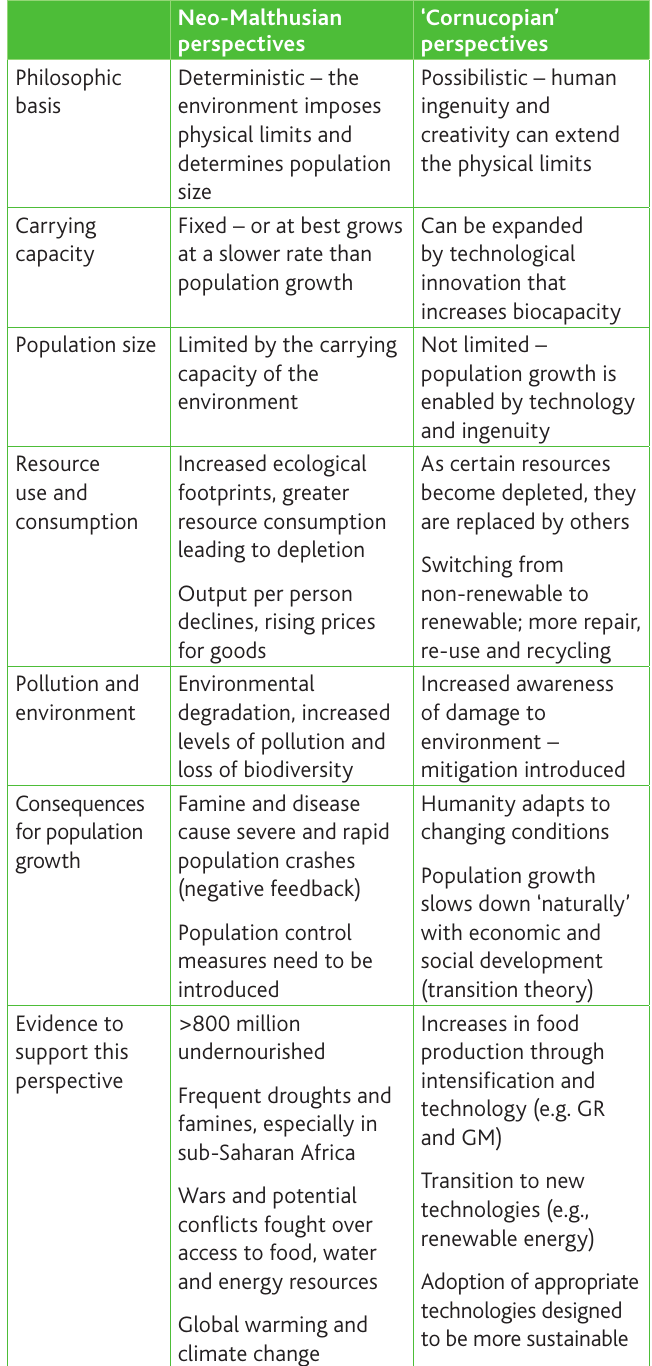
This viewpoint presents a pessimistic outlook on population growth. Neo-Malthusians believe that:
Philosophical foundation:
- The environment sets definite boundaries that determine how large populations can grow
- Physical limits cannot be overcome indefinitely
- This is a deterministic worldview
Important
Carrying capacity refers to the maximum population size that an environment can sustainably support. Neo-Malthusians view this as fixed or growing only very slowly.
Resource concerns: The Neo-Malthusian perspective highlights several worrying trends:
- Ecological footprints are expanding as people consume more resources
- Resource consumption is leading to depletion of finite materials
- Output per person is declining whilst prices for goods are rising
- Environmental degradation is increasing
- Pollution levels and biodiversity loss are accelerating
Predicted consequences:
- Population growth will eventually lead to severe food shortages, famines and disease outbreaks
- These crises will cause rapid population crashes (negative feedback)
- Population control measures may need to be introduced to prevent catastrophe
Supporting evidence: Neo-Malthusians point to current problems as proof their concerns are valid:
- Over 800 million people worldwide suffer from undernourishment
- Frequent droughts and famines occur, especially in sub-Saharan Africa
- Wars and conflicts erupt over access to food, water and energy resources
- Global warming and climate change are intensifying environmental pressures
Cornucopian perspectives
This viewpoint presents an optimistic outlook on population growth. Cornucopians argue that:
Philosophical foundation:
- Human ingenuity, creativity and problem-solving abilities can overcome natural constraints
- Technology enables us to expand the limits imposed by the environment
- This is a possibilistic worldview (possibilities exist through human action)
Important
Biocapacity can be increased through technological innovation, according to cornucopian thinking. As technology advances, Earth's capacity to support human populations expands.
Resource optimism: Cornucopians challenge Neo-Malthusian fears by highlighting positive trends:
- As certain resources become depleted, alternatives are developed
- Society is switching from non-renewable to renewable resources (such as solar and wind energy)
- Increased recycling and more efficient use of materials reduces waste
- Innovation continually finds ways to repair environmental damage
- Growing awareness of environmental issues drives more sustainable practices
Predicted outcomes:
- Humanity adapts successfully to changing conditions through innovation
- Population growth slows down naturally as societies develop economically and socially
- This follows the demographic transition theory - as countries become wealthier, birth rates decline voluntarily without coercive population control
Supporting evidence: Cornucopians cite improvements in human welfare:
- Food production has increased through agricultural intensification and new technologies (e.g. the Green Revolution)
- Adoption of renewable energy technologies is accelerating globally
- New sustainable technologies are being developed to address environmental challenges
Julian Simon: a key cornucopian thinker
Julian Simon was an influential academic who championed the cornucopian perspective. He argued that despite rapid population growth, human material welfare has improved across virtually all parts of the world.
Simon's key arguments:
Simon used factual evidence to support his optimistic view:
- Air quality in wealthy countries has become safer to breathe
- Water cleanliness has improved overall
- Cropland conditions are improving rather than deteriorating
- Food production increases have consistently matched or exceeded population increases
Note
In his 1981 book The Ultimate Resource, Simon made a bold claim: the only resource Earth was genuinely running short of was people. He believed that having more people, with their creativity and ingenuity, was actually beneficial.
Challenges to Simon's arguments:
Whilst many of Simon's claims are supported by data, more recent trends reveal flaws in his reasoning:
- His premise that resources increase alongside population growth has weaknesses
- As global population has expanded, resource availability has not kept pace in all areas
- Environmental degradation continues despite technological advances
The debate between Neo-Malthusian and cornucopian perspectives remains active. Both viewpoints present evidence and arguments to support their positions. As students of population and environment, it is important to research both sides and develop an informed understanding of this complex issue.
Health impacts of global environmental change
Environmental changes caused by human activity are having direct consequences for human health. Two significant examples are ozone depletion and its associated health impacts.
Ozone depletion
Important
Ozone depletion refers to the thinning of the stratospheric ozone layer caused by human-made chemicals, particularly chlorofluorocarbons (CFCs).
What causes ozone depletion?
Ozone () is a form of oxygen composed of three atoms. The stratospheric ozone layer sits in the extreme cold of the polar stratosphere and acts as Earth's protective shield.
- CFCs were widely used in refrigeration, insulation and spray-can propellants
- These halogenated chemicals react with and destroy ozone molecules
- Destruction occurs mainly during late winter and early spring
- The process is relatively recent in human history, becoming apparent in recent decades
Why is the ozone layer important?
The stratospheric ozone layer serves a critical protective function:
- It filters out much of the Sun's incoming ultraviolet (UV) radiation
- UV radiation, particularly shorter wavelength UVR, is biologically damaging
- When ozone becomes depleted, more UV rays reach Earth's surface
- This increased UV exposure has harmful impacts on humans, flora and fauna
Note
Health consequences of increased UV exposure:
Extended exposure to UV radiation causes several serious health problems:
- Increased prevalence of skin cancers
- Cataract formation in the eyes
- Increases in other eye diseases
- Greater susceptibility to infectious diseases due to weakened immune systems
Skin cancer
Skin cancer is one of the most significant health consequences of ozone depletion and increased UV exposure.
Types of skin cancer:
There are two main categories:
- Non-melanoma skin cancer - The most common type includes basal cell carcinomas
- Malignant melanoma - Less common but far more dangerous as it can spread (metastasise) to other organs if not treated early
Global patterns:
- Non-melanoma skin cancer is the fifth most commonly occurring cancer globally
- Over one million diagnoses occurred worldwide in 2018
- Malignant melanoma, whilst less common, has become the nineteenth most common cancer
- Over 300,000 cases of malignant melanoma were diagnosed in 2018
Risk factors:
Melanomas are more likely to affect certain groups:
- Fair-skinned populations (less protective melanin pigmentation)
- Elderly people (cumulative lifetime exposure)
- Those living in lower latitudes (stronger solar radiation)
- Males (slightly higher incidence rates, possibly due to more outdoor occupations)
Example
Regional Case Study: Australia and New Zealand
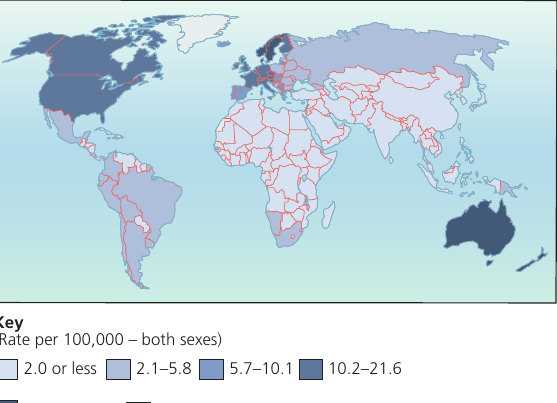
These countries have the highest rates of skin cancer globally:
- Australia: 33.6 cases per 100,000 population
- New Zealand: 33.3 cases per 100,000 population
Several factors contribute to these high rates:
- Predominantly fair-skinned populations in lower latitudes
- High levels of ultraviolet radiation due to geographical location
- Cultural emphasis on outdoor activities and lifestyles
Statistics for Australia:
- At least two out of three Australians will be diagnosed with some form of skin cancer by age 70
- Approximately 2,000 Australians die from skin cancer annually
- Around 80% of new cancer diagnoses each year are skin cancers
- Of these, 11% are malignant melanomas
- Melanomas account for 3% of all cancer deaths
- The cost to the Australian health system was approximately A$900 million in 2017 for diagnosis, treatment and pathology
Cataracts
Important
Cataracts are a form of eye damage causing loss of transparency in the lens of the eye.
Cataracts develop when UV radiation damages the proteins in the eye's lens, leading to cloudiness and impaired vision. This is another direct health consequence of increased UV exposure resulting from ozone depletion.
Summary
Remember!
Key Points to Remember:
-
Two contrasting perspectives exist: Neo-Malthusians view population growth pessimistically, seeing environmental limits as fixed, whilst cornucopians believe human innovation can overcome resource constraints.
-
Both sides present evidence: Neo-Malthusians point to current food insecurity, resource conflicts and environmental degradation, whilst cornucopians highlight technological advances, improved food production and the demographic transition.
-
Ozone depletion has serious health impacts: Human-made chemicals (particularly CFCs) have damaged the protective ozone layer, allowing more harmful UV radiation to reach Earth's surface.
-
Skin cancer rates vary geographically: Australia and New Zealand have the world's highest skin cancer rates (over 33 per 100,000), driven by fair-skinned populations, lower latitudes and high UV exposure.
-
Multiple health effects from UV exposure: Beyond skin cancer, increased UV radiation causes cataracts, other eye diseases and weakened immune systems, demonstrating how environmental changes directly impact human health.