Population Ecology: Population Growth (AQA A-Level Geography): Revision Notes
📚Revision Notes
Population Ecology: Population Growth
Understanding population growth dynamics
In ecology, how populations grow depends on two main factors: birth rates and death rates. The balance between these determines whether a population increases, decreases, or stays stable.
The number of births in any species is influenced by its natural ability to reproduce. Different species have different reproductive strategies. For example, fish like herring produce thousands of young because most won't survive to adulthood. In contrast, mammals (including humans) typically have fewer offspring, but these young have a much higher chance of survival.
Important
Biotic potential
Biotic potential is the natural reproductive potential of a species. It represents the maximum rate at which a population could grow under ideal conditions with unlimited resources.
Environmental resistance and limiting factors
While biotic potential determines how many offspring can be born, survival is another matter entirely. The number of deaths in a population is controlled by various environmental factors that act as obstacles to survival.
Important
Environmental resistance
Environmental resistance refers to the mortality rates controlled by environmental factors that prevent survival. These include disease, food shortages, predation, and natural disasters. Also known as 'limiting factors'.
Note
The relationship between biotic potential and environmental resistance determines whether a population will grow, decline, or remain stable. When biotic potential exceeds environmental resistance, populations expand. When environmental resistance is stronger, populations decline or stabilize.
Types of limiting factors
Environmental limiting factors fall into two categories:
Density independent factors:
- These factors affect death rates regardless of how large or dense the population is
- They are not influenced by population size
- Examples include:
- Natural disasters (droughts, floods, volcanic eruptions)
- Extreme weather events
- Natural hazards
These events will increase death rates whether the population is small or large.
Density dependent factors:
- These factors become more significant as population size and density increase
- They are directly related to how crowded a population becomes
- Examples include:
- Food supply limitations
- Disease spread
- Competition for resources
- Waste accumulation
As populations grow larger and more densely packed, these factors become more effective at limiting further growth.
Note
Think of density independent factors as external forces that strike randomly, while density dependent factors are internal pressures that build up as populations become crowded. A volcanic eruption affects all individuals equally, but disease spreads more easily when organisms are packed closely together.
Model growth curves
When biotic potential exceeds environmental resistance, populations will grow. Ecologists use model growth curves to show how populations change over time. These curves typically show three distinct phases:
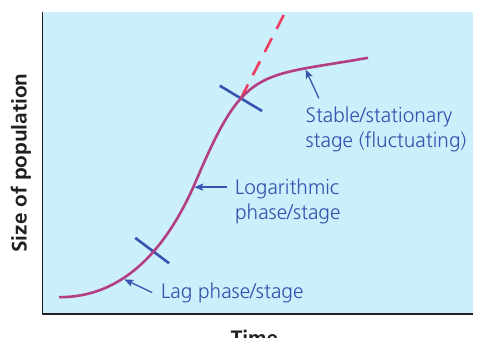
Lag phase:
- The initial period of slow growth
- Population is establishing itself
- Birth rates are beginning to exceed death rates
- Population numbers remain relatively low
Logarithmic phase (exponential phase):
- Rapid population growth occurs
- Birth rates are significantly higher than death rates
- Environmental resistance is low
- Resources are plentiful
- Population increases dramatically
Stable/stationary phase:
- Population growth slows and levels off
- Population size fluctuates around a relatively constant level
- Birth rates and death rates are approximately equal
- Environmental resistance has caught up with biotic potential
- Resources become limited
Note
Understanding the curve:
The model growth curve, often called an S-curve or sigmoid curve, represents the typical pattern of population growth in nature. Few populations can maintain exponential growth indefinitely - eventually, environmental factors catch up and limit further expansion. This results in the characteristic S-shape where rapid growth transitions to stability.
Application to human populations
Historical population patterns
For most of human history, population size remained relatively stable. Although birth rates were high and families were large, most people only survived into adulthood through having many children. High death rates effectively balanced out high birth rates, preventing significant population growth.
The main reasons for population stability included:
- Widespread diseases that killed large numbers of people
- Low life expectancy
- Frequent food shortages and famines
- Lack of medical knowledge and healthcare
The transformation: technological and medical advances
Significant changes began occurring from around 1800 onwards. Developments in technology dramatically improved food production in many parts of the world. At the same time, advances in medical science, healthcare, and sanitation brought about massive improvements in survival rates.
Key developments included:
- Medicines and vaccines that combat infectious diseases (such as smallpox, measles, tuberculosis)
- Control of water-borne diseases (typhoid, cholera)
- Improved sanitation systems
- Better food security
- Increased life expectancy
These improvements meant that humans overcame much of the environmental resistance that had previously limited population growth.
Note
The demographic transition:
What happened to human populations represents a dramatic shift in the balance between biotic potential and environmental resistance. While our biotic potential (reproductive capacity) remained relatively constant, we successfully reduced environmental resistance through innovation. This created conditions for unprecedented population expansion.
Exponential population growth
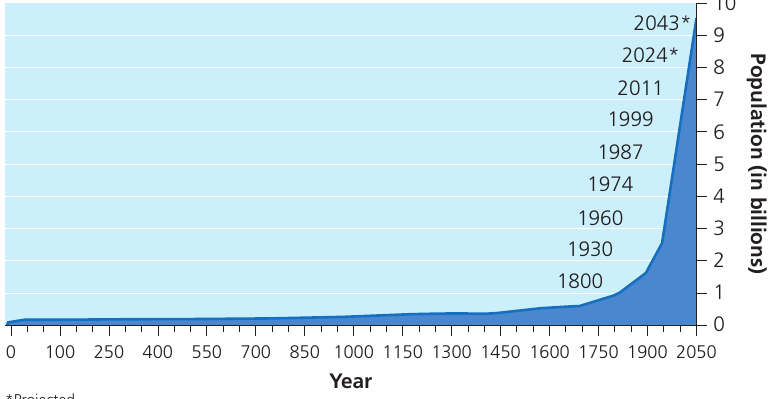
The impact has been dramatic. In 1800, Earth's population was estimated at around 1 billion. By 2020, it had reached approximately 7.8 billion - largely due to the control of death rates through medical and technological advances.
For the past two hundred years, human population has been experiencing a 'log phase' - a period of exponential growth. The global population is still growing rapidly, though recent data suggests the rate of growth is beginning to slow down.
According to demographer Nicholas Eberstadt: "We didn't start breeding like rabbits, we stopped dying like flies." This quote perfectly captures how population growth has been driven more by declining death rates than by increasing birth rates.
Summary
Key Points to Remember:
- Biotic potential is the natural reproductive capacity of a species, while environmental resistance consists of factors that limit survival and growth.
- Population growth occurs when biotic potential exceeds environmental resistance.
- Density independent factors (like natural disasters) affect populations regardless of size, while density dependent factors (like food supply) become more important as populations grow.
- Population growth typically follows three phases: lag phase (slow growth), logarithmic phase (rapid growth), and stable phase (levelling off).
- Human populations remained stable for most of history due to high death rates balancing high birth rates, but technological and medical advances have allowed exponential growth over the past 200 years.
- The human population has increased from approximately 1 billion in 1800 to 7.8 billion in 2020, representing a dramatic log phase of growth.