Energy Security (AQA A-Level Geography): Revision Notes
📚Revision Notes
Energy security
What is energy security?
Energy security refers to the reliable availability and access to energy resources needed to power societies and economies. In 2015, energy ministers from the G7 group of nations met in Hamburg to discuss an initiative focused on sustainable energy security. They agreed on a fundamental principle: ensuring sustainable energy security is a shared responsibility that all nations must work together to achieve.
The geopolitical significance of global energy security cannot be overstated. Nations depend on stable energy supplies for economic growth, social development and national security. Disruptions to energy systems can have severe consequences across multiple sectors.

Strategic challenges for the global energy system
The global energy system faces three major strategic challenges throughout the twenty-first century:
The energy transition challenge
The world must shift from fossil fuel dependency toward cleaner renewable energy sources. This transformation is driven by several urgent factors:
- Climate change mitigation: Reducing energy-related carbon dioxide (CO₂) emissions is essential to limit global temperature rises
- Environmental damage: The extraction, transportation and combustion of fossil fuels cause significant harm to ecosystems and human health
- Resource depletion: Non-renewable energy supplies are finite and continuing to diminish
Important
Energy transition is the process of transforming the global energy sector from fossil fuel dependency to zero carbon emissions by the second half of this century. The core goal is reducing energy-related CO₂ emissions to limit climate change.
Political disruptions and security threats
Growing risks of interruptions to energy supplies stem from:
- Political tensions between nations
- Armed conflicts in energy-producing regions
- Wars that disrupt supply chains and infrastructure
- Geopolitical competition for energy resources
Note
Energy supply disruptions can cascade through entire economies, affecting everything from manufacturing and transportation to heating and food production. This makes energy security a critical component of national security policy.
Energy poverty in developing countries
Many developing nations continue to experience energy poverty, where populations lack access to reliable, affordable energy services. This creates barriers to:
- Economic development and industrialisation
- Improved living standards and healthcare
- Educational opportunities
- Social equality
Understanding energy sources
Primary and secondary energy
Energy resources exist in two fundamental categories that determine how they can be used:
Important
Primary energy (resources) are potential sources of energy found naturally in their raw form. Examples include wind, running water, coal, oil, wood and uranium. These cannot be directly used until they are converted or processed.
Important
Secondary energy (resources) are transformed or converted from primary sources into usable forms of power. Examples include petrol, diesel fuel and electricity. These are the forms of energy we actually use in daily life.
The conversion process is essential. For instance:
- Primary: Crude oil (found underground) → Secondary: Petrol (processed for vehicles)
- Primary: Moving water in rivers → Secondary: Electricity (generated by turbines)
- Primary: Uranium ore → Secondary: Electricity (produced in nuclear reactors)
Note
In developed countries, the main energy sources include oil, natural gas, coal, hydroelectric power and uranium, which primarily produce electricity. Conversely, many less developed countries rely heavily on biomass sources such as fuelwood and animal waste for their energy needs.
Important
Energy mix describes the composition of various sources of energy used in a country or globally. The primary energy mix includes all sources used to produce secondary energy. Some data focuses specifically on sources used to generate electricity.
Fossil fuels
Fossil fuels currently dominate the global energy supply, though their proportion is gradually declining. The three main types each have distinct characteristics:
Oil
- Accounts for 30 per cent of total primary energy supply
- Remains the most widely used single energy source globally
- Share has decreased but continues to play a dominant role
- Essential for transportation sector and petrochemical industries
Natural gas
- Represents 22 per cent of the global energy budget
- The fastest growing fossil fuel source
- Considered cleaner than coal or oil
- Produces lower environmental impact and fewer emissions
- Increasingly popular for electricity generation and heating
Note
Natural gas is often viewed as a "transition fuel" - cleaner than coal and oil, but still a fossil fuel. Its growth reflects efforts to reduce emissions while maintaining energy security during the shift to renewables.
Coal
- Comprises approximately 24 per cent of world energy supply
- Generates around 37 per cent of global electricity
- Used extensively in China and India to support industrialisation
- Major contributor to greenhouse gas emissions and acid rain
- Experiencing gradual decline due to environmental concerns
- Many countries phasing out coal-fired power stations
Important
Coal remains the most polluting fossil fuel, contributing significantly to both greenhouse gas emissions and acid rain. Despite its declining use in developed nations, it continues to be heavily utilized in industrializing countries, creating tension between economic development and environmental protection goals.
Nuclear energy
Nuclear power generates around six per cent of the world's energy. This technology requires:
- Advanced technical expertise and infrastructure
- Substantial financial investment
- Highly trained workforce
- Sophisticated safety systems
Consequently, nuclear power is predominantly found in developed, high-income countries. However, developing nations like China and India have begun investing more heavily in nuclear power plants as their economies grow and energy demands increase.
Challenges facing nuclear energy
Political factors have significantly impacted nuclear energy development. Major nuclear accidents have raised serious concerns:
- Chernobyl, Ukraine (1986): Caused evacuation of local populations and released massive amounts of radioactive material into surrounding areas
- Fukushima, Japan (2011): Led to widespread evacuations and environmental contamination
Important
Major challenges for nuclear power:
These disasters resulted in:
- Loss of human lives
- Large-scale environmental damage
- Long-term health impacts on affected populations
- Increased public opposition to nuclear power
Additionally, the disposal of radioactive waste remains an inherent and unresolved problem. Nuclear waste remains hazardous for thousands of years, requiring secure storage facilities that can contain radiation safely over extremely long timescales.
Global energy mix and trends
The composition of global energy sources has been shifting gradually but noticeably over recent years. Examining data from the World Energy Council reveals important trends in how the world produces and consumes energy.
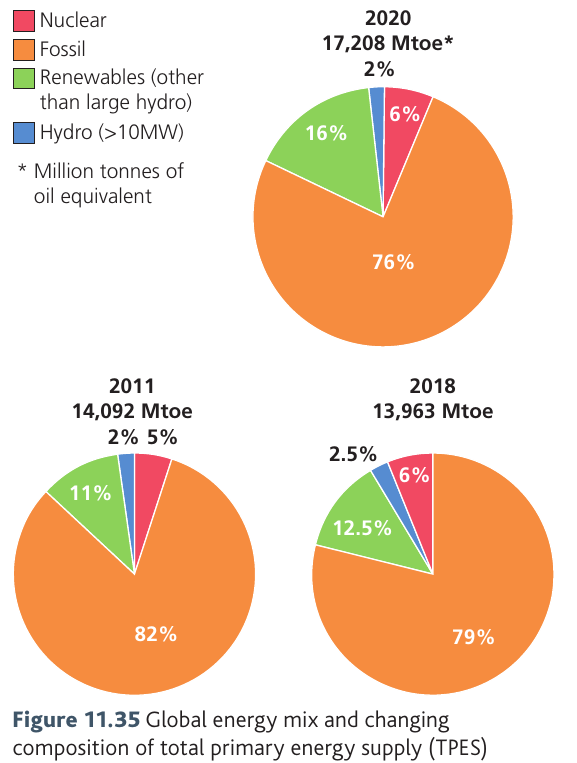
The data shows the Total Primary Energy Supply (TPES), measured in million tonnes of oil equivalent (Mtoe), across three key years:
Key trends from 2011 to 2020
Fossil fuels (shown in orange):
- 2011: 82 per cent of total energy supply
- 2018: 79 per cent of total energy supply
- 2020: 76 per cent of total energy supply
- Clear downward trend showing gradual decline in fossil fuel dependency
Renewable energy excluding large hydropower (shown in green):
- 2011: 11 per cent of total energy supply
- 2018: 12.5 per cent of total energy supply
- 2020: 16 per cent of total energy supply
- Significant upward trend demonstrating growing adoption of renewable technologies
Nuclear energy (shown in red/pink):
- Maintained relatively stable at around 5-6 per cent throughout the period
- 2011: approximately 5 per cent
- 2018 and 2020: 6 per cent
Large-scale hydropower (shown in blue):
- Remained fairly constant at approximately 2-2.5 per cent across all three years
What these trends reveal
The changing energy mix demonstrates that the global energy transition is underway, though progress remains gradual. Fossil fuels still dominate, providing more than three-quarters of the world's energy in 2020. However, the steady decline from 82 per cent to 76 per cent over nine years shows movement in the right direction.
Note
Renewable energy sources (excluding large hydro) have grown from 11 per cent to 16 per cent, representing a 45 per cent relative increase. This growth reflects increased investment in wind, solar and other renewable technologies.
The total energy consumption also increased from 14,092 Mtoe in 2011 to 17,208 Mtoe in 2020, indicating that despite efficiency improvements, global energy demand continues to rise as populations grow and economies develop.
Summary
Key Points to Remember:
-
Energy security is a shared global responsibility requiring nations to work together to ensure reliable, sustainable energy supplies for all.
-
Three major challenges define the future of energy: transitioning away from fossil fuels to combat climate change, managing political disruptions to supply, and addressing energy poverty in developing countries.
-
Primary energy sources must be converted to secondary energy before they can be used - for example, crude oil becomes petrol, and moving water generates electricity.
-
Fossil fuels still dominate but are declining, dropping from 82% (2011) to 76% (2020) of global energy supply, while renewable energy has grown from 11% to 16% over the same period.
-
Nuclear energy provides 6% of global power but faces significant challenges including safety concerns from accidents like Chernobyl and Fukushima, and the ongoing problem of radioactive waste disposal.