Equilibrium in 2D (AQA A-Level Mathematics): Revision Notes
📚Revision Notes
3.1.3 Equilibrium in 2D
Note
To approach equilibrium questions in 2D Mechanics, follow these key steps:
- Identify all forces: List all the forces acting on the object, including weight, tension, normal reaction, and friction.
- Resolve forces into components: Split each force into horizontal and vertical components, typically using trigonometry (sine and cosine functions for angled forces).
- Apply equilibrium conditions: For an object in equilibrium, the sum of forces in both directions must equal zero:
- (sum of horizontal forces)
- (sum of vertical forces)
- Solve the system of equations: Use the two equations to find unknown forces or angles. This method ensures that all forces balance, confirming that the object is in equilibrium.
Static Bodies in 2D
Concept:
- A static body is an object that lies in equilibrium. In this scenario, all forces attached to the object sum to zero.
Note
Example:
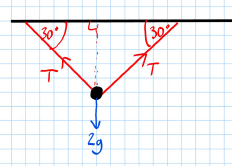
-
Consider a scenario where a single piece of string is threaded through a particle, with the string being light and inextensible. The particle is held in equilibrium by two strings forming angles of with the horizontal. Problem:
-
Given that the weight of the particle is g, find the tension in the strings. Solution:
- Resolve Forces in a Relevant Direction:
- Consider the vertical direction for resolving forces.
- Vertical Forces:
- Since , the equation simplifies to:
Final Answer:
- The tension in each string is .
Mechanics Problems in 3D
Key Concept:
- All mechanical concepts (equilibrium, , SUVAT, etc.) apply in 3D as well as in 2D.
Note
Q1, (Jan 2005, Q3)
Problem Statement: A particle is in equilibrium when acted on by the forces, where the units are Newtons.
- Find the values of , , and
- Calculate the magnitude of .
Solution:
Part (i): Finding the Values of , , and
- Condition for Equilibrium:
- Since the particle is in equilibrium, the sum of all forces must be zero:
- Solve for , , and :
- Equating the components:
Answer (i):
Part (ii): Calculating the Magnitude
- Calculate the magnitude of :
Answer (ii): The magnitude is .
Problem: Finding the Tension in the String and the Weight of the Bead
Note
Problem Statement:
-
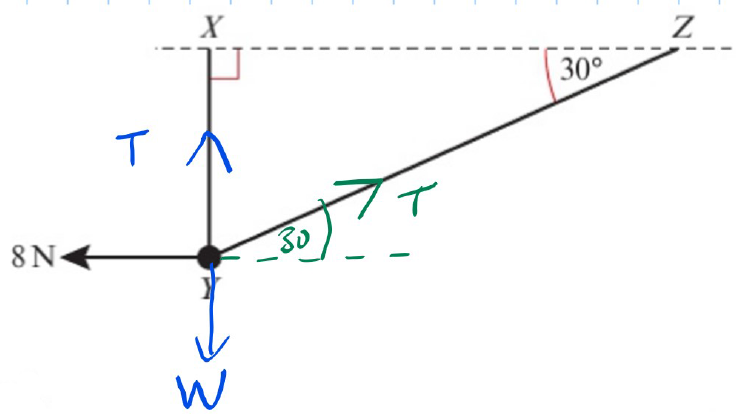
A smooth bead Y is threaded on a light inextensible string.
-
The string is attached to two fixed points, and , which are on the same horizontal level.
-
The bead is in equilibrium, held by a horizontal force of magnitude acting parallel to .
-
The bead is vertically below , and \angle . Find:
-
The tension in the string .
-
The weight of the bead .
Solution:
- Tension in the String:
- Since the bead is in equilibrium and the string is inextensible, the tension is the same throughout the string.
- Resolve forces horizontally:
- Weight of the Bead:
- Resolve forces vertically:
Answer:
- Tension
- Weight
Problem: Tension in the String and Weight of the Bead
Note
Problem Statement:
-
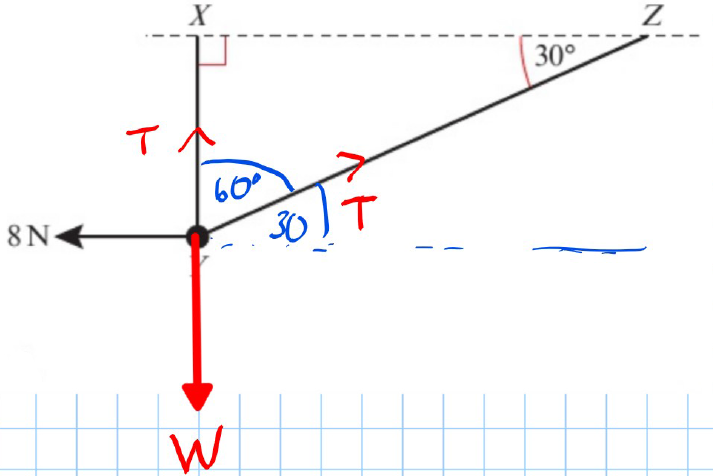
A smooth bead is threaded on a light inextensible string. The ends of the string are attached to two fixed points, and , on the same horizontal level.
-
The bead is in equilibrium under a horizontal force of magnitude acting parallel to .
-
The bead is vertically below , and . Objective:
-
Find the tension in the string.
-
Find the weight of the bead.
Solution:
- Resolving Forces Horizontally:
- The horizontal component of the tension must balance the horizontal force:
- Resolving Forces Vertically:
- The vertical components of the tension must balance the weight :
- Substituting and :
Final Answer:
- Tension in the string is .
- Weight of the bead is .