Further Forces & Newton's Laws (AQA A-Level Mathematics): Revision Notes
📚Revision Notes
3.3.5 Coefficient of Friction - Harder Problems
Note
In harder coefficient of friction problems, multiple forces and varying conditions come into play. Here's a summary of the approach:
- Identify all forces: Draw a free body diagram, showing forces like weight, normal reaction, friction, applied forces, and tension (if present).
- Resolve forces into components: On inclined planes, break forces into parallel and perpendicular components. Use and for weight components.
- Apply friction formulas:
- Static friction: (when preventing motion).
- Kinetic friction: (when the object is moving).
- Use : Apply Newton's second law to solve for unknowns like acceleration, tension, or friction. Consider equilibrium conditions if the object is stationary. These problems require careful force resolution, consistent sign convention, and correct use of friction formulas.
Note
Example: Force on a Rough Inclined Plane
Problem Statement:
- A box of mass 10 kg rests in limiting equilibrium on a rough plane inclined at 20° above the horizontal.
- A horizontal force of magnitude P is applied to the box.
- Given that the box remains in equilibrium, find:
- The coefficient of friction between the box and the plane.
- The maximum possible value of P.
Part (a): Find the Coefficient of Friction
- Forces acting:
- Gravitational force component along the slope:
- Normal reaction force:
- Frictional force (acting up the slope).
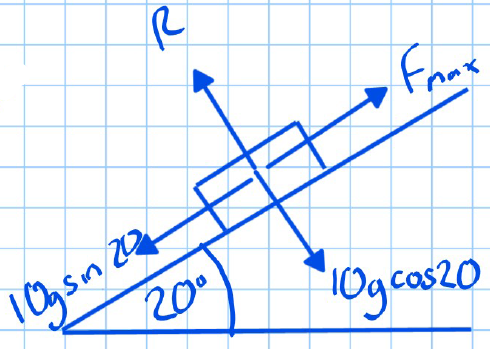
- Equations of equilibrium:
- Along the plane:
- Perpendicular to the plane:
- Solve for :
Answer (a): The coefficient of friction .
Part (b): Find the Maximum Possible Value of
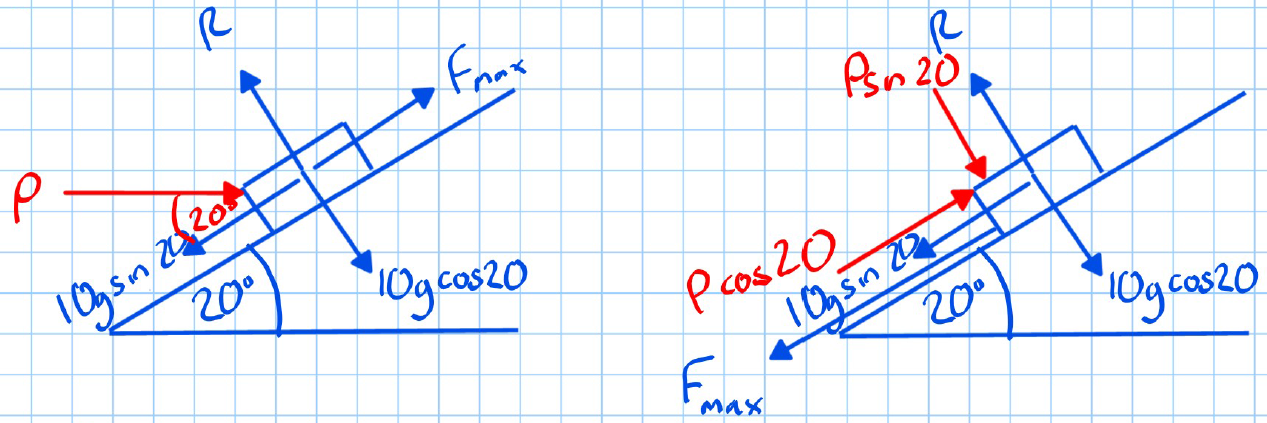
- Forces acting:
- The force P is horizontal and can be resolved into components parallel and perpendicular to the slope:
- Parallel:
- Perpendicular:
- Equations of equilibrium:
- Along the slope:
- Perpendicular to the slope:
- Substitute and solve for :
Answer (b): The maximum possible value of P is approximately 82.24 N.
:::
Tips:
Note
- Resolve forces correctly: Always resolve forces into horizontal and vertical components (or parallel/perpendicular to an inclined plane). Pay special attention to the normal force, as it may not always equal if other forces are acting at angles.
- Check motion status: Determine whether static or kinetic friction applies. If the object is on the verge of moving, use the maximum static friction . If it's already moving, apply kinetic friction.
- Solve systematically: Use in both horizontal and vertical directions to set up equations for unknowns. Make sure to account for all forces, including tension, applied forces, and weight components, for precise solutions.