Quadratic Inequalities (AQA A-Level Mathematics): Revision Notes
📚Revision Notes
2.4.2 Quadratic Inequalities
Quadratic inequalities are inequalities that involve a quadratic expression, which means they have a term with , like , and are solved differently from linear inequalities. The goal is to find the range of values for x that makes the inequality true.
Steps to Solve Quadratic Inequalities:
Note
- Write the Inequality in Standard Form:
- Ensure the inequality is in the form with one side equal to 0.
- Example:
- Solve the Related Quadratic Equation:
- Find the roots of the equation These roots divide the number line into intervals.
Note
- Example: For , factor it into , so the roots are and
- Determine the Sign in Each Interval:
- Use the roots to divide the number line into intervals: and
- Test a value from each interval in the original inequality to see if it makes the inequality true.
Note
📑Example:
- Write the Solution:
- Combine the intervals that satisfy the inequality.
Note
📑Example: The solution for
- Graph the Solution:
- Plot the roots on a number line with open circles (if the inequality is or closed circles (if the inequality is
- Shade the intervals where the inequality holds true.
:::
Note
📑Example: Solve
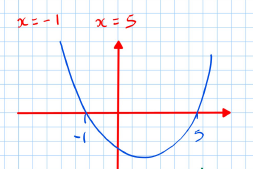
- Solve for = 0 and sketch the curve:
- Roots are and
- Divide the graph vertically into strips through the roots and label these strips + or -:
- The graph will have three regions:
- Left of (positive)
- Between and (negative)
- Right of (positive)
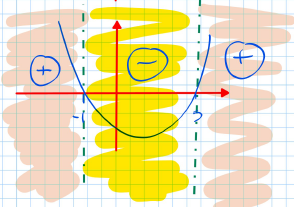
- Decide which strips to use based on the inequality:
- Need negative strip(s) since
- Solution: -1 < x < 5
- Calculator Instructions:
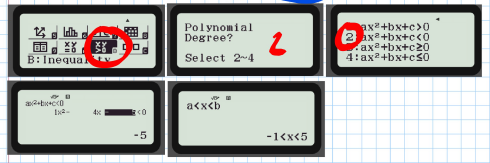
- Go to the inequality solving mode.
- Select polynomial degree ( 2 for quadratic).
- Input the coefficients.
Note
📑Example: Solve
- Rewrite the inequality:
- Doesn't factorise easily, so use the quadratic formula.
- Solutions:
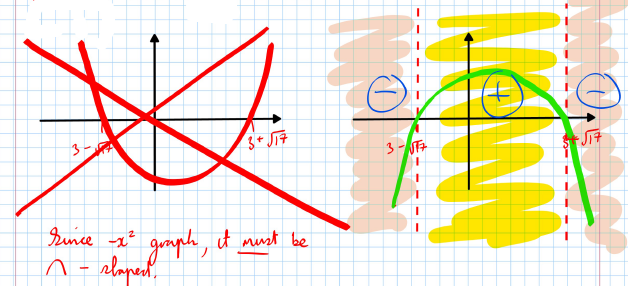
- Sketch the curve and determine the regions:
- Since it's a downward-facing parabola, regions are .
- Solution:
- x ≤ 3 - √17 or x ≥ 3 + √17
Note
📝Q5 (Jun 2014, Q6)
Example: Solve the inequality
- Factor the quadratic equation:
- Given equation:
- Factor the quadratic:
- Identify pairs of factors for that add up to 10:
- Pairs: (1, 9)
- Rewrite the quadratic:
- Factor by grouping:
-
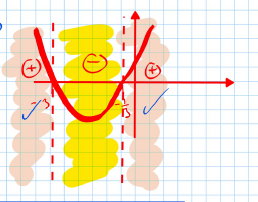
- Find the roots of the quadratic:
- Set each factor to zero:
- Sketch the graph:
- The parabola opens upwards because the coefficient of is positive.
- The roots divide the -axis into three intervals:
- (positive region)
- (negative region)
- (positive region)
- Determine the solution intervals:
- The inequality is satisfied in the positive regions.
- Solution:
Final Solution:
- x < -3 or x > -1/3
Applications to Roots of Quadratics
- State the values of for which the quadratic equation has distinct roots:
Note
📑Example: