Sigma Notation (AQA A-Level Mathematics): Revision Notes
📚Revision Notes
4.5.2 Sigma Notation
Sigma Notation
Sigma notation is a compact way of expressing the sum of a series of terms. It uses the Greek letter (capital sigma), which stands for "sum."
These are called limits.
This means to evaluate for to .
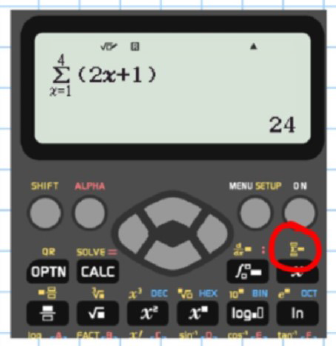
e.g. Find
This refers to the variable that we are incrementing. If the variable does not appear in the expression, we still evaluate the expression.
With each term corresponding to .
General Form:
Note
The sigma notation is written as:
This represents the sum of the terms from Here's what each part means:
- denotes summation.
- is the index of summation, which starts at the lower limit and increases to the upper limit
- is the general term of the sequence you're summing.
Note
Example 1:
Sum the first natural numbers:
Note
Example 2:
Sum the squares of the first 4 natural numbers:
Step-by-Step Breakdown:
-
Identify the General Term This is the expression that changes as changes. For example, in, the general term
-
Determine the Limits of Summation: The lower limit is where starts, and the upper limit is where ends. In the example starts at and ends at .
-
Expand and Calculate: Substitute the values of into the general term and add them together.
Properties of Sigma Notation:
-
Linearity: where is a constant.
-
Shifting the Index: If you shift the index by a constant, the sum changes accordingly: where
-
Splitting the Sum: for any integer between
Note
Example Exam Question:
Question: Evaluate the sum:
[3 marks]
Solution:
- Expand the Summation:
- Calculate the Sum: Final Answer: