Radian Measure (AQA A-Level Mathematics): Revision Notes
📚Revision Notes
5.4.1 Radian Measure
Radian measure is a way of measuring angles based on the radius of a circle. Unlike degrees, which divide a circle into 360 equal parts, radians measure the angle as the length of the arc subtended by the angle at the centre of the circle, relative to the radius.
1. Definition of a Radian:
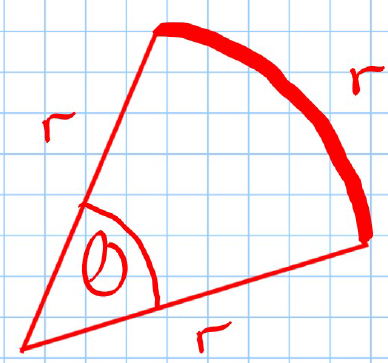
- A radian is the angle subtended at the centre of a circle by an arc whose length is equal to the radius of the circle.
- Mathematically, 1 radian is the angle such that the length of the arc is equal to the radius of the circle: .
2. Relationship Between Degrees and Radians:
- Since the circumference of a circle is r and represents a full angle of 360°, we have: Thus:
- To convert from degrees to radians:
- To convert from radians to degrees:
3. Common Angles in Radians:
| Degrees | Radians |
|---|---|
4. Arc Length and Sector Area Using Radians:
Note
- Arc Length s: Where:
- is the arc length,
- is the radius of the circle,
- is the angle in radians.
- Area of a Sector A: Where:
- is the area of the sector,
- is the radius,
- is the angle in radians.
5. Applications of Radian Measure:
- Trigonometry: Trigonometric functions such as sine, cosine, and tangent are often more naturally expressed in radians, particularly in calculus where the derivatives and integrals of trigonometric functions are involved.
- Physics: Radians are used to measure angular velocity and angular displacement.
- Circular Motion: In circular motion, angular displacement, angular velocity, and angular acceleration are commonly measured in radians.
6. Example Problems:
Note
Example 1: Convert to radians.
- Solution:
Note
Example 2: Find the arc length subtended by an angle of radians in a circle of radius cm.
- Solution:
Note
Example 3: Calculate the area of a sector with a central angle of radians and a radius of cm.
- Solution:
Summary:
- Radians are a natural and efficient way to measure angles, especially in trigonometry and calculus.
- Converting between degrees and radians is straightforward using
- The radian measure simplifies the formulas for arc length and sector area, making them directly proportional to the angle in radians. Understanding and using radians is essential in advanced mathematics and physics.
Radians
Radians are the standard way of measuring angles in a higher mathematical context.
In a circle sector where all three sides have the same length, the angle made is 1 radian.
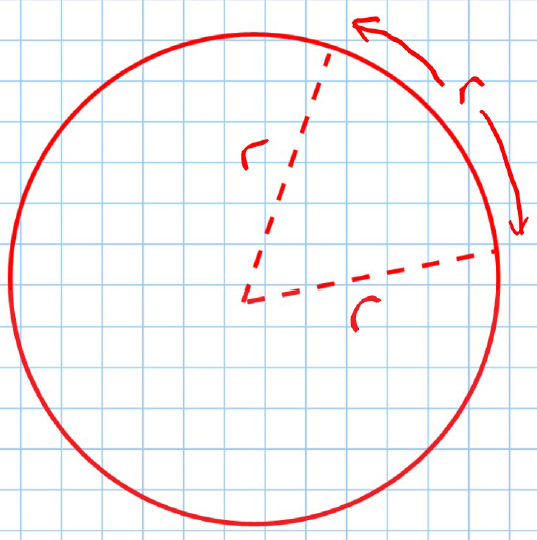
Since the circumference of a circle is given by , this states that there are 2π radians in the circumference of a circle.
This means that there are 2π radians in a full circle.
Note
Example 1: Convert to radians
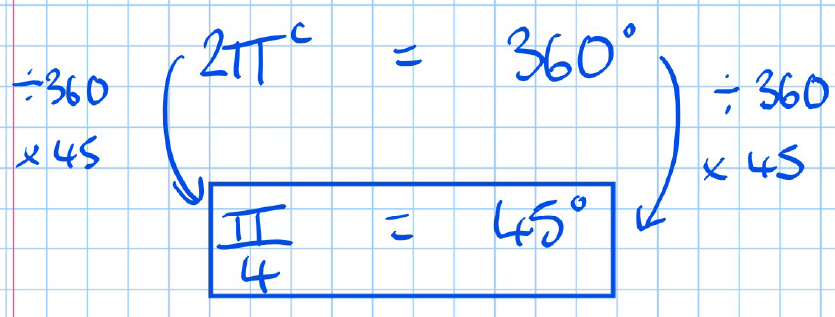
Example 2: Convert 2 radians to degrees
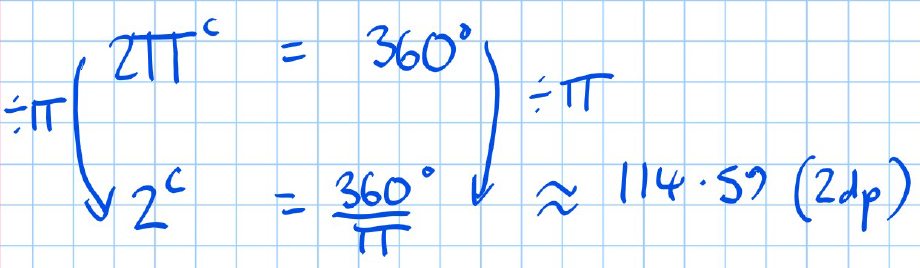
- Note: Radians are often expressed as multiples of π, but do not need to be.
Areas and Arc Lengths of Circle Sectors
Formula For Degrees:
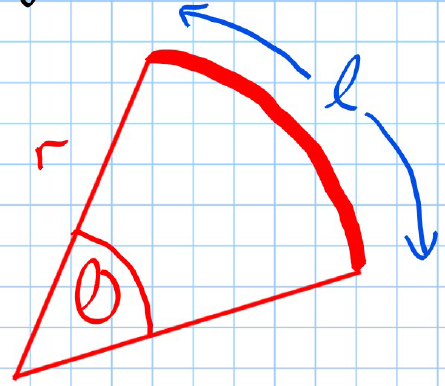
When measured in radians, the formulae are much simpler:
Note
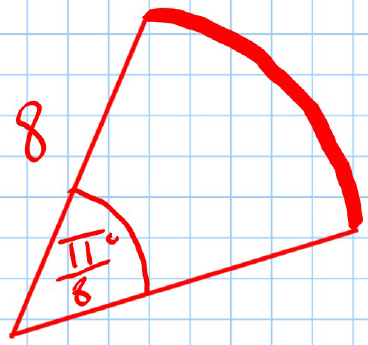
Example: Find the area and arc length of the following sector:
- Arc Length:
- Area:
Note
Q2 (Jan 2007, Q2)
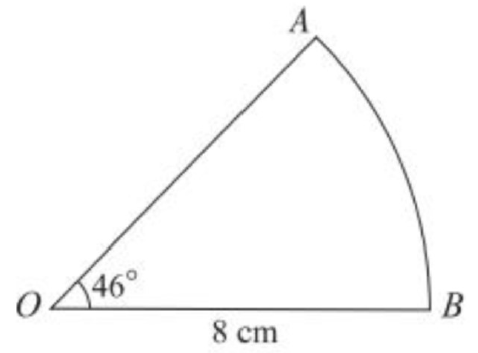
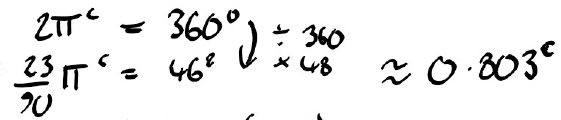
The diagram shows a sector OAB of a circle, centre and radius 8 cm. The angle is 46°.
i) Express 46° in radians, correct to 3 significant figures.
ii) Find the length of the arc AB.
iii) Find the area of the sector OAB.
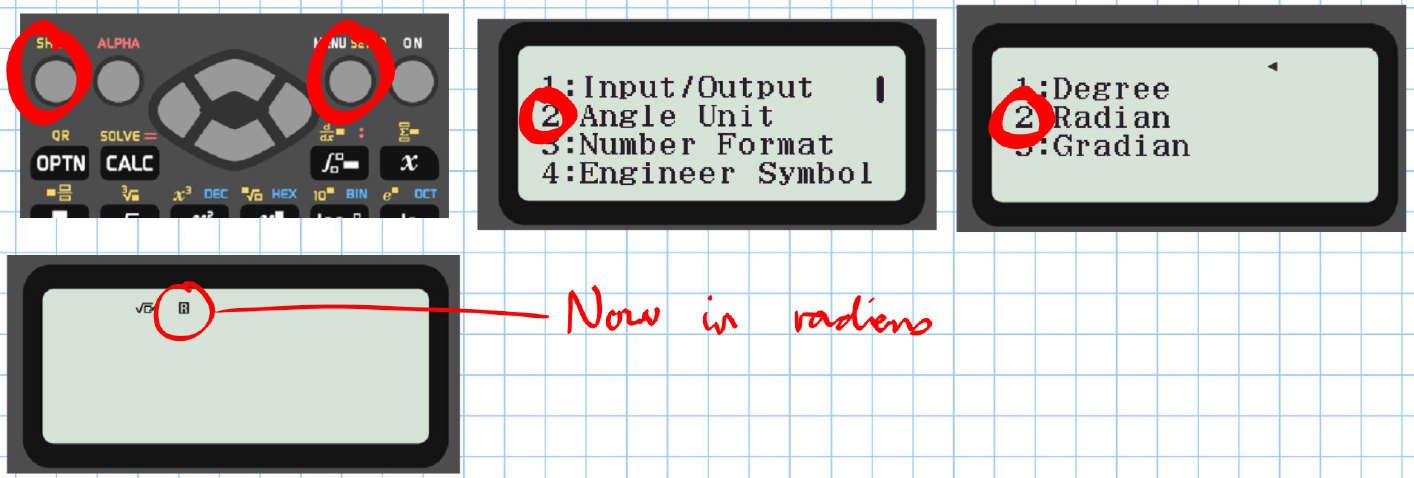
Radians Mode in Calculator
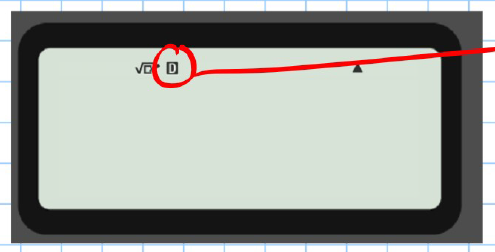
- This indicates the calculator is in degree mode.