Compound Angle Formulae (AQA A-Level Mathematics): Revision Notes
📚Revision Notes
5.6.1 Compound Angle Formulae
Compound angle formulae are trigonometric identities that express the sine, cosine, and tangent of the sum or difference of two angles in terms of the sine, cosine, and tangent of the individual angles. These formulae are extremely useful in solving trigonometric equations, simplifying expressions, and proving other trigonometric identities.
1. Sine of a Sum/Difference:
- Sine of the Sum of Two Angles:
- This formula expresses the sine of the sum of two angles and as a combination of the sines and cosines of the individual angles.
- Sine of the Difference of Two Angles:
- This formula expresses the sine of the difference of two angles A and B similarly.
2. Cosine of a Sum/Difference:
- Cosine of the Sum of Two Angles:
- This formula expresses the cosine of the sum of two angles and in terms of the cosines and sines of the individual angles.
- Cosine of the Difference of Two Angles:
- This formula expresses the cosine of the difference of two angles and
3. Tangent of a Sum/Difference:
- Tangent of the Sum of Two Angles:
- This formula expresses the tangent of the sum of two angles and in terms of the tangents of the individual angles.
- Tangent of the Difference of Two Angles:
- This formula expresses the tangent of the difference of two angles and
4. Derivation of Compound Angle Formulae:
The compound angle formulae can be derived using the unit circle, trigonometric identities, and geometric methods. Here's a brief outline of how you might derive them:
- Sine and Cosine Formulae:
- Consider the angles A and B placed on the unit circle. Use the coordinates of the points where the terminal sides of these angles intersect the circle to express and
- Use the fact that the length of the hypotenuse in the unit circle is , and apply the Pythagorean identity to derive the formulae.
- Tangent Formula:
- The tangent formulae can be derived by dividing the sine formula by the cosine formula:
5. Example Problems Using Compound Angle Formulae:
Note
Example 1: Calculate ) using the compound angle formula.
- Solution:
- Recognise that
- Apply the sine of a sum formula:
Note
Example 2: Simplify
- Solution:
- Recognise that
- Apply the cosine of a difference formula:
Note
Example 3: Find .
- Solution:
- Recognise that
- Apply the tangent of a sum formula:
6. Applications of Compound Angle Formulae:
- Solving Trigonometric Equations: Compound angle formulae are essential when solving trigonometric equations involving sums or differences of angles.
- Proving Identities: These formulae are frequently used in proving more complex trigonometric identities.
- Simplifying Expressions: They help in simplifying trigonometric expressions to make them easier to evaluate or integrate.
- Geometry and Physics: These formulae are useful in applications involving rotations, wave interference, and oscillations.
Summary:
Note
- Compound angle formulae are powerful tools in trigonometry that allow you to express the sine, cosine, and tangent of sums and differences of angles in terms of the individual angles.
- These formulae are essential for solving complex trigonometric equations, simplifying expressions, and proving identities.
- Mastery of these identities expands your ability to tackle a wide range of trigonometric problems in mathematics, physics, and engineering.
Expanding Trig Brackets: Compound Angle Formulae
When expanding trigonometric functions, e.g., , the ordinary rules of algebra do not apply.
Proposition:
Proof:
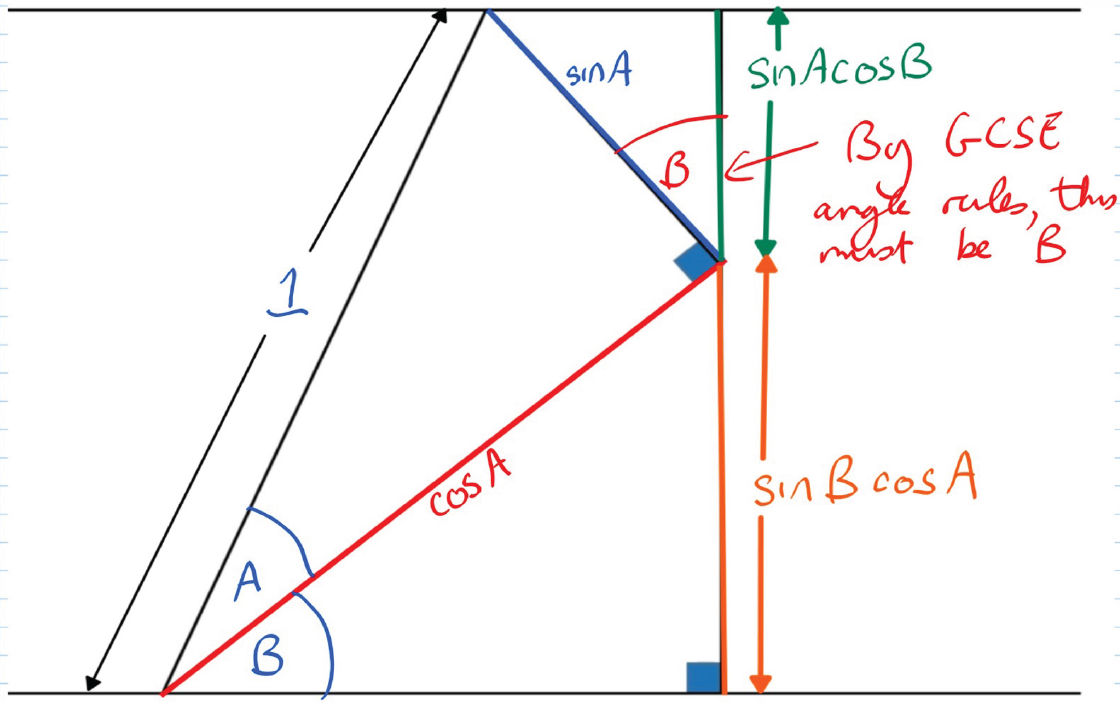
Finding the lengths of the four coloured sides:
- For the side corresponding to :
- For the side corresponding to :
- For the side corresponding to :
- For the side corresponding to :
For the equation :
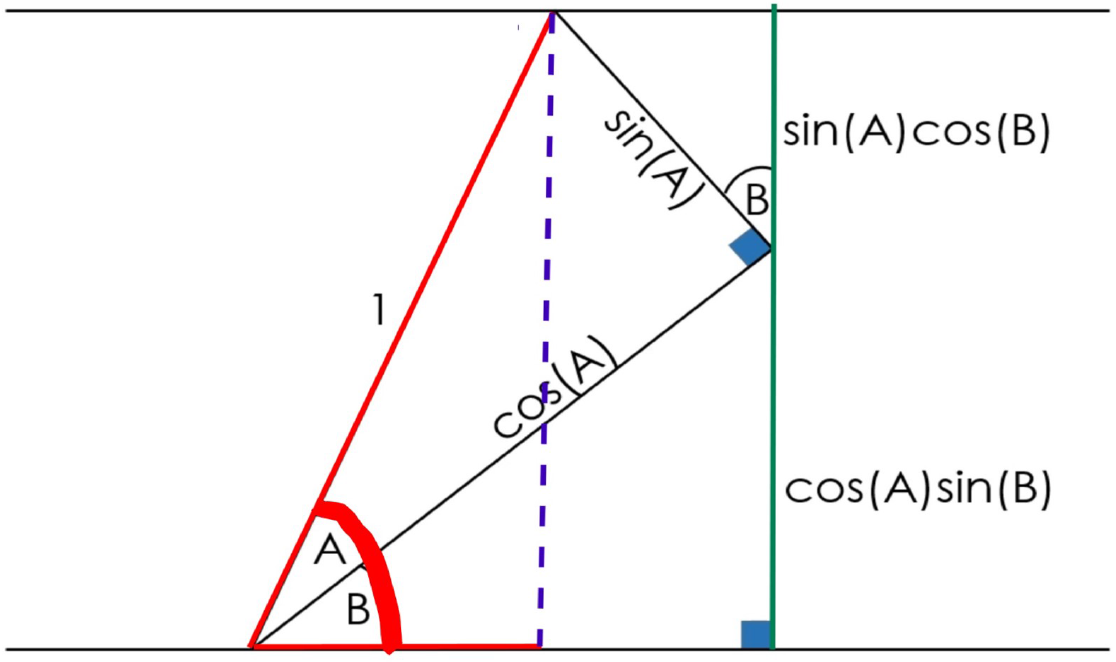
The calculation in the diagram confirms that:
From the diagram, we can also see that:
Proposition:
Proof:
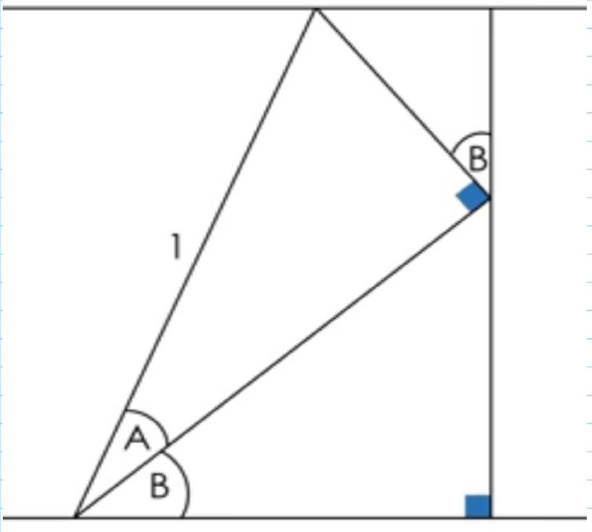
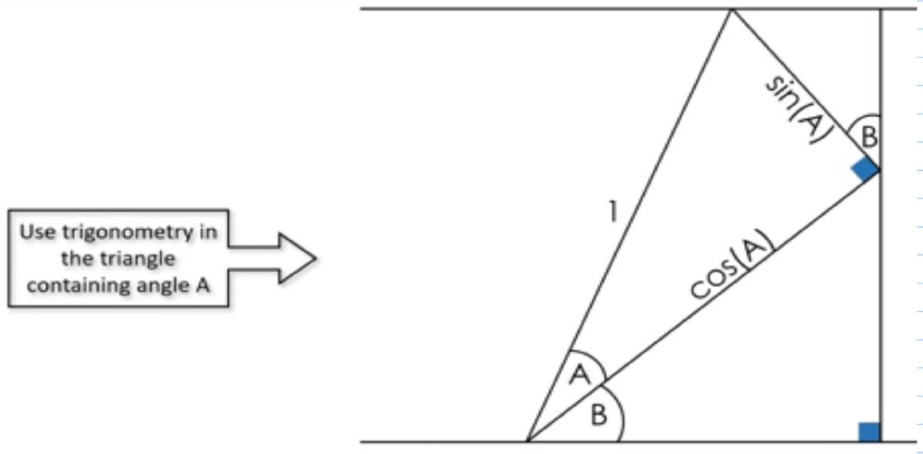
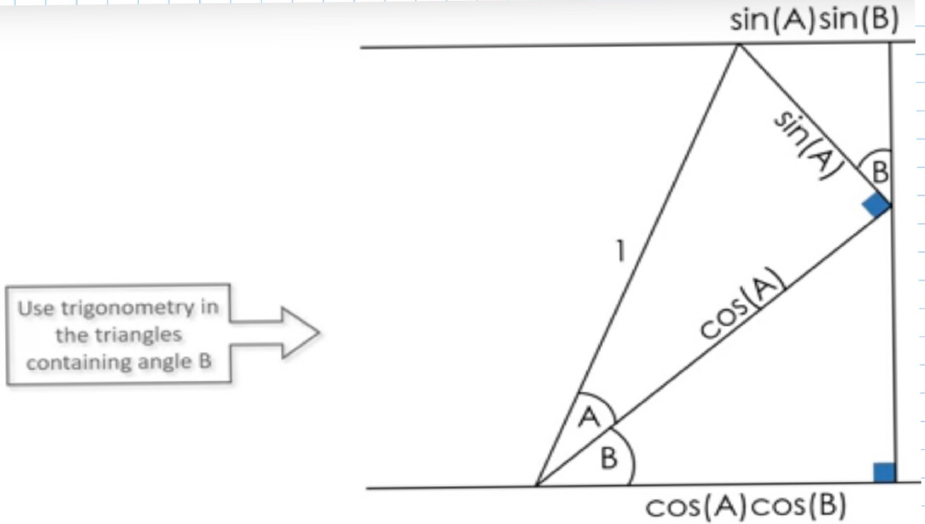
Diagram Explanation:
Note
- The base of the blue triangle is given by:
- Notice also that can be obtained by:
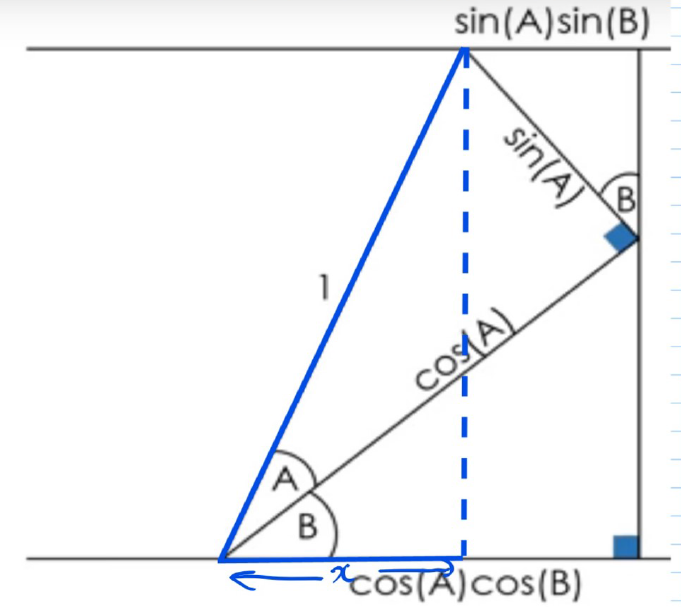
Compound Angle Formulae
Note
Note
Example:
Use the compound angle formulae to expand and simplify :
Let :
Since and :
Note
Example: "Factorise"
Hint: The trick here is to look at which trig identity it most closely matches.
We can see here that .
Note
Given that and that , find without using a calculator the value of:
Diagrams:
- For angle A:
- Hypotenuse = 5, Opposite = 4, Adjacent =
- For angle B:
- Hypotenuse = 3, Adjacent = 2, Opposite =
Solutions:
b)
c)
- We can now find each of these individually from the triangles to evaluate the expression. From above triangle,
d)
Solving Equations With Compound Angle Formulae
Note
Example: Solve For
In any example like this, there are certain questions to ask:
- Is it solvable as it is? If so, do it.
- If not, ask "do I need to expand or factorise?"
Step-by-Step Solution:
- Let and
From the cosine graph:
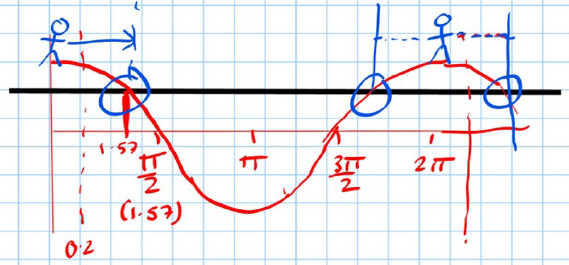
Calculating for :
Note
Example: Solve .
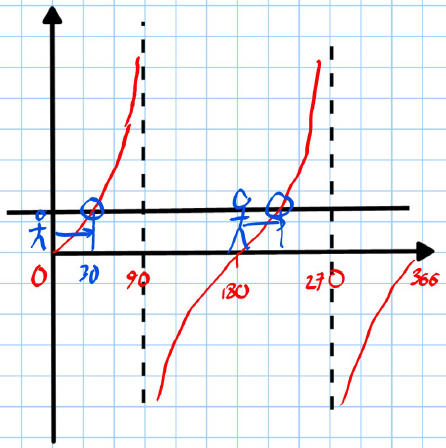
From the graph: