Position Vectors (AQA A-Level Mathematics): Revision Notes
📚Revision Notes
11.1.4 Position Vectors
What is a Position Vector?
A position vector is a vector that represents the position of a point in space relative to a fixed origin. If we have a point in space, the position vector of is usually denoted as or , where is the origin and is the point.
Representation of Position Vectors:
Note
In two dimensions (2D), if the coordinates of point are , the position vector is:
In three dimensions (3D), if the coordinates of point are , the position vector is:
This vector points from the origin in 2D or in 3D to the point or .
Note
📑Example:
If point is located at in 2D space, the position vector is:
In 3D space, if point is located at , the position vector is:
Operations Involving Position Vectors:
Note
- Addition: If you have two points and with position vectors and , the vector from to is:
This represents the displacement from to . 2. Magnitude: The magnitude (length) of a position vector in 2D is given by:
In 3D, for :
- Direction: The direction of a position vector is given by its direction cosines or by normalising the vector (dividing by its magnitude).
Application in Mechanics:
In mechanics, position vectors are used to describe the location of objects in space. The change in the position vector over time gives the velocity vector, and further differentiation gives the acceleration vector.
Collinear Vectors
Three position vectors (points) are collinear if they lie on the same straight line.
Problem Statement:
Note
📝Consider the points, and . Determine whether these points are collinear.
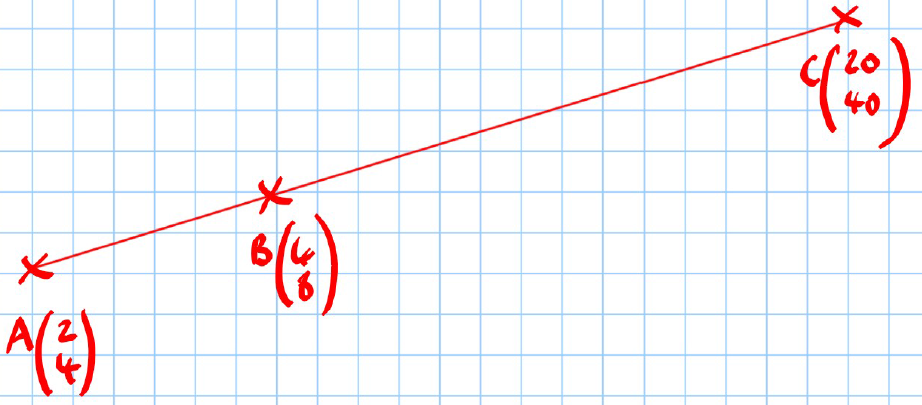
Solution:
- Calculate Vector :
- Vector
- Calculate Vector :
- Vector
- Compare the Vectors:
- This means and are parallel.
- Conclusion:
- Since and have the same direction, and share the point ,
- Therefore, points , and are collinear.
Summary:
Note
- A position vector locates a point in space relative to the origin.
- It is represented by coordinates in vector form, either in 2D or 3D.
- Position vectors can be added, subtracted, and their magnitudes can be calculated to understand the spatial relationships between points.