Standard Deviation & Variance (AQA A-Level Mathematics): Revision Notes
📚Revision Notes
2.1.3 Standard Deviation & Variance
Standard Deviation
This measure of spread measures, on average, how far each data point deviates from the mean of a set.
Note
Example: Find the standard deviation of
- Calculate the mean:
- Calculate how far each point deviates from the mean (best in tabular form):
- Add to the table in column to make these deviations positive (see above in red).
- To find the mean square deviation, we calculate:
- Where is the sum of all squared deviations.
- is the number of items. This quantity, which measures squared spread, is called the variance.
- Standard deviation is the square root of the variance:
This quantity, on its own, does not mean much. We need another standard deviation to compare it to, for it to make sense.
Summary of Formulae
- is the mean of all squared data.
- is the mean of all data then squared. Verifying formula (2) for our previous example (2, 1, 3, 6)****:
Note
Question 2: (AQA SS1B, Jan 2007, Q1) The times, in seconds, taken by 20 people to solve a simple numerical puzzle were:
(a) Calculate the mean and the standard deviation of these times.
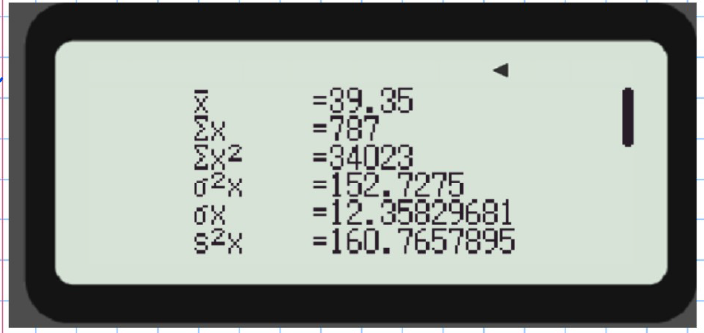
(b) In fact, 23 people solved the puzzle. However, 3 of them failed to solve it within the allotted time of 60 seconds.
Calculate the median and the interquartile range of the times taken by all 23 people.
(Inputting 3 extra values bigger than 60):
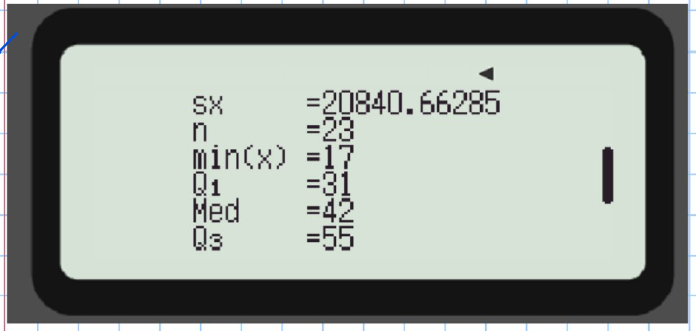
(c) For the times taken by all 23 people, explain why:
(i) The mode is not an appropriate numerical measure;
There is no mode.
(ii) The range is not an appropriate numerical measure.
We don't know the highest value, so the range is not possible to calculate.
| Range | IQR | |
|---|---|---|
| Uses two data points | Uses two data points | Uses all data |
| Includes outliers | Ignores outliers | Includes extreme outliers |
| Easy to calculate | Relatively easy to calculate | More difficult to calculate |