Hypothesis Testing (AQA A-Level Mathematics): Revision Notes
📚Revision Notes
5.1.1 Hypothesis Testing
Critical Regions in Hypothesis Tests
The critical region of a hypothesis test (also the rejection region) is the set of x values that would lead to the null hypothesis being rejected.
Note
Example: A single observation, x, is taken from a binomial distribution B(10, p) and a value of 5 is obtained.
Use this observation to test H₀: p = 0.25 against H₁: p > 0.25 using a 5% significance level.
We will use critical regions to perform this test.
We need the set of x values such that P(X ≥ k) ≤ 0.05, i.e., every single value we can observe that would lead to H₀ being rejected.
We do this by trial and improvement:
We have seen crossing one boundary from reject to accept; we can be certain we have found the entire critical region.
Using "List Mode" in Binomial CD to speed this up
- Select 'List' on Binomial CD.
- Starting at the biggest value (if we are testing the right tail) or the smallest (if we are testing the left tail), type in lots of numbers.
Left Tail:
- Look for P(X ≤ k) crossing over sig level boundary.
- Summarise.
Right Tail:
- Look for the probability crossing over the (1 - SIG LEVEL) boundary.
- Write down the calculations either side of this boundary:
- Summarise:
A test statistic has a distribution B(10, p). Given that H₀: p = 0.2, H₁: p > 0.2, find the critical region for the test using a 5% significance level.
Note
Example: Binomial CD
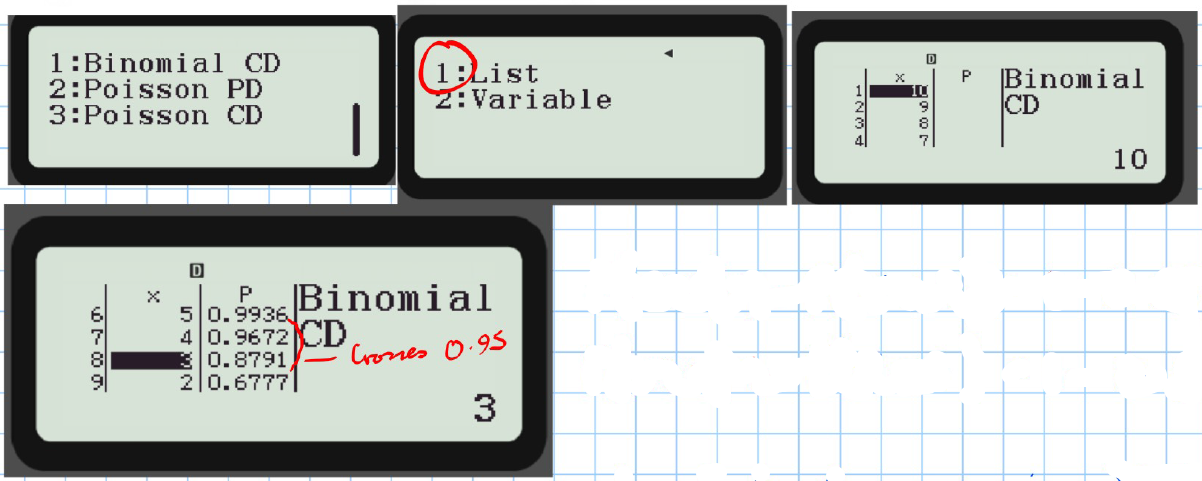
Note
Example: A random variable has a distribution B(20, p). A single observation is used to test H₀: p = 0.15 against H₁: p < 0.15.
Using a 5% level of significance, find the critical region of this test.
Since it's a left tail test, we just need to cross the 0.05 boundary.
Therefore, the critical region is X ≤ 0 (i.e., X = 0 is acceptable).
The test is performed and X = 3 is observed. Conclude 3 > 0. Therefore, Do not reject H₀.
Note
Example: A random variable has a distribution B(20, p). A single observation is used to test H₀: p = 0.4 against H₁: p ≠ 0.4.
Questions:
a) Using the 5% level of significance, find the critical region of this test.
b) Write down the actual significance level of the test.
a) For a two-tailed test, the significance level for each tail is 0.025.
Left Tail:
Thus, the left critical region is X ≤ 3.
Right Tail:
Thus, the right critical region is X ≥ 13.
Therefore, the critical region is X ≤ 3 or X ≥ 13.
b) The actual significance level is the probability contained within the rejection region: