Angular momentum (AQA A-Level Physics): Revision Notes
📚Revision Notes
Angular momentum
Definition of angular momentum
Angular momentum is a measure of the rotational motion of an object. For a single particle moving in a circular path, the angular momentum about the axis of rotation depends on both its linear momentum and its distance from the axis.
For a particle of mass m at a perpendicular distance r from the axis, moving with linear velocity v, the angular momentum L is defined as:
When a particle rotates about an axis with angular velocity ω, we can use the relationship to express the angular momentum as:
Note
For a rigid body composed of many particles at various distances from the rotation axis, we must consider all the individual contributions. Each particle i has mass at distance from the axis, contributing angular momentum . Since all particles rotate with the same angular velocity ω, we can sum these contributions.
The total angular momentum can be written as:
Factoring out the common ω gives:
The term in brackets is the moment of inertia I of the rigid body. This leads to the fundamental expression for angular momentum:
where:
- L is the angular momentum ()
- I is the moment of inertia ()
- ω is the angular velocity ()
Important
This equation shows that angular momentum is directly proportional to both the moment of inertia and the angular velocity of the rotating object.
Vector nature and direction of angular momentum
Angular momentum is a vector quantity, meaning it has both magnitude and direction. The direction of the angular momentum vector is always perpendicular to the plane of rotation, lying along the axis of rotation.
Note
The Right-Hand Rule:
By convention, if an object rotates anticlockwise when viewed by an observer, the angular momentum vector points toward that observer. This follows the right-hand rule: if you curl the fingers of your right hand in the direction of rotation, your thumb points in the direction of the angular momentum vector.
Units of angular momentum
The SI unit for angular momentum follows directly from the equation . Since moment of inertia has units of and angular velocity has units of (or simply , as radians are dimensionless), the unit of angular momentum is:
kg m² s⁻¹
An alternative unit can be derived by recalling that torque , where α is angular acceleration. Rearranging gives . Substituting into yields:
Since torque has units of N m and angular acceleration has units of , this gives angular momentum units of:
Both kg m² s⁻¹ and N m s are equivalent and acceptable units for angular momentum.
Calculating angular momentum: worked example
Example
Worked Example: Rotating Observation Wheel
Consider a large rotating observation wheel with a diameter of 135 m that completes one full rotation in 30 minutes. If its total moment of inertia is , we can calculate its angular momentum.
Step 1: Determine the angular velocity
One complete rotation corresponds to an angular displacement of radians. Converting the time period to seconds: s.
The angular velocity is:
Step 2: Calculate angular momentum using
Answer: The angular momentum of the observation wheel is approximately 2.9 × 10⁷ kg m² s⁻¹.
Conservation of angular momentum
The principle of conservation of angular momentum states that:
Important
The total angular momentum of a system remains constant over time, provided no external torque acts on the system.
Mathematically, if a system's angular momentum is at some initial time and at a later time, then:
In terms of moment of inertia and angular velocity:
This principle is analogous to the conservation of linear momentum but applies to rotational motion. It holds universally, from subatomic particles to astronomical objects, with no known exceptions.
Application: ice skater spinning
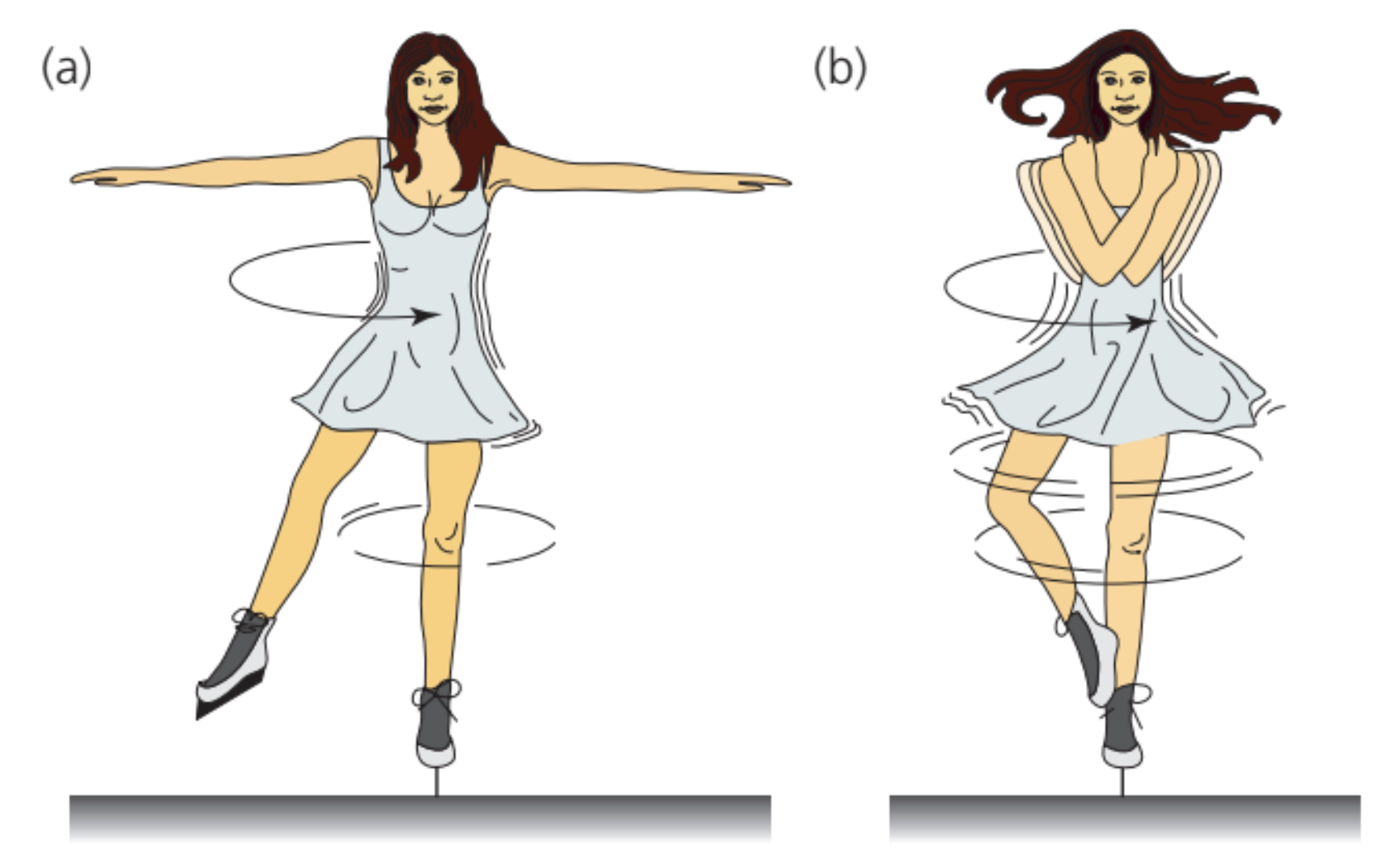
When a figure skater spins with arms extended and then pulls them inward, a dramatic change occurs. Initially, with arms outstretched, the skater's mass is distributed far from the rotation axis, giving a large moment of inertia and a moderate angular velocity .
Note
When the skater draws her arms close to her body, the mass moves closer to the axis of rotation, significantly reducing the moment of inertia to . Since angular momentum must be conserved () and , the angular velocity must increase: . The skater spins faster.
The rotational kinetic energy () increases in this process. This additional energy comes from the work done by the skater's muscles in pulling the arms inward against the centrifugal effect.
Application: high-board diving
Divers exploit conservation of angular momentum to control their rotation during flight. By changing body position—tucking into a tight ball or extending fully—they alter their moment of inertia and thus their rotation rate.
A tucked position (small I) produces rapid spinning, allowing multiple rotations. Extending the body (large I) slows the rotation, enabling a controlled entry into the water. The total angular momentum remains constant throughout the dive, determined by the initial push-off from the board.
Application: Earth-Moon system
The Earth-Moon system possesses a total angular momentum that is conserved. Due to tidal drag—friction caused by tidal bulges raised on Earth by the Moon's gravity—Earth's rotation gradually slows down. Its angular momentum decreases.
Note
Angular Momentum Transfer:
To conserve the total angular momentum of the system, this lost angular momentum must be transferred elsewhere. The Moon gains this angular momentum, which manifests as an increase in its orbital radius. Currently, the Moon recedes from Earth at approximately 3 cm per year.
Gyroscopes
A gyroscope is a device consisting of a rapidly spinning wheel or disc mounted so that its axis can freely change direction. Gyroscopes exhibit remarkable stability due to conservation of angular momentum.
When a gyroscope is set spinning with its axis pointing in a particular direction, it maintains that orientation as long as it continues spinning rapidly. The large angular momentum of the spinning wheel resists changes in direction. Tilting or rotating the mounting has little effect on the axis orientation—the gyroscope "remembers" its initial direction.
This stability makes gyroscopes invaluable for navigation and stabilization applications.
Precession
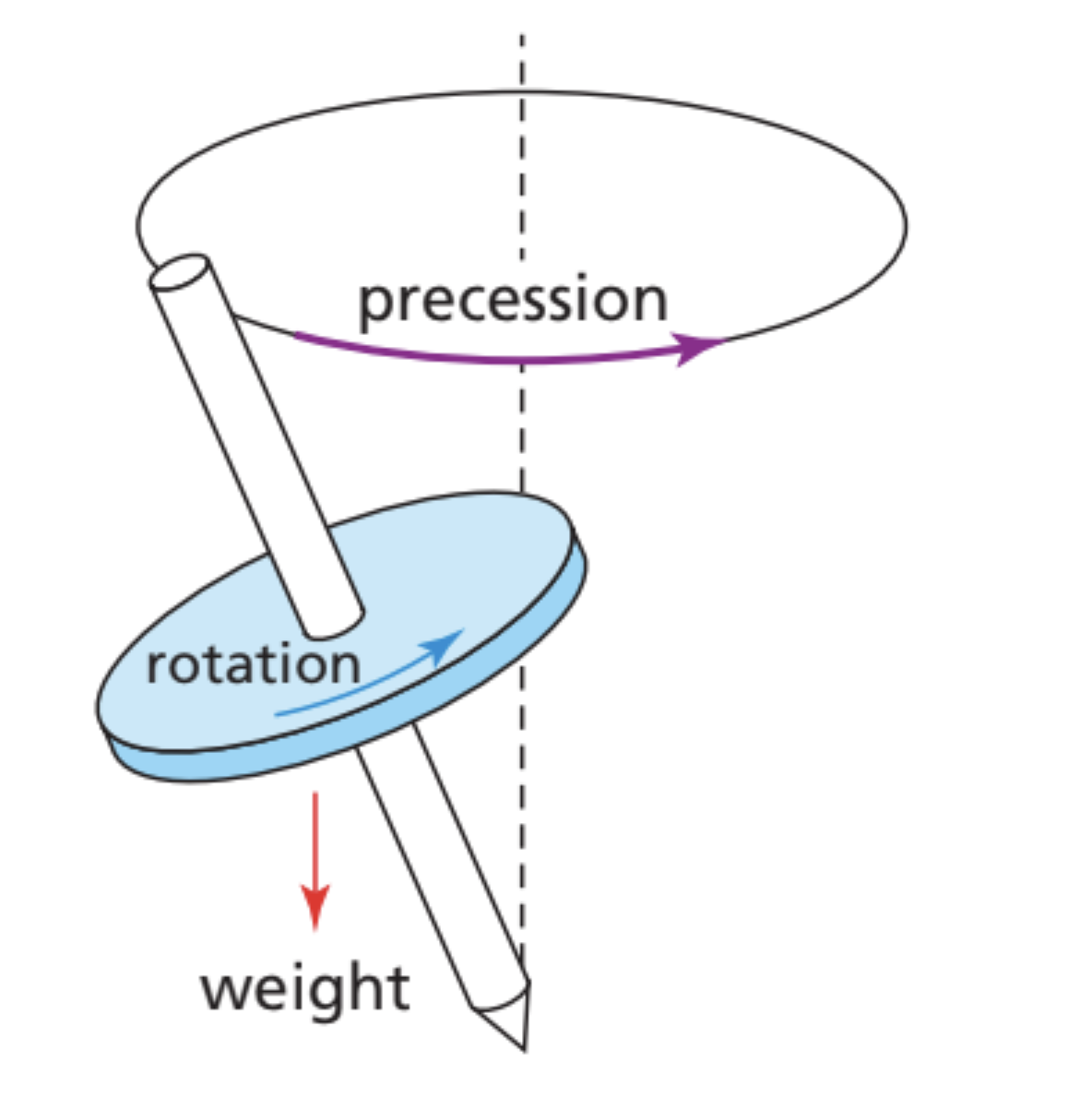
In practice, friction gradually reduces a gyroscope's spin rate. When mounted on a small base, the gyroscope is inherently unstable. Any slight deviation from perfect alignment, combined with slowing rotation, allows gravity to exert an external torque on the system.
Note
This torque causes a change in angular momentum, but not in the way one might expect. Rather than simply toppling over, the axis rotates slowly around the vertical. This phenomenon is called precession.
The axis of rotation sweeps out a cone shape, with the direction of precession matching the sense (clockwise or anticlockwise) of the gyroscope's spin. The slower the spin rate, the larger the angle the axis makes to the vertical, until eventually the gyroscope becomes too unstable and falls.
Applications of gyroscopes
Gyroscopes have numerous practical applications:
- Navigation and guidance: In aircraft, any deviation from a gyroscope axis can be measured and used either to determine the aircraft's position or to make corrections to return to the intended course. Satellites employ gyroscopes that measure changes in all three dimensions for navigation.
- Stabilisation: Ships use gyroscopes spun at speeds up to 10,000 rpm to help maintain an upright position, particularly in rough seas. The gyroscope, fixed to the hull, resists rolling motion. Similarly, Segway scooters and two-legged robots use assemblies of gyroscopes to maintain vertical balance.
- Motion sensing: Modern computer devices and virtual reality headsets contain miniature gyroscopic sensors. These detect rotational movements—of a mouse moving through the air or a user's head turning—and feed this information back to update the display, creating responsive control or seamless perspective changes.
- Vehicle dynamics: In racing cars, the spinning engine creates a gyroscopic effect. When the car turns, this effect forces the car's nose either up or down, affecting weight distribution and tire grip on the road surface.
Angular impulse
Just as linear momentum is conserved only when no external force acts, angular momentum is conserved only when no external torque acts. When a torque is applied to a rotating system, the angular momentum changes. This change is called the angular impulse.
The change in angular momentum is:
This can be expressed as:
Or, if the moment of inertia remains constant:
The unit of angular impulse is the same as angular momentum: kg m² s⁻¹.
Relationship between torque and angular impulse
Torque represents the rate of change of angular momentum. From the fundamental relationship between torque and angular acceleration:
where α is the angular acceleration. Since , we can write:
Rearranging this expression gives the angular impulse:
Important
This is the rotational analogue of linear impulse (), where torque replaces force and angular momentum replaces linear momentum.
For situations where the moment of inertia changes (such as the ice skater pulling in her arms), the more general form should be used:
This accounts for changes in both moment of inertia and angular velocity.
Applying angular impulse calculations
To bring a stationary flywheel up to a certain rotation rate, an angular impulse must be applied. For example, if a flywheel with moment of inertia I needs to reach angular velocity ω from rest, the required angular impulse is:
If this impulse is delivered over a time interval , the average torque needed is:
Note
Conversely, if a known torque is applied for a known duration, the resulting change in angular momentum (and hence the change in rotation rate) can be calculated directly.
Remember!
Summary
Key Points to Remember:
-
Angular momentum is defined as , the product of moment of inertia and angular velocity, with units of kg m² s⁻¹ or N m s.
-
Angular momentum is a vector quantity directed along the axis of rotation, perpendicular to the plane of rotation.
-
The conservation of angular momentum states that total angular momentum remains constant when no external torque acts, leading to fascinating effects like ice skaters spinning faster when pulling their arms in.
-
Gyroscopes maintain their orientation due to conservation of angular momentum; when spinning rapidly, they resist changes in axis direction and are used extensively in navigation and stabilization.
-
Angular impulse () describes how torque applied over time changes the angular momentum of a system, analogous to linear impulse in translational motion.