First law of thermodynamics (AQA A-Level Physics): Revision Notes
📚Revision Notes
11.2.1 First law of thermodynamics
First Law of Thermodynamics Overview
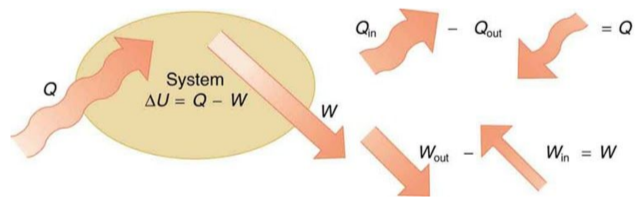
The first law of thermodynamics is a principle of energy conservation in thermodynamic systems. It states that the energy transferred to a system through heating is equal to the sum of the increase in internal energy and the work done by the system . Mathematically, this is expressed as:
Where:
- is the energy added to the system via heating or cooling.
- is the change in internal energy of the system.
- is the work done by the system on its surroundings.
Understanding Internal Energy and Work
- Internal Energy :
- This is the total energy of a system, which includes both the kinetic energy of the particles (due to their motion) and their potential energy.
- An increase in internal energy implies that the particles in the system are gaining energy, whereas a decrease implies they are losing energy.
- Work Done ($$ W ):
- Work is done by the system when it expands against an external pressure, moving the boundary of the system (e.g., expanding gas).
- If is positive, the system is doing work on the surroundings (energy leaves the system).
- If is negative, work is being done on the system (energy is added to the system).
Note
Example: Gas Expansion and Compression
- Expansion: When a gas expands, it does work on its surroundings, so is positive.
- Compression: When a gas is compressed by an external force, work is done on the system, and is negative.
Open and Closed Systems
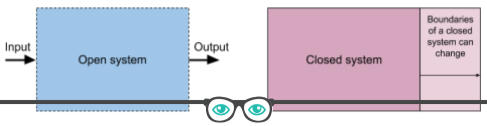
- Open System:
- In an open system, gas can flow in and out of the system. Energy and matter can cross the boundary.
- Example: An aerosol can, where gas can leave the container when sprayed.
- Closed System:
- In a closed system, no gas can enter or leave, although energy may still transfer across the boundaries.
- Example: A balloon with a fixed amount of air inside, but which may change shape or volume.
Practical Application: Human Metabolism
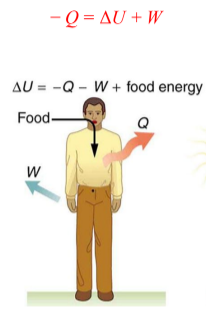
In biological systems, such as the human body, the first law of thermodynamics explains how internal energy changes due to heat and work. Here:
- represents heat lost from the body (e.g., through skin to surroundings).
- represents work done by the body (e.g., muscle movements). For example, when exercising, the body transfers heat to the surroundings (negative and does work (positive , leading to a decrease in internal energy unless replenished by food energy.
Note
Key Points
- Positive : Energy enters the system.
- Negative : Energy leaves the system.
- Positive : System does work (e.g., expansion).
- Negative : Work is done on the system (e.g., compression).