Reversed heat engines (AQA A-Level Physics): Revision Notes
📚Revision Notes
11.2.6 Reversed heat engines
Concept Overview:
Reversed heat engines operate by having work done on them to move heat from a colder region to a warmer one. This requires external energy because, under normal circumstances, heat flows naturally from warmer to colder regions.
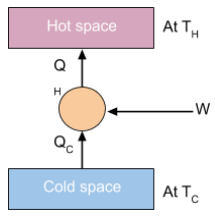
Note
Examples of reversed heat engines include:
- Refrigerators: Remove heat from a cold space (inside the fridge) and transfer it to a warmer space (the room).
- Heat Pumps: Transfer heat from the outside (cold space) to the inside of a building (warm space) to heat it.
Key Terms:
- Coefficient of Performance (COP): Unlike efficiency, COP can be greater than 1. COP measures how effectively the engine transfers heat for each unit of work done.
Types of Reversed Heat Engines and COP Calculations:
- Refrigerator: COP (denoted as is the ratio of heat removed from the cold region to the work done :
- Where and are the temperatures of the cold and hot regions, respectively.
- Heat Pump: COP (denoted as is the ratio of heat added to the warm region ( to the work done :
Note: Calculations assume maximum theoretical efficiency, using the absolute temperatures of the regions.
Explanation of COP:
- If a system has a COP of 5, this means that 5 joules of heat energy are transferred for every 1 joule of work done.
- COP depends on whether the system functions as a refrigerator or a heat pump, which impacts the formula and interpretation.
Practical Applications:
- Dual Functionality: Heat pumps can act both as refrigerators and heating systems, making them versatile. They are more energy-efficient compared to conventional electric heaters since they can transfer more than 1 joule of heat energy per joule of work done.
- Cost Efficiency: In heating mode, heat pumps are more cost-effective because they deliver more heat energy than the electrical energy they consume, unlike traditional heaters that convert electrical energy directly to heat.
Important Considerations:
-
Specification of Heat Flow: When discussing energy transfer in reversed heat engines, always clarify which region (hot or cold) the heat is being moved into, as this defines whether it's working as a refrigerator or a heat pump. For example:
- "Input energy" could refer to the work done on the engine or the energy transferred into either the hot or cold region.