Electromagnetic radiation and quantum phenomena (AQA A-Level Physics): Revision Notes
📚Revision Notes
2.2.4 Wave-particle duality
Wave-Particle Duality of Light and Matter
Wave-particle duality describes the concept that light and particles can exhibit both wave and particle properties.
Note
- Examples in Light:
- Wave Properties: Light demonstrates wave-like behaviours, such as diffraction and interference.
- Particle Properties: The photoelectric effect shows light acting as particles called photons.
- Wave-Particle Duality of Electrons:
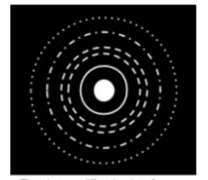
- Electron Diffraction: Electrons, which are generally considered particles, also exhibit wave properties. When a beam of electrons passes through a crystal lattice or diffraction grating, it creates a diffraction pattern of concentric rings, which only waves can produce. This duality suggests that particles like electrons have wave-like characteristics, as shown through experiments involving electron diffraction.
De Broglie's Hypothesis
Louis de Broglie proposed that if light (typically a wave) exhibits particle properties, then particles should also exhibit wave-like properties. He derived an equation to calculate the wavelength of a particle based on its momentum :
where:
- is Planck's constant ,
- is the mass of the particle,
- is the velocity of the particle.
Explanation of De Broglie's Equation:
- Higher Momentum (e.g., faster particles) results in a shorter wavelength, leading to less diffraction. The diffraction pattern rings become closer together.
- Lower Momentum (e.g., slower particles) results in a longer wavelength, causing more diffraction and a spread-out pattern with rings further apart. This equation connects particle motion with wave-like properties and supports the idea that particles like electrons can behave as waves under certain conditions.
Acceptance of Wave-Particle Duality
Initially, the scientific community was sceptical of the concept that particles exhibit wave properties. However, as experimental evidence accumulated, including electron diffraction and the photoelectric effect, wave-particle duality became widely accepted.
The scientific process relies on gathering experimental evidence, which must be published and peer-reviewed to be validated. This peer review ensures that findings are rigorously tested and accepted by the scientific community, contributing to the evolving understanding of concepts like wave-particle duality.
Note
Key Points
- Wave-Particle Duality: Describes how particles and light can show both wave and particle characteristics.
- De Broglie's Wavelength Equation: Calculates the wavelength of a particle using its momentum, confirming wave-like properties in particles.
- Electron Diffraction: Experimental evidence that electrons, though particles, create diffraction patterns like waves.
- Scientific Acceptance: New concepts, like wave-particle duality, require rigorous experimental evidence and peer review to be accepted.
Note
Worked Example:
- To find the wavelength of an electron moving at with a mass of :