The photoelectric effect (AQA A-Level Physics): Revision Notes
📚Revision Notes
2.2.1 The Photoelectric Effect
Understanding the Photoelectric Effect
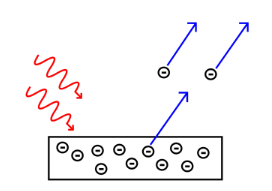
The photoelectric effect is the process in which photoelectrons are emitted from the surface of a metal when light of a certain frequency is shone on it. However, light below a specific frequency fails to emit photoelectrons, regardless of its intensity. This specific frequency is known as the threshold frequency, and it varies depending on the type of metal.
Wave Theory vs Photon Theory
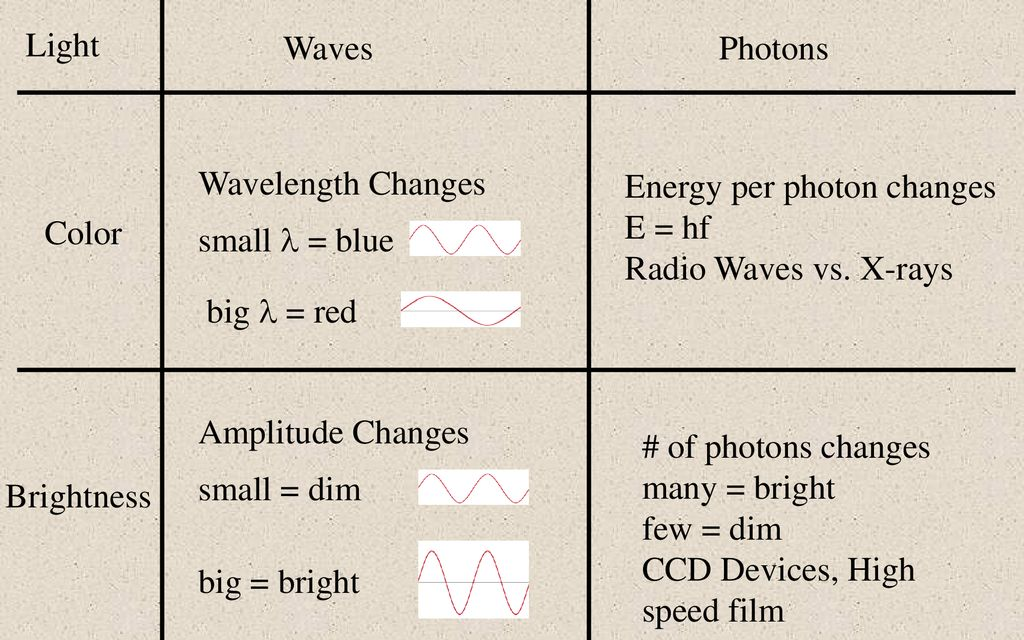
The wave theory of light suggested that any frequency of light should eventually provide enough energy to release an electron if it is intense enough, but experiments showed this was not the case. The photon model of light, however, provides a solution to this observation. According to this model:
- Photons: Light consists of discrete packets of energy called photons.
- The energy of each photon is proportional to its frequency , where is Planck's constant approximately 6.63 × 10^-34 J s .
- Absorption of Photons by Electrons: Each electron can absorb only one photon at a time.
- If the photon's energy (related to its frequency) is above the threshold frequency for that metal, the electron absorbs this energy and is emitted as a photoelectron.
- If the frequency of light is below the threshold frequency, no photoelectrons are emitted, regardless of the intensity.
- Effect of Light Intensity: If the intensity of light is increased (more photons per second), and the frequency is above the threshold, more photoelectrons are emitted per second. However, the maximum kinetic energy of each photoelectron depends only on the frequency, not the intensity.
Key Terms in the Photoelectric Effect
- Work Function :
- The work function is the minimum energy required to remove an electron from the surface of a metal. It is unique to each material.
- If the photon energy (determined by its frequency) is greater than the work function, electrons can be emitted.
- Stopping Potential :
- The stopping potential is the voltage needed to stop the emitted photoelectrons with maximum kinetic energy.
- By applying a stopping potential, we can measure the maximum kinetic energy of the photoelectrons:
where is the charge of an electron ) and is the stopping potential. This relationship is derived from the formula .
The Photoelectric Equation
The photoelectric equation relates the energy of the incident photon, the work function of the material, and the kinetic energy of the emitted photoelectrons:
where:
- is the photon energy,
- represents the photon energy (with being the frequency of light),
- is the work function of the metal,
- is the maximum kinetic energy of the emitted photoelectron.
Understanding the Equation:
- If , the photon has just enough energy to release an electron, but the electron will have zero kinetic energy.
- If , the excess energy appears as the kinetic energy of the emitted electron.
Note
Key Points
- Photoelectric Effect: Emission of photoelectrons from a metal surface due to light of frequency above a threshold frequency.
- Photon Model: Light consists of photons, and each photon's energy is related to its frequency.
- Work Function: The minimum energy required to release an electron from a metal surface.
- Stopping Potential: The voltage required to stop photoelectrons with maximum kinetic energy, used to measure this kinetic energy.
- Photoelectric Equation: Describes the relationship between photon energy, work function, and kinetic energy.