Energy levels and photon emission (AQA A-Level Physics): Revision Notes
📚Revision Notes
2.2.3 Energy levels and photon emission
Line Spectra and Photon Emission
When light from a fluorescent tube is passed through a diffraction grating or prism, it produces a line spectrum. Each line in this spectrum represents a unique wavelength of light emitted by the tube. This line spectrum is not continuous; instead, it contains discrete wavelengths only. This is because the photon energies correspond to specific differences between energy levels in atoms, indicating that electrons in atoms can only move between discrete energy levels.
This line spectrum is evidence for quantised energy levels in atoms, as it shows that electrons can only transition between fixed energy states, emitting photons of specific wavelengths as they do so.

Absorption Spectra
If white light is passed through a cooled gas, it produces a line absorption spectrum. In an absorption spectrum, the continuous spectrum of all wavelengths has dark lines at specific wavelengths where light has been absorbed. These dark lines represent energy differences between the atomic energy levels. The electrons in the gas atoms absorb photons that have exactly the right energy to move to a higher energy level, leaving gaps (dark lines) in the spectrum.
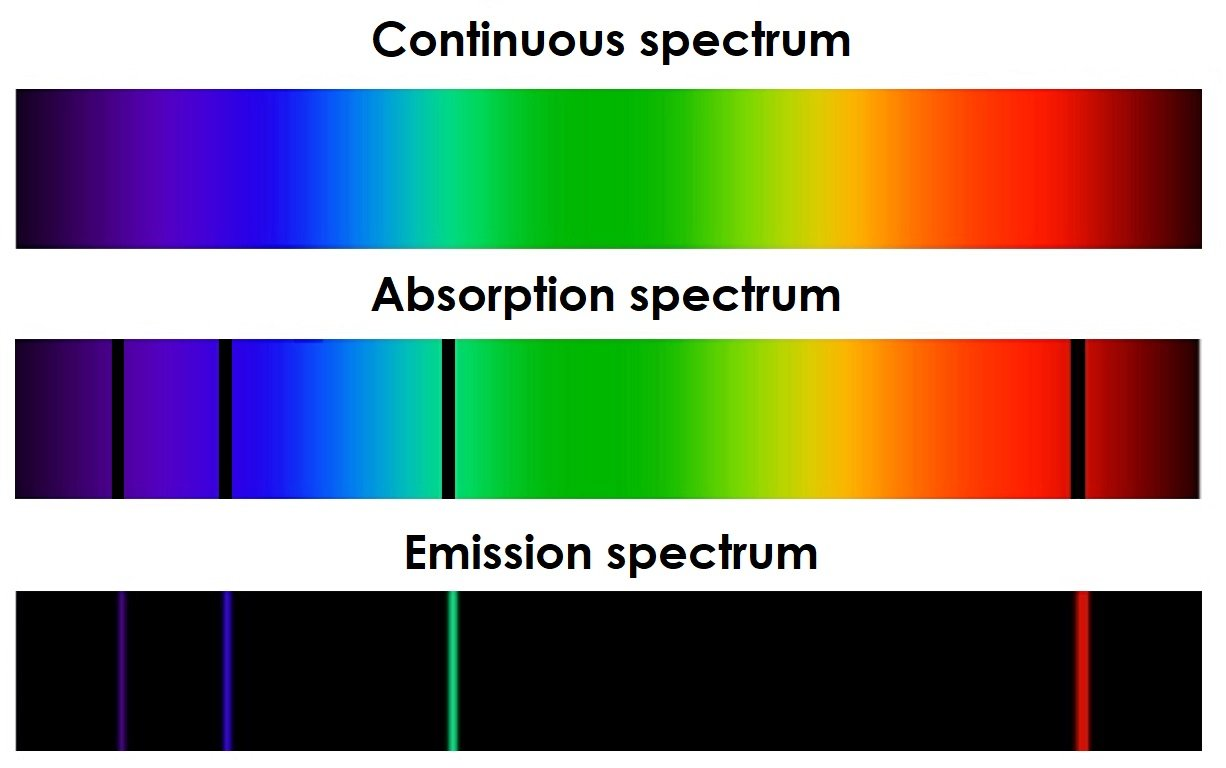
Photon Energy and Energy Levels
The energy difference between two energy levels, and , is associated with the energy of the emitted or absorbed photon. This energy difference is given by:
Since the energy of a photon is also given by ( E = hf ), where ( h ) is Planck's constant and ( f ) is the frequency of the photon, we can write:
This equation allows us to calculate the frequency (and hence the wavelength) of the emitted or absorbed photon based on the difference in energy levels.
Note
Key Points
- Line Spectrum: Produced when light from an excited gas passes through a diffraction grating, showing only discrete wavelengths.
- Absorption Spectrum: Produced when white light passes through a gas, showing dark lines where specific wavelengths are absorbed.
- Quantised Energy Levels: Electrons occupy discrete energy levels in atoms, and transitions between these levels correspond to specific photon energies.
- Photon Energy Equation: The energy of an emitted or absorbed photon corresponds to the difference between two energy levels in the atom, .
Note
Worked Example:
- Suppose an electron transitions from an energy level of to in an atom.
- Energy Difference: .
- To convert this energy into joules, use :
- This is the energy of the photon emitted during this transition.