Progressive and stationary waves (AQA A-Level Physics): Revision Notes
📚Revision Notes
3.1.3 Principle of Superposition of waves and formation of stationary waves
Principle of Superposition
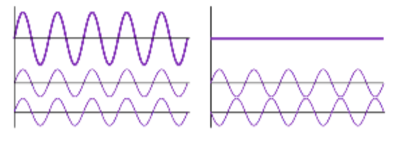
The principle of superposition states that when two or more waves overlap, their displacements combine to produce a resultant displacement. This resultant displacement is the vector sum of each wave's individual displacement. There are two types of interference that can occur due to superposition:
- Constructive Interference:
- Occurs when two waves have displacements in the same direction. The resultant wave has a larger amplitude.
- Destructive Interference:
- Occurs when one wave has a positive displacement and the other a negative displacement. If the waves have equal but opposite displacements, total destructive interference occurs, cancelling each other out.
Formation of Stationary Waves
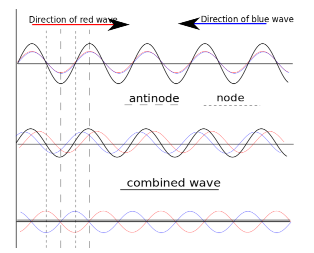
A stationary wave is formed when two progressive waves of the same frequency, wavelength, and amplitude travel in opposite directions and superpose. Unlike progressive waves, stationary waves do not transfer energy through the medium.
In a stationary wave:
- Antinodes are points of maximum amplitude, where constructive interference occurs.
- Nodes are points of no displacement, where destructive interference occurs.
Example
Example of Formation:
- A string fixed at one end and attached to a driving oscillator at the other can form a stationary wave. A wave travels down the string, reflects off the fixed end, and interferes with incoming waves. When the conditions for frequency, wavelength, and amplitude are met, a stationary wave pattern forms.
Harmonics and Frequency Calculation
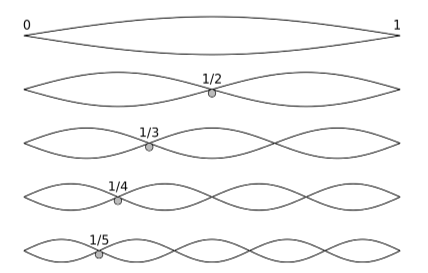
- The first harmonic (or fundamental frequency) is the lowest frequency at which a stationary wave forms. In this mode, the wave has two nodes and one antinode.
- Distance between nodes and antinodes: The distance between adjacent nodes (or antinodes) is half a wavelength for any harmonic.
Frequency of Stationary Waves: The frequency of the first harmonic can be calculated using:
where:
- is the length of the vibrating string,
- is the tension in the string,
- is the mass per unit length of the string.
Higher Harmonics:
- The second harmonic has two antinodes and three nodes, with a frequency twice that of the first harmonic.
- The third harmonic has three antinodes and four nodes, with a frequency three times that of the first harmonic, and so forth.
Example
Examples of Stationary Waves
- Microwaves:
- Stationary microwaves can be created by reflecting a microwave beam off a metal plate. Using a microwave probe, nodes and antinodes can be located.
- Sound Waves:
- Stationary sound waves can be produced in a closed tube. Placing powder across the tube allows observation of the nodes and antinodes, as the powder settles at the nodes.
In these examples, the distance between nodes corresponds to half a wavelength , which can help determine the wavelength and frequency of the wave.
Note
Key Points
- Superposition Principle: When two waves meet, their displacements combine to form a resultant displacement.
- Interference:
- Constructive Interference: Waves add up to form a larger amplitude.
- Destructive Interference: Waves cancel each other out.
- Stationary Waves:
- Formed from the superposition of two waves moving in opposite directions with the same frequency, wavelength, and amplitude.
- Have nodes (no displacement) and antinodes (maximum displacement).
- Harmonics: Higher harmonics have frequencies that are integer multiples of the fundamental frequency.