Progressive Waves (AQA A-Level Physics): Revision Notes
📚Revision Notes
3.1.1 Progressive Waves
Note
Definition of a Progressive Wave
A progressive wave is a wave that transfers energy through a medium (or field) without transferring material. This means that although particles within the medium oscillate (move back and forth), they do not travel along with the wave. For example, water waves consist of water particles oscillating up and down, transferring energy through the water without moving the water itself along with the wave.
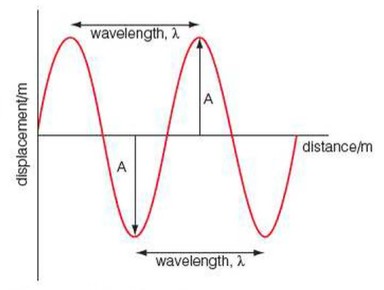
Key Characteristics of Progressive Waves
- Amplitude :
- The maximum displacement of a point on the wave from its equilibrium position. Amplitude is measured in metres ().
- Frequency :
- The number of complete oscillations passing a point per second. Frequency is measured in hertz ().
- Wavelength :
- The distance over which the wave's shape repeats, or the length of one complete wave cycle (e.g., from one peak to the next peak). Wavelength is measured in metres ().
- Speed or :
- The distance travelled by the wave per unit time. Wave speed is measured in metres per second ().
- Phase:
- The position of a point within the wave cycle, usually measured in radians or degrees.
- Phase Difference:
- The amount by which one point on a wave lags behind another, measured in radians, degrees, or as a fraction of the wave cycle.
- Period ($$ T ):
- The time taken for one complete oscillation or one full cycle of the wave. Period is measured in seconds ().
In Phase and Out of Phase
- In Phase: Two points on a wave are in phase if they are at the same position in the cycle (same displacement and velocity) with a phase difference that is a multiple of (or radians). Points in phase have the same frequency and wavelength but do not need the same amplitude.
- Out of Phase: Two points are completely out of phase if they are an odd integer of half cycles apart, meaning their phase difference is (or radians). For example, if one point is at the peak of the wave while the other is at the trough.
Equations for Wave Properties
- Wave Speed Equation:
This equation states that the speed () of a wave is equal to its frequency () multiplied by its wavelength (λ).
- Frequency and Period Relationship:
The frequency () of a wave is the inverse of its period (), which is the time for one full oscillation.
Note
Worked Example
Example: A wave has a frequency of 500 Hz and a wavelength of 0.6 m. What is its speed?
Using the wave speed equation:
Thus, the wave speed is 300 m/s.
Note
Key Points
- Progressive Waves transfer energy without moving material.
- Key properties include amplitude, frequency, wavelength, speed, phase, phase difference, and period.
- In Phase points are in the same position within the wave cycle, while Out of Phase points are half a cycle apart.
- Equations: and allow calculation of wave speed and frequency from known values.