Interference (AQA A-Level Physics): Revision Notes
📚Revision Notes
3.2.1 Interference
Path Difference and Coherent Sources
- Path Difference: This is the difference in the distance travelled by two waves from their respective sources to a point where they meet.
- Coherent Light Source: A coherent light source has the same frequency and wavelength and maintains a fixed phase difference. Lasers are an example, often used in interference experiments due to their coherence and monochromatic (single wavelength) nature, making it easy to observe interference patterns.
Young's Double-Slit Experiment
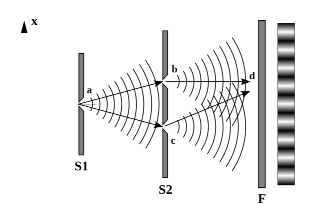
Young's double-slit experiment demonstrates interference using two coherent light sources. This setup produces an interference pattern of bright and dark fringes on a screen, proving the wave nature of light. Here's how it works:
- Procedure:
- Shine a coherent light source (such as a laser) through two slits that have the same width as the wavelength of the light.
- This causes diffraction of the light as it passes through each slit, allowing it to spread and overlap.
- Formation of Fringes:
- Each slit acts as a coherent point source, emitting light that overlaps to create an interference pattern of bright (constructive interference) and dark (destructive interference) fringes.
- Bright Fringes: Form where the path difference is a whole number of wavelengths , leading to constructive interference.
- Dark Fringes: Form where the path difference is a half-integer of wavelengths , causing destructive interference.
- Equation for Fringe Spacing:
Where:
- is the fringe spacing (distance between adjacent bright or dark fringes),
- is the wavelength of the light,
- is the distance between the screen and the slits,
- is the slit separation.
- Using White Light: If white light is used instead of monochromatic light, the result is a central white fringe with a spectrum of colours on either side. This occurs because each colour has a different wavelength, so they interfere differently, creating coloured fringes. Violet is closest to the central maximum, and red is furthest.
Safety Precautions with Lasers
Lasers are very intense light sources and can cause eye damage. Always follow these safety precautions:
- Wear laser safety goggles.
- Avoid shining lasers at reflective surfaces.
- Display a warning sign when using lasers.
- Never point a laser at a person. Other Examples of Interference
- Sound Waves: A similar interference pattern can be created with sound waves by using two speakers connected to the same generator. The intensity of the sound (loud or quiet) at different points corresponds to constructive and destructive interference.
Evidence for the Wave Nature of Light
Young's double-slit experiment provided strong evidence for the wave nature of light. The observed diffraction and interference patterns demonstrated that light behaves as a wave, supporting the idea that electromagnetic (EM) radiation can act as a wave. This experiment challenged earlier particle theories of light, showing that light's behaviour aligns with wave-based phenomena.
The process of scientific validation involves gathering experimental evidence, publishing findings, and allowing peer review to ensure acceptance within the scientific community. The double-slit experiment remains a classic demonstration of how experimental results can challenge and refine our understanding of fundamental concepts in physics.
Note
Key Points
- Path Difference: Determines whether interference is constructive or destructive.
- Coherent Light Source: Required to maintain a constant phase difference for interference.
- Young's Double-Slit Experiment:
- Produces a pattern of bright and dark fringes due to interference.
- Fringe spacing depends on wavelength, distance to screen, and slit separation.
- Safety with Lasers: Essential to prevent eye damage.
- Wave Nature of Light: Proven by interference patterns, supporting the view that light behaves as a wave.
Note
Worked Example:
If a laser with a wavelength of is used in Young's double-slit setup with a screen away and slit separation of , calculate the fringe spacing: