Diffraction (AQA A-Level Physics): Revision Notes
📚Revision Notes
3.2.2 Diffraction
Note
Definition of Diffraction
Diffraction is the spreading out of waves as they pass through a gap or around an obstacle. The extent of diffraction depends on the relationship between the wavelength of the wave and the size of the gap:
- Greatest Diffraction: Occurs when the gap size is approximately the same as the wavelength.
- Smaller Gaps than Wavelength: Most waves are reflected rather than diffracted.
- Larger Gaps than Wavelength: Minimal diffraction is observed, as most of the wave passes through with little spreading. When waves encounter obstacles, they diffract around the edges, with wider obstacles causing less diffraction.
Single-Slit Diffraction with Monochromatic Light
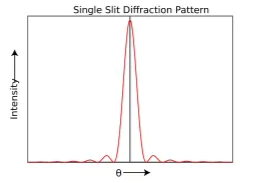
When monochromatic light (light of a single wavelength) passes through a narrow slit, it forms a diffraction pattern on a screen. The resulting pattern consists of a bright central fringe (twice the width of the other fringes) with alternating dark and bright fringes on either side.
- Central Bright Fringe: The most intense and broadest fringe in the pattern.
- Bright Fringes: Caused by constructive interference, where waves meet in phase.
- Dark Fringes: Caused by destructive interference, where waves are completely out of phase. The intensity of the fringes decreases with distance from the central fringe.
Diffraction of White Light
White light contains a range of wavelengths, each corresponding to a different colour. When white light passes through a slit:
- A central white maximum forms, surrounded by coloured fringes.
- The different wavelengths are diffracted by different amounts, creating a spectrum of colours.
- Violet (shorter wavelength) appears closer to the central maximum, while red (longer wavelength) is further away.

Factors Affecting Diffraction Patterns
- Slit Width:
- Narrower Slit: Increases the amount of diffraction, causing the central maximum to be wider but with lower intensity.
- Wider Slit: Decreases diffraction, narrowing the central maximum and increasing its intensity.
- Wavelength:
- Longer Wavelength: Increases diffraction, creating a wider central maximum with lower intensity.
- Shorter Wavelength: Reduces diffraction, producing a narrower central maximum with higher intensity.
Diffraction Gratings
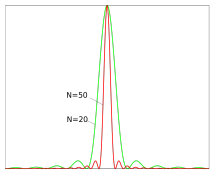
A diffraction grating is an optical component with many closely spaced slits that diffract light. When monochromatic light passes through a diffraction grating, the interference pattern becomes sharper and brighter compared to that produced by a double-slit.
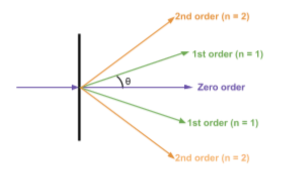
- Zero Order Line: The central bright fringe, aligned with the original light direction.
- First Order Lines: The first set of bright fringes on either side of the zero-order line.
- Higher Order Lines: Additional bright fringes further out, where the path difference equals multiples of the wavelength.
Diffraction Grating Formula:
where:
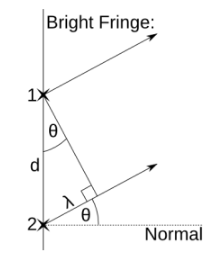
- is the distance between slits,
- is the angle from the normal to the maxima,
- is the order of the maximum,
- is the wavelength of the light. This formula is derived from considering the path difference between adjacent rays of light that interfere constructively at each maximum.
Applications of Diffraction Gratings:
- Astronomy: Diffraction gratings are used to analyse absorption spectra from stars, identifying the elements present.
- X-ray Crystallography: X-rays, with wavelengths similar to atomic spacings, produce diffraction patterns when directed at crystals, allowing scientists to study atomic structures.
Note
Key Points
- Diffraction: Waves spread out when passing through gaps or around obstacles.
- Single-Slit Diffraction Pattern: Central bright fringe with alternating dark and bright fringes; influenced by slit width and wavelength.
- White Light Diffraction: Produces a central white maximum with coloured fringes, due to different wavelengths.
- Diffraction Grating: Provides sharper patterns with bright maxima; described by .
- Applications: Spectroscopy in astronomy and X-ray crystallography for studying atomic spacing.