Moments (AQA A-Level Physics): Revision Notes
📚Revision Notes
4.1.2 Moments
Note
Definition of a Moment
A moment is the turning effect of a force around a pivot point or axis. It depends on both the magnitude of the force and its perpendicular distance from the point of rotation. The equation for calculating a moment is:
- Measured in Newton-metres ().
- For example, applying a larger force or increasing the distance from the pivot increases the moment.
Couples and Moments of a Couple
A couple consists of two equal but opposite forces acting in the same plane (called coplanar forces) but along different lines of action, creating a rotational effect without a resultant linear force.
The moment of a couple is calculated by:
Principle of Moments
The principle of moments states:
For an object to be in equilibrium, the sum of clockwise moments about a pivot must equal the sum of anticlockwise moments.
This principle can be used to solve for unknown forces or distances in equilibrium situations.
Note
Example Problem Using the Principle of Moments
Given a beam in equilibrium, supported at two points with forces acting at different distances:
- Identify the pivot and take moments around it.
- Set the sum of clockwise moments equal to the sum of anticlockwise moments.
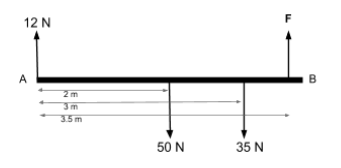
Example Calculation:
For the beam below, find :
- Clockwise Moments = Anticlockwise Moments
- Given:
- ,
- force at ,
- Unknown at from the pivot .
Centre of Mass
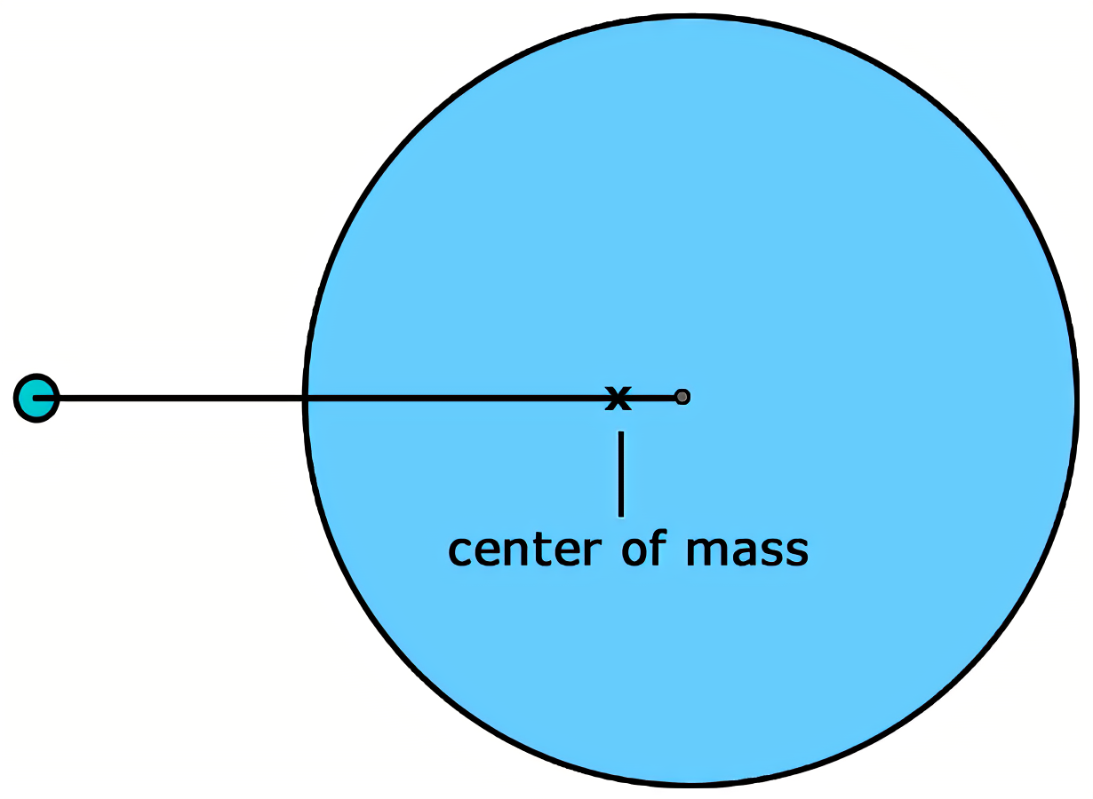
The centre of mass of an object is the point where its entire mass appears to act. For a uniform object (symmetrically distributed mass), the centre of mass lies at its geometric centre.
Note
Key Points
- Moment: Calculated by force and perpendicular distance to the pivot; a measure of the force's turning effect.
- Couple: Pair of equal, opposite forces producing rotation without translation.
- Principle of Moments: For equilibrium, the total clockwise moments must equal the total anticlockwise moments.
- Centre of Mass: The point at which an object's mass is effectively concentrated, crucial for balance and stability.