Work, energy, and power (AQA A-Level Physics): Revision Notes
📚Revision Notes
4.1.7 Work, energy, and power
Work Done (W)
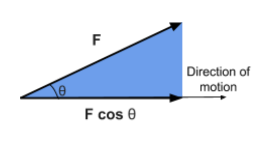
Work done is defined as the force causing an object to move, multiplied by the distance that the object travels in the direction of the force. The formula for calculating work done is:
Where:
- is the force applied in newtons, .
- is the distance travelled by the object (in metres, ).
- is the angle between the direction of the force and the direction of motion.
Example
Example: If a force of N is applied at an angle of to move an object m, the work done can be calculated as:
Power (P)
Power is the rate at which work is done or energy is transferred. It is calculated as:
Where:
- is the work done.
- is the time taken.
- is the velocity of the object (only used if force and motion are in the same direction).
Example
Example: If a machine does of work in seconds, the power output is:
Force-Displacement Graphs
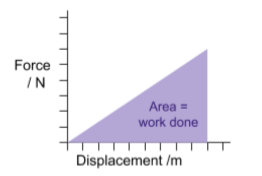
When the force applied to an object varies over the distance travelled, we cannot use the straightforward formula. Instead, the work done is represented by the area under a force-displacement graph.
Efficiency
Efficiency measures how effectively a system converts input energy into useful output energy. It is calculated by dividing the useful output power by the total input power.
Efficiency is often expressed as a percentage.
Example: If a motor has an input power of W and outputs W of useful work, its efficiency is: