Circuits (AQA A-Level Physics): Revision Notes
📚Revision Notes
5.1.4 Circuits
Note
In electrical circuits, the arrangement of resistors affects the overall resistance of the circuit. There are two common ways to connect resistors: in series and in parallel. Each configuration has its own rule for calculating the total resistance.
1. Series and Parallel Resistors
- Series Connection: The total resistance, , is the sum of the individual resistances.
- Parallel Connection: The reciprocal of the total resistance is the sum of the reciprocals of the individual resistances.
Note
Example Calculation
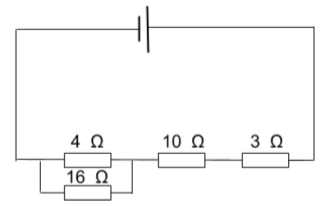
To find the total resistance in a mixed series and parallel circuit:
- Calculate the resistance of the parallel section first:
- Use the series rule to add the resistances:
Therefore, the total resistance is
2. Power and Energy Transfer in Circuits
- Power () is the rate of energy transfer. It is calculated using:
where is the energy transferred, is the potential difference, is the current, and is the resistance.
- Energy Transferred (E):
Note
Example Problem
If a lamp has a power rating of W and operates at V, calculate the energy used in minutes and the current in the lamp.
- Energy Calculation: Convert time to seconds: .
- Current Calculation:
3. Series and Parallel Circuits – Current and Voltage Distribution
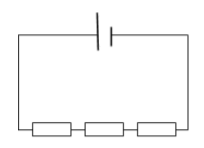
- Series Circuits:
- The current is the same throughout the circuit.
- The total potential difference (p.d.) across the circuit is the sum of the potential differences across each component.
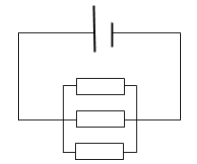
- Parallel Circuits:
- The total current is the sum of the currents through each branch.
- The potential difference across each branch is the same.
4. Battery Cells in Series and Parallel
- When connected in series, the total voltage is the sum of each cell's voltage.
- When identical cells are connected in parallel, the total voltage remains the same as a single cell's voltage.
5. Kirchhoff's Laws
- Kirchhoff's First Law: The total current flowing into a junction is equal to the total current flowing out. This is based on conservation of charge.
- Kirchhoff's Second Law: In any closed loop within a circuit, the sum of the electromotive forces (e.m.f.s) is equal to the sum of the potential drops. This law follows the conservation of energy.