Composition and Appointments (AQA A-Level Politics): Revision Notes
📚Revision Notes
Composition and Appointments
The UK judiciary comprises all judges in the UK legal system, from magistrates and tribunal members through to the 12 senior justices of the Supreme Court. Understanding how the judiciary is structured and how senior judges are appointed is essential for analysing the role of the courts in UK politics.
The structure of the UK judiciary
The judiciary is not a single unified body. Scotland and Northern Ireland operate under different legal arrangements from England and Wales. However, all three systems share one common feature: the UK Supreme Court, which serves as the highest court of appeal across the United Kingdom.
The Supreme Court comprises 12 justices and is based in Middlesex Guildhall, close to Westminster. It acts as the final court of appeal for all cases in England, Wales and Northern Ireland, and hears appeals from civil cases in Scotland. The Court plays a crucial role in establishing legal precedent by hearing appeals and laying down case law in cases where there is legal uncertainty.
Important
Before October 2009, the UK's highest court of appeal consisted of 12 Law Lords who sat in the Appellate Committee of the House of Lords. This meant they were technically members of both the judiciary and the legislature, which raised serious concerns about the separation of powers.
The hierarchy of courts in England and Wales
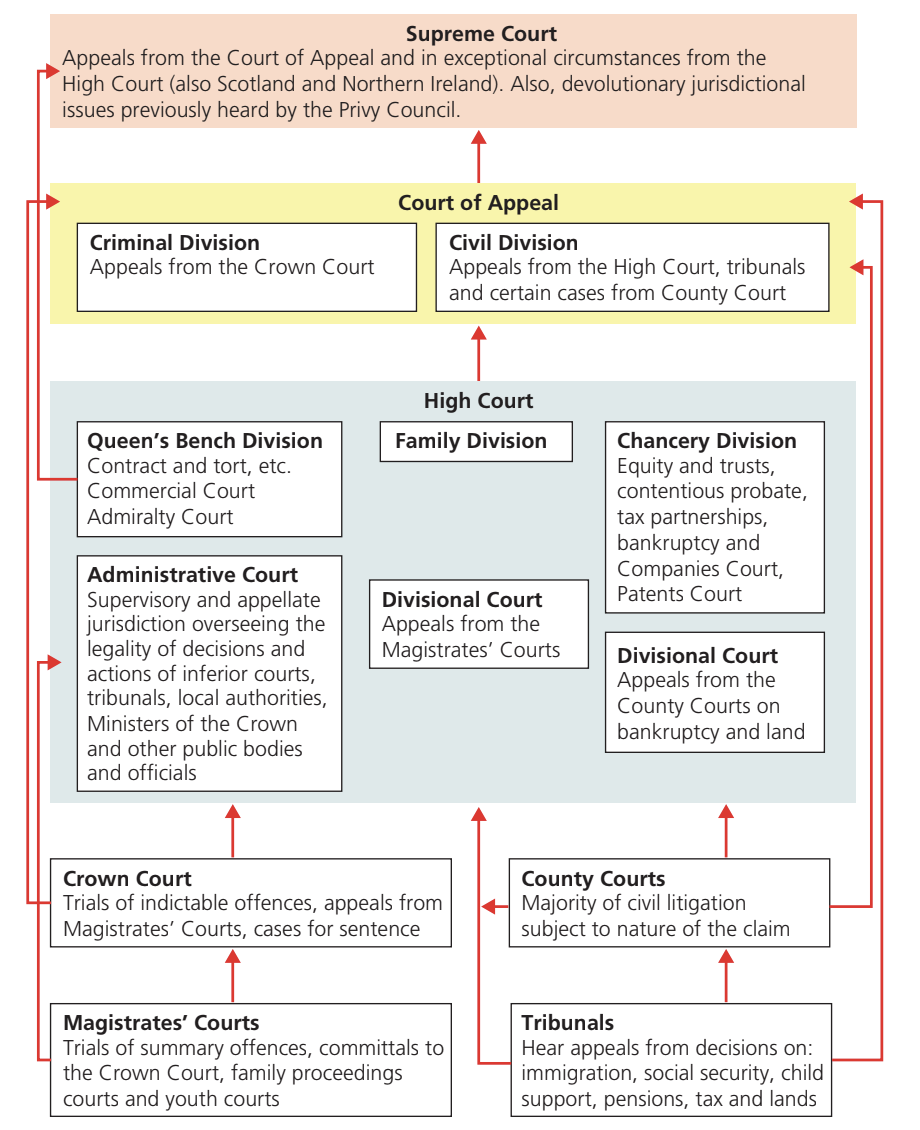
The court system operates hierarchically, with cases moving upwards through different levels depending on the nature of the appeal.
Note
At the base of the system sit Magistrates' Courts (handling summary criminal offences) and Tribunals (dealing with immigration, social security, tax and other administrative matters). Above these are the Crown Court (for serious criminal trials) and County Courts (for civil litigation).
The High Court sits at the next level, divided into three main divisions: Queen's Bench, Family, and Chancery. Each division has specific responsibilities, and some have Divisional Courts to hear appeals from lower courts.
The Court of Appeal, split into Criminal and Civil Divisions, hears appeals from the Crown Court and High Court respectively. Finally, the Supreme Court sits at the apex of this structure.
The senior judiciary
The senior judiciary comprises justices of the Supreme Court, heads of divisions, Lords Justices of Appeal, High Court judges, and deputy High Court judges. This group plays a significant role in the UK political system.
Senior judges exercise the power of judicial review, which allows them to clarify or establish a legal position where statute law is absent or unclear. The decisions they make create case law (sometimes called common law), forming a body of legal precedent that guides both lower courts and future lawmakers. This gives the senior judiciary considerable influence over how laws are interpreted and applied.
Appointments to the senior judiciary
The old system and its problems
Historically, appointments to the senior judiciary were made by the monarch on the advice of the prime minister and the Lord Chancellor. The Lord Chancellor would make selections based on 'secret soundings' with close associates and existing senior judges.
Important
This system faced three major criticisms:
- It lacked transparency, operating behind closed doors
- It undermined the separation of powers by giving politicians direct control over judicial appointments
- It resulted in a senior judiciary drawn almost exclusively from a narrow social circle: public school and Oxbridge educated, white, male, and beyond middle age
These concerns led to the Constitutional Reform Act 2005.
The Constitutional Reform Act 2005
The Constitutional Reform Act 2005 fundamentally reformed judicial appointments. It reduced the power of the Lord Chancellor and placed most senior judicial appointments into the hands of a new, independent Judicial Appointments Commission (JAC). This change aimed to enhance the separation of powers and create a more socially representative senior judiciary.
The Act also provided for the creation of the Supreme Court itself. This would house 12 justices who would discharge the roles previously performed by the Law Lords in the Appellate Committee of the House of Lords.
Note
Exam tip: Be prepared to explain why the JAC was created and what it was intended to achieve. The key points are transparency, separation of powers, and social diversity.
Appointments to the UK Supreme Court
While the JAC handles most senior judicial appointments, the Constitutional Reform Act established a separate, special process for appointing justices to the Supreme Court. This system is more transparent than the old Law Lords appointment process but retains a limited role for the Lord Chancellor.
Qualifications
Candidates for appointment to the Supreme Court must meet strict criteria. They must have either:
- Held high judicial office for at least 2 years, OR
- Been a qualifying practitioner for a period of 15 years
A qualifying practitioner is someone who has a senior courts qualification, is an advocate in Scotland or solicitor entitled to appear in the Scottish Court of Session and High Court of Justiciary, or is a member of the Bar of Northern Ireland or solicitor of the Court of Judicature of Northern Ireland.
The appointment process
The process involves several stages and multiple actors.
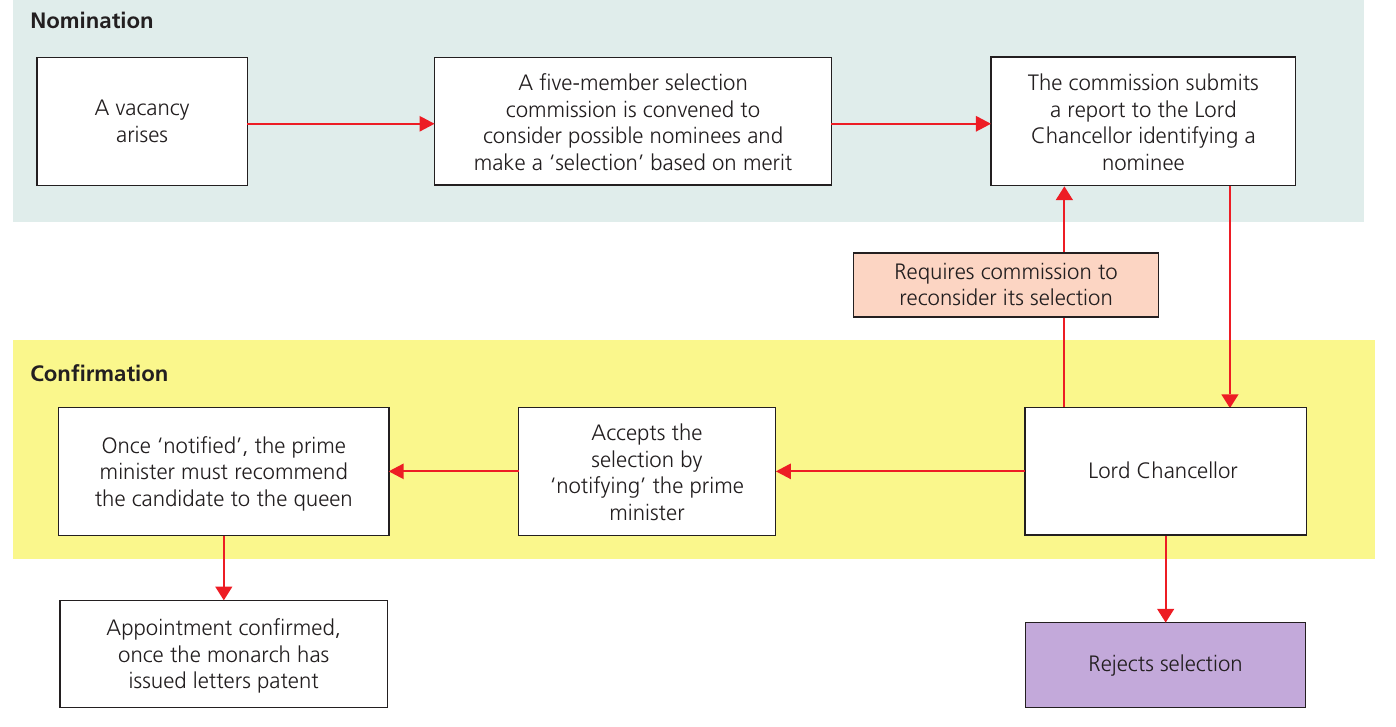
When a vacancy arises, a five-member selection commission convenes to consider possible nominees. The commission makes a selection based on merit and submits a report to the Lord Chancellor identifying a nominee.
The Lord Chancellor then has three options:
- Accept the selection by 'notifying' the prime minister
- Reject the selection outright
- Require the commission to reconsider its selection
If the Lord Chancellor accepts, the prime minister must recommend the candidate to the Queen, who confirms the appointment by issuing letters patent.
Note
Exam tip: This process represents a compromise between full political control and complete independence. The Lord Chancellor retains some influence but cannot simply appoint their preferred candidate.
The composition of the Supreme Court
Despite reforms intended to increase diversity, the Supreme Court's membership continues to face criticism for lacking social representativeness.
Educational background and demographics
As of 20 April 2021, the Court's composition reflected significant disparities compared to the general UK population.
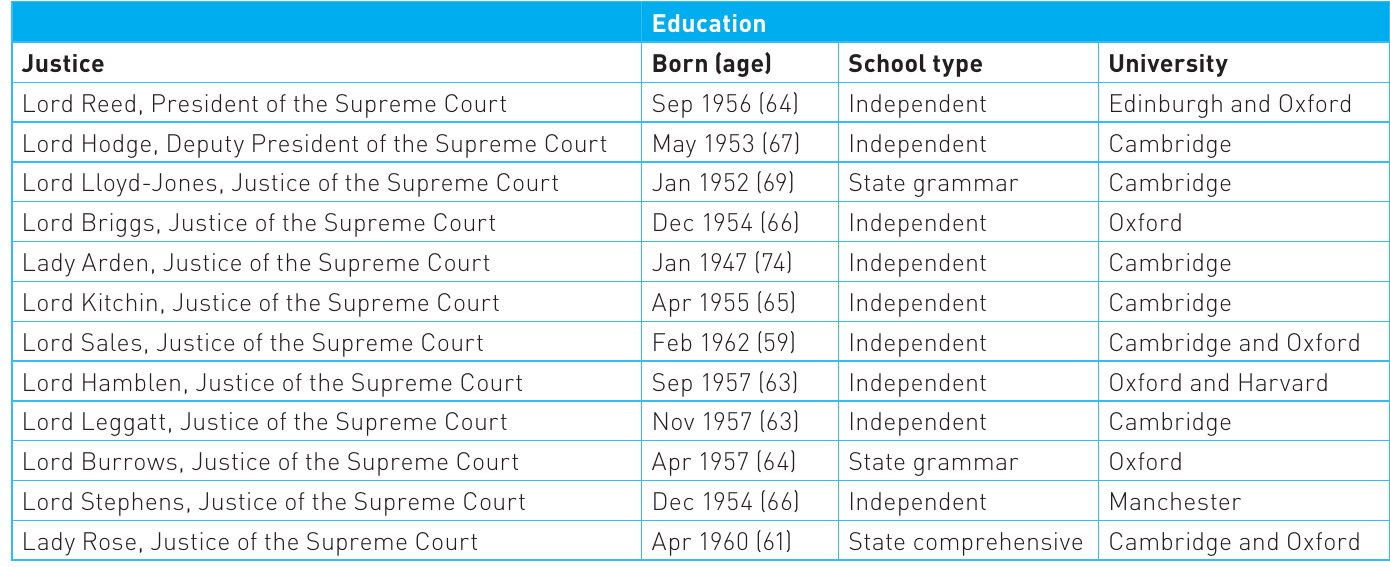
The justices' educational backgrounds show a clear pattern:
- Nine out of 12 (75%) attended independent secondary schools, compared to just 7% of the UK population
- Eleven out of 12 (92%) attended Oxford or Cambridge, compared to 1% of the UK population
- Only one justice (Lord Stephens) attended a university other than Oxbridge
Diversity issues
The Court faces particular challenges regarding gender and ethnic diversity.
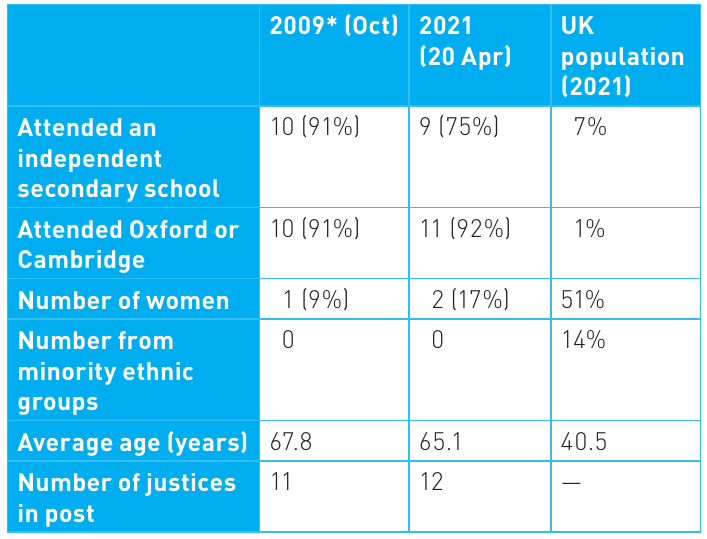
Comparing October 2009 (when the Court opened) with April 2021 reveals some progress but persistent disparities:
Educational background:
- Independent school attendance has decreased from 91% to 75%, but remains far above the 7% national figure
- Oxbridge attendance has actually increased slightly from 91% to 92%, compared to 1% nationally
Gender:
- Female representation has increased from one justice (9%) to two (17%)
- This compares to women comprising 51% of the UK population
- The Court has still never had more than two female justices at any time
Ethnicity:
- No justices from minority ethnic groups have ever served on the Supreme Court
- Minority ethnic groups comprise 14% of the UK population
Age:
- The average age has decreased from 67.8 years to 65.1 years
- This remains significantly higher than the UK average of 40.5 years
Note
Exam tip: When discussing Supreme Court composition, acknowledge both the progress made (fewer independent school attendees, more women) and the persistent gaps (no ethnic minority representation, continued Oxbridge dominance). Be prepared to evaluate whether the appointment process has achieved its aims.
Why does composition matter?
The lack of diversity raises concerns about whether the Court can fully understand the experiences and perspectives of the broader population when making judgements. Critics argue that a more diverse bench would bring different life experiences and viewpoints to legal reasoning, potentially leading to different outcomes in some cases.
Important
However, defenders of the current system point out that:
- The stringent qualification requirements naturally limit the pool of candidates
- Appointments are made on merit, ensuring the highest quality of legal reasoning
- Judges are expected to apply the law impartially regardless of their background
- The situation has improved since 2009 and continues to evolve
Remember!
Summary
Key Points to Remember:
-
The senior judiciary includes Supreme Court justices, heads of divisions, Lords Justices of Appeal, and High Court judges. They establish legal precedent through case law.
-
The Constitutional Reform Act 2005 created the Judicial Appointments Commission (JAC) to make senior judicial appointments more transparent and independent, and established the Supreme Court to replace the Law Lords.
-
Supreme Court justices must have held high judicial office for 2+ years OR been a qualifying practitioner for 15 years. They are selected by a five-member commission, with the Lord Chancellor retaining limited powers to accept, reject, or require reconsideration.
-
The Supreme Court's composition remains heavily weighted towards Oxbridge-educated justices from independent schools. In 2021, 92% attended Oxbridge and 75% attended independent schools, compared to 1% and 7% of the population respectively.
-
Only two of the 12 justices are women (17%), and no justices from minority ethnic groups have ever served on the Supreme Court, raising ongoing concerns about representativeness and diversity.