The Core Executive (AQA A-Level Politics): Revision Notes
📚Revision Notes
The Core Executive
What is the core executive?
The core executive refers to the network at the heart of UK government where policy is made. It's not just the Prime Minister working alone, but rather a complex web of key players and institutions that work together. This network includes:
- The Prime Minister (the head of government)
- The Cabinet (around 20-25 senior ministers who meet weekly)
- Senior civil servants (politically neutral administrators)
- Cabinet committees (smaller groups focusing on specific policy areas)
- The Cabinet Office (which coordinates government work)
Note
What makes the core executive distinctive is that power flows through relationships and interdependence rather than simple top-down command. Each part of this network has its own resources and influence. Political elements change when governments change, but the civil service remains politically neutral and continuous.
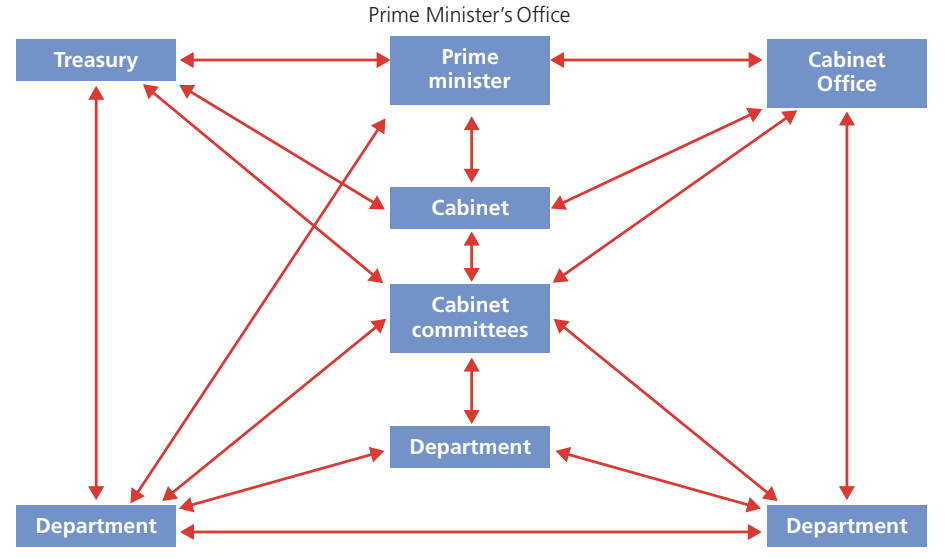
The diagram above shows how these different parts of the core executive connect and interact. Notice how the Prime Minister sits at the centre, but depends on relationships with the Treasury, Cabinet, Cabinet Office, and various departments.
Origins of the Prime Minister role
Unlike the US President, whose role was formally established in a written constitution, the position of Prime Minister emerged over time rather than being deliberately created. This reflects the evolutionary nature of Britain's uncodified constitution.
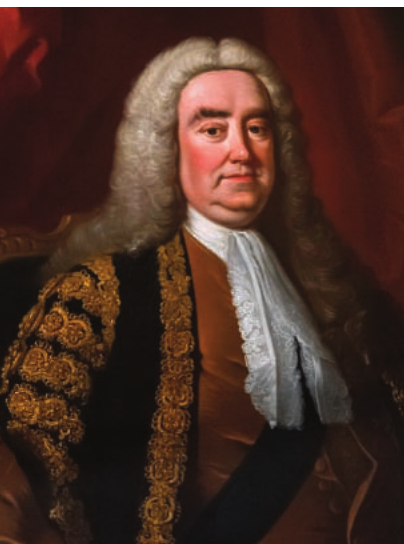
The first widely recognised Prime Minister was Robert Walpole, who served from 1721 to 1742. He was appointed as First Lord of the Treasury, Chancellor of the Exchequer, and Leader of the House of Commons. Interestingly, Walpole left office when he lost a vote of no confidence in Parliament—this early precedent established the principle that the Prime Minister must maintain parliamentary support.
For much of the 18th and 19th centuries, the role developed through convention and custom rather than written rules. It wasn't until 1992 that the Ministerial Code was published, providing the first formal written guide to the Prime Minister's duties and responsibilities.
Important
The Prime Minister role was not deliberately designed but evolved gradually through convention—this is fundamentally different from presidencies like that of the USA, which were formally established in written constitutions.
How is the Prime Minister chosen?
The Prime Minister is not directly elected by voters, unlike the US President. Instead, under the parliamentary system, the PM is the leader of the party that can command a majority in the House of Commons.
Technically, the monarch invites the party leader to form a government, but this is purely ceremonial. By convention, the monarch must choose whoever can maintain majority support in Parliament. When election results are clear-cut, this is straightforward. When they're not, the situation becomes more complex.
Example
Worked Example: The 2017 Election
After the 2017 election, no party won an overall majority. Theresa May, as leader of the largest single party (the Conservatives), was given the first opportunity to form a government. She secured a 'confidence and supply' arrangement with the Democratic Unionist Party (DUP). This meant the DUP agreed to support the government on crucial votes like the budget and confidence motions, though it wasn't a full coalition.
How Prime Ministers leave office
Prime Ministers depart for various reasons:
- Election defeat (most common)
- Resignation due to ill health (e.g., Harold Wilson, 1976)
- Party pressure making their position untenable (e.g., Margaret Thatcher, 1990; Theresa May, 2019)
- Personal choice (e.g., Tony Blair announcing his departure date in advance)
Note
Prime Ministers who take office mid-term (without winning a general election) often lack a personal mandate and may call elections to secure public endorsement. Both Theresa May (2017) and Boris Johnson (2019) did this, though their elections were also driven by Brexit.
Postwar Prime Ministers
| Prime minister | Period | Party | Reason for leaving |
|---|---|---|---|
| Clement Attlee | 1945–51 | Labour | Election defeat |
| Winston Churchill | 1951–55 | Conservative | Ill health and party pressure |
| Anthony Eden | 1955–57 | Conservative | Ill health and Suez Crisis |
| Harold Macmillan | 1957–63 | Conservative | Ill health |
| Alec Douglas-Home | 1963–64 | Conservative | Election defeat |
| Harold Wilson | 1964–70 | Labour | Election defeat |
| Edward Heath | 1970–74 | Conservative | Election defeat |
| Harold Wilson | 1974–76 | Labour | Feared ill health |
| James Callaghan | 1976–79 | Labour | Confidence vote defeat, then election |
| Margaret Thatcher | 1979–90 | Conservative | Failed leadership contest |
| John Major | 1990–97 | Conservative | Election defeat |
| Tony Blair | 1997–2007 | Labour | Party pressure, announced departure |
| Gordon Brown | 2007–10 | Labour | Election defeat |
| David Cameron | 2010–16 | Conservative | EU referendum result |
| Theresa May | 2016–19 | Conservative | Brexit deadlock and party pressure |
| Boris Johnson | 2019–22 | Conservative | Resigned under party pressure |
| Liz Truss | 2022 | Conservative | Resigned after brief tenure |
| Rishi Sunak | 2022–24 | Conservative | Election defeat |
| Keir Starmer | 2024–present | Labour | Incumbent |
Key roles of the core executive
The core executive performs four essential functions in UK government:
Making policy
The executive's primary role is setting political priorities and deciding policy. This happens through Cabinet meetings and Cabinet committees. Once decisions are made, the civil service (the permanent administrative machinery) implements these policies and runs government day-to-day.
The policy-making process is collaborative, involving negotiation between different ministers and departments. However, the Prime Minister plays a crucial coordinating role and can often steer decisions in their preferred direction.
Passing legislation
Although Parliament must approve all laws, major bills originate at Cabinet level. The executive discusses and approves proposed legislation before sending it to Parliament for debate. Most of the time, this process runs smoothly because the Prime Minister's party typically has a Commons majority.
Note
As Brexit demonstrated, this can become problematic and drawn-out when the government lacks a clear majority or faces significant backbench opposition.
Financing decisions
A critical function of the executive—particularly the Chancellor of the Exchequer and the Treasury—is deciding on taxation and government spending. These decisions are announced in the annual Budget.
There's usually intense discussion between ministers and departments about how taxpayers' money should be allocated. Different ministers advocate for their departments' priorities. The Cabinet, overseen by the Prime Minister, often serves as the forum where these competing demands are balanced and final decisions reached.
Being the national first responder
During national emergencies—wars, terrorist attacks, natural disasters, or pandemics—the executive must respond quickly and effectively. This requires:
- Swift coordination between multiple departments
- Clear public communication to inform and reassure citizens
- Emergency measures to address the threat
Example
Example: COVID-19 Pandemic Response
Handling the COVID-19 pandemic required cooperation between Health, Home Office (police), Defence (armed forces), Education, Social Security, and Treasury departments. The Prime Minister's broadcast on 23 March 2020 about the national lockdown was watched by approximately 27 million people, demonstrating the PM's crucial role in crisis communication.
Main powers of the executive
Royal prerogative powers
Many executive powers derive from the royal prerogative—powers once held by the monarch but now exercised by the government. Key prerogative powers include:
- Patronage powers: The Prime Minister can appoint and dismiss ministers without external approval. This is arguably one of the most significant powers, giving the PM substantial control over their government's composition.
- Military deployment: The government can deploy UK armed forces overseas without formal parliamentary approval.
- International relations: The executive conducts diplomacy with other nations and represents the UK internationally.
- Treaty-making: The government can negotiate and ratify international treaties and agreements in areas like trade and defence.
- Civil service organisation: The PM and Cabinet determine the structure and organisation of the civil service.
- Emergency directives: During national crises, the executive can issue statements and guidelines (though these must be backed by legislation to have legal force).
Legislative control
Beyond prerogative powers, the executive's ability to pass its legislative agenda through Parliament is crucial. The executive controls the parliamentary timetable and, with a majority, can usually ensure its bills become law.
Important
All executive decisions must be lawful and covered by legislation. This prevents arbitrary government (characteristic of dictatorships) and maintains the UK as a liberal democracy. For instance, during COVID-19, while Boris Johnson could instruct people to 'stay at home', Parliament had to pass the Coronavirus Act 2020 for these guidelines to be legally enforceable with fines.
How significant are prerogative powers?
There's ongoing debate about the importance of executive prerogative powers:
Arguments for significance
Military deployment: The ability to deploy armed forces overseas without parliamentary approval is clearly significant. The government doesn't formally need Commons approval or additional funding authorisation.
Unlimited ministerial choice: Prime Ministers have free rein over government appointments. Unlike the US President, whose Cabinet nominations require Senate approval, UK Prime Ministers face no similar requirement. They can even appoint ministers from the House of Lords who lack democratic mandates.
Crisis leadership: During emergencies, the executive—especially the Prime Minister—has a direct line to the public through broadcasts, speeches, and social media. This allows them to inform and reassure citizens without parliamentary intermediation.
Treaty negotiation: The executive conducts crucial international negotiations in trade and defence without these normally requiring direct parliamentary approval.
Arguments for limitations
Military convention: By convention, all recent military action overseas has been voted on in the Commons. This includes the Gulf Wars and air strikes on Syria and Iraq. So while the formal power exists, it's rarely used unilaterally.
Cabinet diversity requirements: Prime Ministers are constrained in ministerial choices. They must appoint cabinets with diversity in background and representation from across their party's political spectrum. Theresa May, for instance, had to include both Remainers and Brexiteers. Few cabinet members come from the Lords.
Parliamentary scrutiny of emergencies: The executive must rely on Parliament to pass necessary legislation (e.g., anti-terror laws). The opposition monitors and critiques the government's emergency responses.
Brexit limitations: The Brexit saga revealed clear limits on prerogative powers. A Supreme Court ruling forced the Prime Minister to submit Brexit deals to Parliament for approval. Even in foreign policy and diplomacy, the government is indirectly influenced by Parliament, media, and public opinion.
Note
Exam tip
When evaluating prerogative powers, consider both the formal powers (what the government can theoretically do) and the practical constraints (conventions, parliamentary pressure, public opinion that limit these powers in practice). The strongest answers will analyse specific examples like Brexit or military deployment to support arguments on both sides.
The UK executive in context
The UK executive system differs significantly from other models. In the USA, for example, the president often faces 'divided government', where their party doesn't control both houses of Congress. This creates stalemate and gridlock.
In contrast, the UK executive normally controls Parliament through its Commons majority, making it easier to pass legislation. This fusion of executive and legislative power is a defining feature of the Westminster system. However, as seen during 2017-2019, minority governments or slim majorities can significantly weaken the executive's ability to implement its agenda.
Remember!
Summary
Key Points to Remember:
- The core executive is a network including the PM, Cabinet, civil servants, Cabinet committees, and Cabinet Office—not just the PM alone
- The Prime Minister role emerged from 1721 with Robert Walpole rather than being formally created like the US presidency
- The PM is chosen by the monarch but must be able to command Commons majority—they're not directly elected
- The core executive has four key roles: making policy, passing legislation, financial decisions, and acting as first responder in emergencies
- Prerogative powers (from the royal prerogative) give significant authority over military, appointments, and treaties, but are increasingly limited by convention and parliamentary pressure
- The relationship between executive and Parliament is crucial—the executive typically controls Parliament through party majority, but this isn't guaranteed
- Key term: Primus inter pares (first among equals)—the PM is the most important Cabinet member but governs collectively, not as a dictator