Structure, Role, and Powers (AQA A-Level Politics): Revision Notes
📚Revision Notes
Structure, Role, and Powers
Introduction to Congress
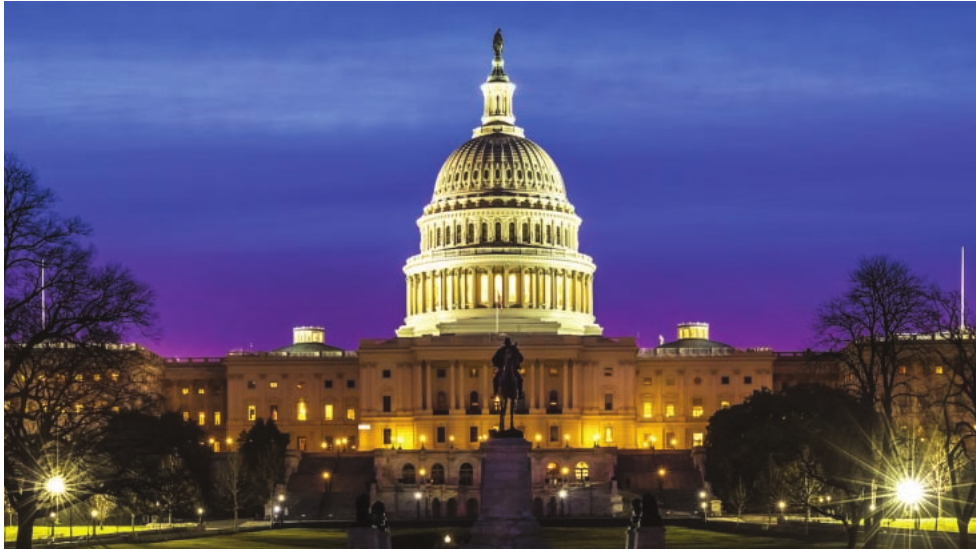
Congress serves as the federal legislature of the United States, holding responsibility for creating laws that apply across all 50 states. The institution is housed in the Capitol building on Capitol Hill in Washington, DC, with this prominent location reflecting its constitutional importance as one of the three branches of government.
As the legislative branch, Congress operates independently from both the executive and judicial branches due to the separation of powers established in the Constitution. This independence allows members of Congress to scrutinise and check the actions of the president and federal government without interference. The USA's federal system means that whilst state legislatures create laws for individual states, Congress creates federal law that supersedes state law where applicable.
Note
The Capitol building serves as a powerful symbol of American democracy, housing both chambers of Congress and representing the people's voice in government. Its central location on Capitol Hill emphasizes the legislative branch's fundamental role in the constitutional framework.
The structure of Congress
The US Congress operates with two separate chambers, known as a bicameral structure. This design emerged from careful compromise during the Constitutional Convention and continues to shape how legislation is created today.
The House of Representatives
The House of Representatives functions as the lower chamber of Congress and contains the larger number of members. There are 435 congress(wo)men (also called representatives) who each represent a specific congressional district within their state. These representatives serve relatively short 2-year terms, meaning they face re-election frequently. All 435 seats in the House are contested simultaneously at each congressional election.
Note
The short 2-year terms in the House ensure that representatives remain closely connected to their constituents' current concerns and priorities. This frequent accountability contrasts with the Senate's longer terms, which allow for more independence from immediate political pressures.
The Senate
The Senate serves as the upper chamber and has 100 members called senators. Each state, regardless of its population size, sends exactly two senators to Congress. Senators serve longer 6-year terms to provide greater stability and independence from short-term political pressures. Congressional elections occur every two years, but only one-third of Senate seats are contested at each election, ensuring continuity in the chamber's membership.
Historical origins: the Connecticut Compromise
The bicameral structure of Congress resulted from intense debate during the Philadelphia Convention in 1787. Smaller states supported the New Jersey Plan, which proposed equal representation for all states regardless of population. This would have protected their interests but would have left citizens in larger states underrepresented. Larger states favoured the Virginia Plan, where representation would be based on population size.
Important
The Connecticut Compromise represents one of the most significant agreements in American constitutional history. This compromise created a two-chamber system where the House of Representatives allocates seats according to each state's population, whilst the Senate provides equal representation by giving every state two senators. This brilliant solution balanced the competing interests of large and small states, making the Constitution's ratification possible.
Distribution of congressional seats
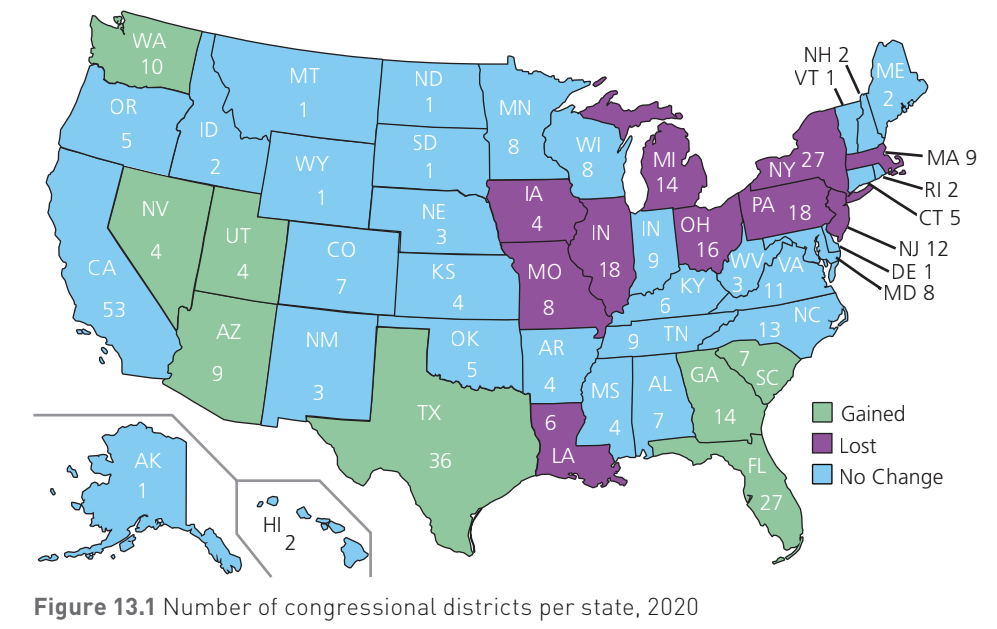
The allocation of House seats varies significantly across states based on population. California, the most populous state with nearly 40 million residents, has 53 representatives in the House. In contrast, seven smaller states qualify for only one representative each, including geographically large states like Alaska and Montana. This distribution is regularly updated following the census, which occurs every ten years, to reflect population changes across the country.
Roles of Congress
Congress fulfils three essential functions within the American political system. Understanding these roles helps explain why Congress possesses such extensive powers and why its actions can significantly affect both domestic and foreign policy.
Passing legislation
As the legislative body of the federal government, Congress bears primary responsibility for creating new laws. Both the House and Senate must approve any bill before it can become federal law. This law-making function represents Congress's most fundamental role and requires careful coordination between the two chambers.
Representing the people
Members of Congress serve as the direct representatives of American citizens. The Constitution begins with the words "We the People", emphasising that governmental power derives from citizens. Representatives and senators must consider and respond to the interests, concerns, and needs of their constituents when making political decisions.
Note
Popular Sovereignty in Action
The phrase "We the People" embodies the principle of popular sovereignty - the idea that all governmental authority ultimately comes from the consent of the governed. This principle requires members of Congress to maintain strong connections with their constituents and remain accountable to the voters who elected them.
Overseeing the executive
Congress possesses various powers that enable it to scrutinise and potentially restrain actions taken by the president and federal government departments. This congressional oversight function serves as a crucial check on executive power, helping prevent any single branch from becoming too powerful.
Powers of Congress
Congress exercises a wide range of constitutional powers that enable it to fulfil its three main roles. These powers can be grouped into several categories.
Legislative powers
Congress holds the exclusive authority to initiate federal legislation. Any proposed law, called a bill, must receive approval from both the House of Representatives and the Senate before proceeding to the president. Once both chambers pass a bill in identical form, it moves to the president who can sign it into law, veto it, or leave it on their desk.
If the president leaves a bill on their desk without signing or vetoing it, the bill automatically becomes law after 10 days. However, if Congress adjourns (ends its session) during those 10 days, the president can use a pocket veto to kill the bill without Congress having the opportunity to override the veto.
Note
The pocket veto represents a powerful but limited tool for presidents. It can only be used at the end of a congressional session when Congress cannot reconvene to override the veto. This timing requirement means presidents must carefully consider when to employ this strategy.
Overriding a presidential veto
When the president vetoes a bill, Congress can choose to amend the legislation, abandon it entirely, or attempt to override the veto. Successfully overriding a presidential veto requires a two-thirds majority in both the House and Senate, making this a challenging threshold to reach. This power ensures that Congress retains ultimate legislative authority whilst still respecting the president's role in the law-making process.
Important
The High Bar for Veto Override
The requirement of a two-thirds majority in both chambers makes veto overrides rare and difficult to achieve. This supermajority threshold (67 votes in the Senate and 290 votes in the House) means that presidential vetoes usually stand unless there is overwhelming bipartisan support for the legislation. Congress must demonstrate strong consensus to successfully challenge the president's judgment.
Initiating constitutional amendments
Congress can propose amendments to the Constitution when it identifies necessary changes to the nation's fundamental law. Any proposed amendment requires a two-thirds majority in both chambers before Congress sends it to the states for ratification. Three-quarters of state legislatures must then approve the amendment before it becomes part of the Constitution.
Ratifying treaties
Whilst the president negotiates international treaties, these agreements cannot take effect without Senate approval. The Senate must ratify (officially approve) treaties with a two-thirds majority vote. This requirement, exclusive to the Senate, ensures that significant international commitments receive careful scrutiny before the USA commits to them.
Note
Treaty ratification is one of several powers that belong exclusively to the Senate, not shared with the House. This reflects the Founding Fathers' vision of the Senate as the more deliberative body responsible for foreign policy matters and long-term national interests.
Declaring war
Both chambers of Congress must vote to approve a formal declaration of war before the USA can officially enter into armed conflict. However, this power has not been used since 1941, as modern presidents tend to avoid seeking formal war declarations. Instead, they often rely on other legal authorisations for military action.
Congressional oversight
Congress must approve all federal budgets, giving it significant control over how the government spends taxpayer money. Additionally, congressional committees conduct investigations and hold hearings to examine the actions and policies of executive branch departments and agencies. This oversight function helps ensure accountability and transparency in government operations.
Note
The Power of the Purse
Congressional control over federal spending, often called "the power of the purse", represents one of the most potent tools for checking executive authority. If Congress disagrees with a president's policies, it can refuse to provide funding, effectively preventing those policies from being implemented regardless of executive desires.
Confirming presidential appointments
The Senate holds the exclusive power to confirm or reject presidential appointments to important positions. All nominees to the federal judiciary, including Supreme Court justices, require Senate confirmation. Many high-level appointments to executive branch departments also need Senate approval before the appointee can assume office. This confirmation process allows Congress to vet candidates and potentially block appointments it considers unsuitable.
Impeachment and removal from office
Impeachment represents Congress's most severe check on other government officials. Only the House of Representatives can impeach (formally charge) a public official with wrongdoing, requiring just a simple majority vote. However, only the Senate can conduct the trial and determine guilt or innocence. A two-thirds majority in the Senate is needed for a guilty verdict, which results in the official's immediate removal from office.
Important
Two-Step Impeachment Process
Impeachment is often misunderstood. The House's vote to impeach does NOT remove an official from office - it only brings formal charges, similar to an indictment in a criminal case. Only the Senate can actually remove someone from office after conducting a trial, and this requires a two-thirds supermajority. This division of responsibilities ensures that no single chamber can unilaterally remove elected officials.
Electoral College contingency
In the rare event that no presidential candidate receives a majority of Electoral College votes (a hung Electoral College), Congress has the power to elect the president and vice president. This power has not been needed since 1824, as the Electoral College typically produces a clear winner.
The legislative process in Congress
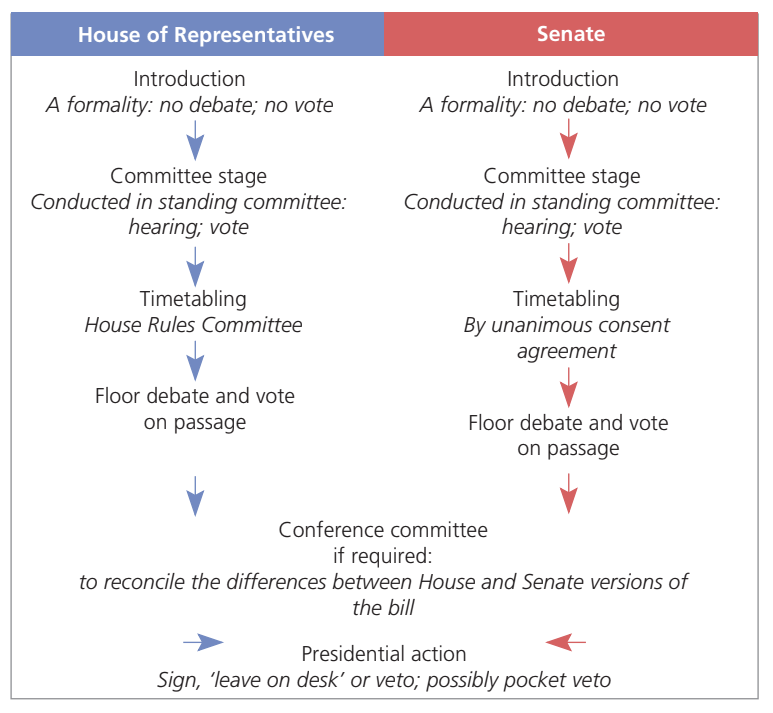
Understanding how a bill becomes law requires examining the multi-stage process that legislation must navigate through both chambers of Congress.
Introduction stage
Bills can originate in either the House or the Senate. The introduction stage serves as a formality where the bill is officially filed, but no debate or vote occurs at this point. The bill is then assigned to the appropriate committee for detailed examination.
Committee stage
The committee stage represents the most critical phase in the legislative process. Bills are sent to standing committees composed of members who possess expertise in the bill's subject area. These committees hold hearings where witnesses provide testimony, and members scrutinise the bill's details. The committee can amend the bill if it wishes and ultimately decides whether to release the bill to the full chamber for consideration.
Important
The Committee Bottleneck
Most bills that fail to become law are rejected during the committee stage, never reaching the main chamber floor. Committees act as gatekeepers, filtering out legislation they consider flawed, unnecessary, or lacking sufficient support. This makes the committee stage the single most important hurdle in the legislative process - if a bill cannot survive committee scrutiny, it has virtually no chance of becoming law.
Timetabling
If a committee releases a bill, it must be scheduled for debate on the chamber floor. The House Rules Committee sets the rules for debate in the House, including whether amendments can be made during floor consideration. The Senate uses a different approach, reaching unanimous consent agreements that establish the terms for debate. These procedural differences reflect the contrasting sizes and traditions of the two chambers.
Floor debate and vote on passage
Once timetabled, the full House or Senate debates the bill. Members can propose amendments during this stage (if the rules permit), and the chamber may modify the bill. After debate concludes, the entire chamber votes on whether to pass the bill.
Conference committee
Because a bill must pass both chambers in identical form, differences between the House and Senate versions must be resolved. A conference committee, made up of members from the relevant standing committees in both chambers, meets to negotiate a single, unified version of the bill. They produce a "conference report" containing the final compromise bill, which must then return to both the House and Senate for approval.
Note
Conference committees demonstrate the importance of compromise in the legislative process. Members from both chambers must work together to reconcile differences, often requiring significant negotiation and mutual concessions. The resulting compromise bill must then satisfy both chambers, adding another layer of difficulty to the already challenging legislative process.
Presidential action
After both chambers approve the final bill, it proceeds to the president. The president has three options: sign the bill into law, veto it, or leave it on their desk (where it becomes law after 10 days unless Congress adjourns, triggering a pocket veto). If the president vetoes the bill, Congress can attempt to override the veto with a two-thirds majority in both chambers.
Composition of Congress
All members of Congress must be elected to their positions and meet specific constitutional requirements related to age, citizenship, and residency.
Age requirements
The Constitution establishes minimum age requirements that vary between the chambers. Representatives in the House must be at least 25 years old, whilst senators must be at least 30 years old. These age minimums reflect the Founding Fathers' belief that senators should possess greater maturity and experience.
Citizenship requirements
Congress members must have been US citizens for a specified minimum period. Representatives need at least seven years of citizenship, whilst senators require at least nine years. These requirements ensure that members have sufficient experience with American society and governance before serving in Congress.
Residency requirements
Both senators and representatives must reside in the state they represent. This requirement ensures that members of Congress have direct knowledge of and connection to their constituents' concerns and interests.
Note
Constitutional Eligibility at a Glance
The differing requirements between House and Senate members reflect the Founding Fathers' vision of each chamber's role. The lower age and shorter citizenship period for House members acknowledges their closer connection to the people and more frequent elections, whilst senators' stricter requirements reflect their longer terms and greater independence.
Remember!
Summary
Key Points to Remember:
-
Congress is the federal legislature with two chambers: the House of Representatives (435 members, 2-year terms) and the Senate (100 members, 6-year terms).
-
The bicameral structure resulted from the Connecticut Compromise, balancing population-based representation in the House with equal state representation in the Senate.
-
Congress has three main roles: passing legislation, representing the people, and overseeing the executive.
-
Key congressional powers include creating laws, overriding presidential vetoes (with two-thirds majorities), ratifying treaties (Senate only), declaring war, conducting oversight, confirming appointments (Senate only), and impeachment.
-
The committee stage is the most important part of the legislative process, where most bills that fail to become law are rejected.
-
Both chambers must pass identical versions of a bill before it proceeds to the president, often requiring a conference committee to resolve differences.