The US Constitution (AQA A-Level Politics): Revision Notes
📚Revision Notes
The US Constitution
Origins of the US Constitution
After the American Revolution, the newly independent states needed a system of government. Their first attempt was the Articles of Confederation, which created a loose alliance of 13 states with minimal central authority and no president. Each colony had fought hard for independence and was reluctant to surrender power to a distant central government.
However, this arrangement quickly proved unworkable. Events such as Shays' Rebellion in 1787 exposed critical weaknesses. This armed uprising consisted of former Revolutionary War soldiers who had become farmers and opposed Massachusetts' harsh economic policies.
Important
The rebellion highlighted a fundamental tension: how to balance individual freedom and the right to resist with the need for stability and effective government. This tension would become a central concern in drafting the new Constitution.
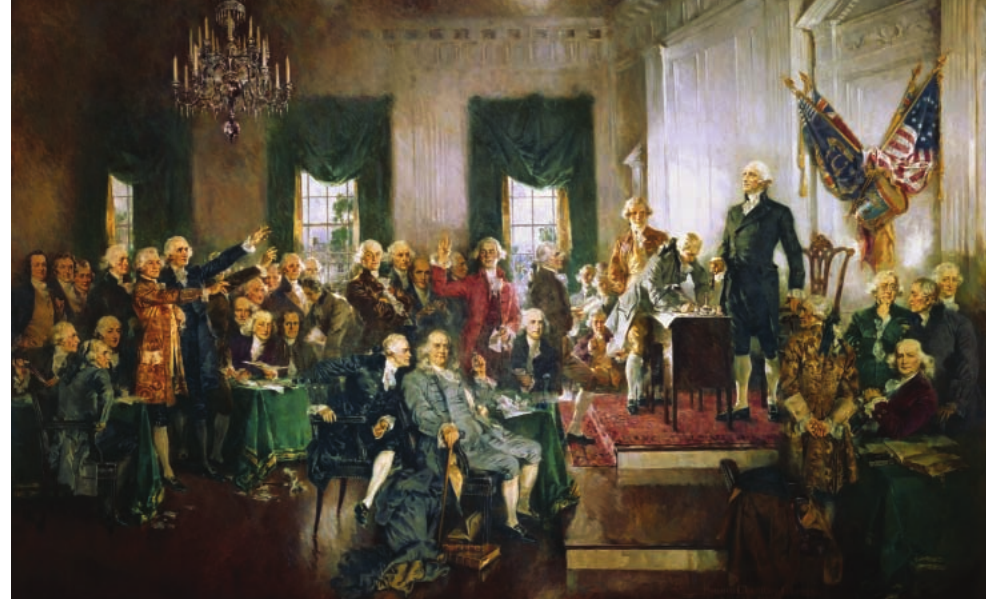
The solution was the Constitutional Convention, held in Philadelphia from May to September 1787. Fifty-five delegates, known as the Founding Fathers, gathered to draft a new constitution. Key figures included George Washington, Alexander Hamilton and Thomas Jefferson. The document required ratification by nine of the 13 states before it could take effect, which was achieved in June 1788 when New Hampshire became the ninth state to ratify.
Key features of the US Constitution
The US Constitution is the document containing the fundamental rules and framework for America's government. Although drafted in 1787, it has been amended 27 times, making today's version longer than the original.
Creating a constitution for the new nation involved heated debates and compromises. The final document contained several important and enduring features:
Representative government, not democracy
The original Constitution did not promote universal suffrage or direct democracy. There were no requirements for secret ballots or one person, one vote. The only reference to elections stated that the timing and manner of holding elections for senators and representatives would be decided by each state legislature.
Note
The president was (and still is) elected indirectly through an Electoral College, not by direct popular vote. Originally, senators were also chosen indirectly by state legislatures, though this changed in 1913 with the Seventeenth Amendment, which introduced direct election of senators.
Fear of mass democracy
Many Founding Fathers were sceptical of direct democracy. Alexander Hamilton questioned whether a democratic assembly that regularly changed with public opinion could steadily pursue the common good. He believed only a permanent body—the Constitution itself—could check what he called "the imprudence of democracy."
A product of its time
The Constitution reflected the perspectives and prejudices of its authors. All the Founding Fathers were white, Christian males. Nearly all owned slaves and most owned land.
Important
There was no intention to fundamentally shift power away from the wealthy elite who controlled the new nation. Understanding this historical context is essential for interpreting the Constitution's original provisions and limitations.
Silence on slavery
Slavery was integral to the economy and society of several states, particularly in the South, where enslaved African-Americans were forced to work on cotton and tobacco plantations. The Constitution remained diplomatically silent on slavery, avoiding direct mention of this controversial institution.
An important related provision was the three-fifths clause. This was not designed to grant enslaved people voting rights. Instead, it was solely used for calculating representation in the House of Representatives—enslaved people would count as three-fifths of a free person. This clause was later repealed by the Fourteenth Amendment in 1868.
Framework, not rights
The original Constitution focused on governmental structure and processes, not individual rights. Personal freedoms first appeared in 1791 with the first ten amendments, collectively known as the Bill of Rights. These amendments protect civil liberties such as freedom of speech and religion from government interference.
Note
It is important to note that the famous words "We hold these truths to be self-evident, that all men are created equal" do not appear in the Constitution. They come from the 1776 Declaration of Independence.
Order of the articles
The sequence of articles was deliberate. Congress appears first, suggesting it was considered the principal institution. The president comes second and was envisaged more as a troubleshooter, international representative and focus for unity than as a dominant authority figure.
Note
Having escaped monarchical "tyranny," the Founding Fathers had no desire to create an American version of a king. This explains why the president's powers were carefully limited and balanced against other branches.
The Supreme Court appears last, with its role lacking specific detail. The Constitution specified no requirements for judges regarding age, number or nationality. There was no mention of judicial review or the Court's role in interpreting the Constitution.
Built on compromise
The Constitution resolved several major disputes through compromise:
The Connecticut Compromise addressed tensions between small and large states, each fearing domination by the other. The solution created a bicameral legislature:
- The upper chamber (Senate) would have equal representation from every state
- The lower chamber (House of Representatives) would have representation based on population size
There was also compromise between Founding Fathers like Hamilton, who favoured strong central government, and those like Jefferson, who wanted most power to remain with individual states.
Based on negotiation and cooperation
The Constitution assumed that political relations, especially between the executive and legislature, would centre on negotiation and cooperation rather than confrontation and competition.
Fear of power and limited government
The framers accepted that governmental power was necessary for national prosperity, but they also feared its dangers. Thomas Jefferson wrote that good governance came "not by the consolidation or concentration of powers, but by their distribution."
Limited government was a fundamental principle. Power was separated and shared between states and the federal government, and divided among different federal institutions.
Important
The balance between individual rights and governmental authority, and between federal and state power, was carefully calibrated. Unlike the British Constitution, the US version was codified—written down in a single document.
Vague and specific elements
The Constitution contains both vague language and precise details. Some powers are only outlined broadly. These are called implied powers—powers of federal government that are suggested by, or read into, its roles and responsibilities.
Example
Implied Powers in Practice
For example, Congress received the power to "provide for the common defence and general welfare of the United States," but what does this mean in practice?
This vague language has been interpreted to justify:
- Military conscription during times of war
- Social welfare programmes
- A national healthcare programme
- Federal disaster relief
The broad nature of this clause allows the government to adapt to changing circumstances and needs.
In contrast, the Constitution is remarkably specific in places. It sets minimum ages for the president (35), senators (30) and House members (25). It grants Congress the power to "coin money" and makes the president commander-in-chief. These clearly stated powers are called enumerated (or delegated) powers.
Note
According to scholar Anthony Bennett, the Constitution is a "blend of specificity and vagueness." This combination allows it to be enduring and long-lasting, not easily changed or overturned. The formal amendment process is deliberately complex and requires high thresholds for approval.
A focus of loyalty
Despite deep political polarisation and disagreements over constitutional interpretation, the Constitution itself serves as a focal point of loyalty and attachment for most Americans.
Sovereign authority
Finally, and perhaps most crucially, the Constitution is sovereign—the ultimate source of authority.
Important
Article VI declares: "This constitution...shall be the supreme Law of the Land." Neither the president nor Congress can override its provisions. This principle of constitutional supremacy remains fundamental to American government today.
Remember!
Summary
Key Points to Remember:
- The US Constitution replaced the failed Articles of Confederation following the Constitutional Convention in 1787
- It emphasised representative government over direct democracy, with indirect election of the president through the Electoral College
- The Constitution was a series of compromises between large and small states, and between advocates of strong central government and states' rights
- It established limited government with power separated between federal and state levels, and divided among federal institutions
- The Constitution blends vagueness (implied powers) and specificity (enumerated powers), allowing it to adapt whilst maintaining core principles
- The Bill of Rights (1791) added protections for individual liberties, which were absent from the original document
- The Constitution is sovereign—the supreme law of the land that no institution can override