US Election Campaigns (AQA A-Level Politics): Revision Notes
📚Revision Notes
US Election Campaigns
US election campaigns are distinctive for their intensity, cost and strategic complexity. Understanding how campaigns operate is essential for analysing American democracy and electoral outcomes. This note explores the key characteristics that define US election campaigns, from their constant nature to their focus on individual candidates and swing states.
Main characteristics of American election campaigns
US election campaigns possess several distinctive features that set them apart from elections in other democracies:
- Regularity and constant campaigning – elections occur frequently with little downtime between campaigns
- Emphasis on individual candidates rather than political parties
- Focus on mobilising supporters rather than persuading undecided voters
- Concentration on swing states in presidential elections and early-voting states in primaries
- Enormous expense affecting not just presidential races but congressional and state elections too
- Midterm elections and the absence of term limits for most elected offices
Note
These characteristics create a unique political environment that shapes how democracy functions in America. Unlike many other democracies where campaigns are shorter, cheaper, and more party-focused, the US system places extraordinary demands on candidates and creates distinct patterns of political behaviour.
Frequency and constant campaigning
American politics operates in a state of perpetual campaign mode. Presidential candidates typically begin their campaigns immediately after the midterm elections (held two years into a president's term). This period marks the start of the invisible primaries, when potential candidates build name recognition, raise funds and secure endorsements before formal primary elections begin.
Presidents seeking re-election remain acutely aware of how their policy decisions might affect their electoral prospects. During the COVID-19 crisis, President Trump's reluctance to support a national lockdown and his emphasis on reopening the economy were widely interpreted as motivated by concerns about re-election. Economic performance traditionally plays a crucial role in determining re-election outcomes, and Trump had consistently highlighted economic growth during his presidency.
Important
This constant campaign cycle creates a political environment where elected officials must balance governing with electioneering, often leading to policy decisions influenced by electoral calculations rather than purely governing considerations. This can result in short-term thinking and policies designed more for electoral appeal than long-term effectiveness.
Individuality over party
US campaigns place far greater emphasis on individual candidates than on political party affiliation. Many campaign materials deliberately avoid mentioning party labels, reflecting a culture of "rugged individualism" in American politics.
Unlike in many other democracies, prospective candidates in the USA do not apply to a party for selection. Instead, they must act as "self-starters" by:
- Building their own campaign teams
- Securing nomination signatures to appear on ballots
- Raising campaign funds independently
- Creating their own publicity materials
- Developing social media presence
- Purchasing advertising space on television and online platforms
Whilst state and national party organisations can channel financial support and help secure endorsements from prominent party figures, candidates ultimately succeed or fail based on their individual appeal and campaign skills.
Example
Worked Example: Trump's Individualistic Campaign Strategy
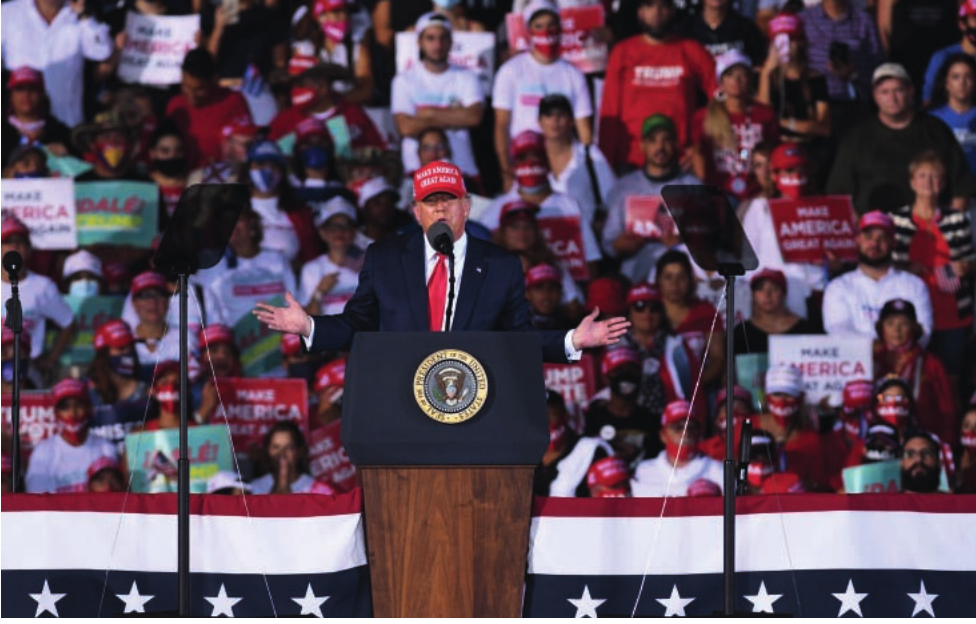
Trump's 2016 victory exemplifies this individualistic approach. Despite never holding elected office and facing strong opposition from the Republican establishment, Trump succeeded through his personal profile, business reputation and campaign messaging.
His slogans – "Build that wall", "Lock her up" and "Make America Great Again" – were deeply personal rather than party-focused. His victory demonstrated that with sufficient money, public profile and campaigning ability, political outsiders can win the presidency.
Congressional and state election campaigns similarly emphasise personal qualities, including:
- Military service (conveying duty and patriotism)
- Professional success (demonstrating ability and experience)
- Family and faith (signalling integrity, commitment and values)
- Government achievements for incumbents seeking re-election
These campaigns create powerful personal brands that often transcend party identification, allowing candidates to build coalitions of support based on individual appeal rather than party loyalty.
Getting the 'right' people to turn out and vote
Modern US campaigns prioritise voter mobilisation over persuasion. Rather than attempting to change voters' minds, campaigns focus on ensuring their core supporters actually cast ballots.
Most candidates have strong appeal among specific demographic groups – white evangelicals, African-Americans, college students, single female graduates, and so forth. Although many Americans identify as independents, most lean towards one party or the other. Consequently, campaigns invest heavily in "Get Out the Vote" (GOTV) operations targeting their likely supporters.
Examples of mobilisation strategies
In 2004, Republicans promoted state ballot measures banning same-sex marriage, deliberately designed to incentivise white conservative evangelicals to vote, thereby supporting President George W. Bush's re-election bid.
However, mobilisation efforts can have a darker side. Some campaigns have attempted to suppress voter turnout among groups likely to support their opponents. Republicans, recognising that African-Americans overwhelmingly vote Democrat, have sometimes supported measures that make voting more difficult for this community.
Important
Voter Suppression: A Critical Challenge to Democratic Access
Voter suppression tactics have included:
- Stricter voter ID requirements
- Reduced enthusiasm for postal voting (which benefits younger and lower-paid workers with long hours)
- Purging voters from electoral rolls without notification
In 2017, Indiana passed legislation allowing the state to remove voters from registers without informing them. The courts subsequently overturned this law as it violated the National Voter Registration Act 1993. Proponents justified such restrictions by claiming they prevented voter fraud, whilst opponents argued they constituted deliberate voter suppression.
Following the 2020 election, President Trump alleged widespread voter fraud, claiming: "If you count the legal votes, I easily win. If you count the illegal votes, they can try to steal the election from us." Subsequent investigations found no credible evidence supporting these allegations.

Note
Exam tip: When discussing campaign strategies, always consider both legitimate mobilisation efforts and controversial suppression tactics. Analyse how these approaches reflect deeper tensions in American democracy about voter access and electoral integrity.
The swing movement
The Electoral College system fundamentally shapes presidential campaign strategy. Rather than campaigning uniformly across the entire nation, candidates concentrate resources on swing states (also called battleground states) – those where either party could realistically win.
Focus on swing states
Safe states like California (reliably Democrat) or Texas (reliably Republican) receive minimal campaign attention relative to their size and number of Electoral College votes. Instead, campaigns pour money and time into competitive states including Florida, Ohio, Pennsylvania, Michigan, Wisconsin and North Carolina.
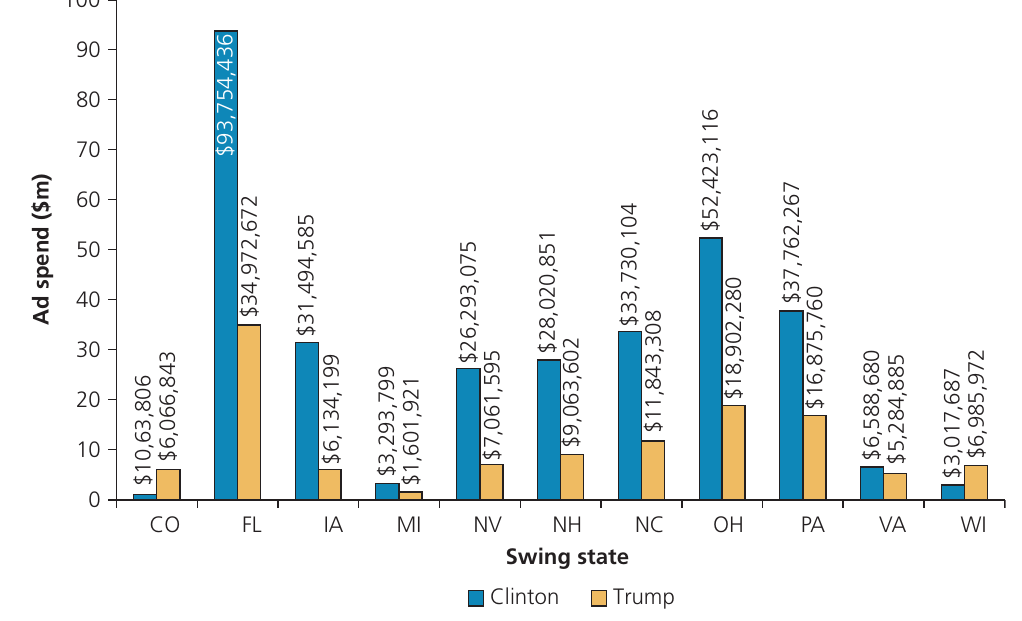
The 2016 election data reveals this strategic concentration. Hillary Clinton's campaign spent $93.75 million on advertising in Florida alone, vastly more than in any safe state. Across eleven swing states, both campaigns invested enormous sums, with Clinton generally outspending Trump.
Campaign visits demonstrate the same pattern. During the 2016 presidential race, two-thirds (273 of 399) of campaign events occurred in just six states: Florida, Michigan, North Carolina, Ohio, Pennsylvania and Virginia. The 2020 election, though affected by the COVID-19 pandemic which reduced in-person events, followed a similar pattern.
Pennsylvania received the most campaign visits in 2020 with 47, followed by Florida (31), North Carolina (25), Michigan (21) and Wisconsin (18). Meanwhile, large states like California and New York, which were not competitive, received virtually no visits despite their substantial populations and Electoral College votes.
Note
Exam tip: The concentration of campaigns in swing states raises important questions about democratic representation. Consider how this system effectively makes some voters' participation more valuable than others, and evaluate arguments for reforming or abolishing the Electoral College.
Primary campaign focus
During the primary season, campaigns concentrate on states voting early in the nomination process. Iowa, New Hampshire, Nevada and South Carolina receive disproportionate attention because early victories build momentum – generating media coverage, attracting donations and securing additional endorsements.
Success in early states often proves decisive. Strong performances can propel relatively unknown candidates into frontrunner status, whilst poor results force marginal candidates to withdraw. During the 2020 Democrat primaries, four contenders withdrew after just the first two contests: Deval Patrick, Andrew Yang, Michael Bennet and Tom Steyer.
Super Tuesday, when numerous states hold primaries simultaneously, represents a crucial moment in the nomination calendar. Candidates who have built momentum through early victories typically consolidate their positions on Super Tuesday, whilst those who have struggled often face insurmountable obstacles.
Caucuses – informal meetings of party supporters at local level – play a smaller but still significant role in some states. Iowa's caucuses traditionally open the nomination season, attracting enormous candidate attention despite the state's relatively small population and number of delegates.
'Money, money, money'
The enormous cost of US elections represents one of the system's most troubling aspects. Campaign spending has increased dramatically over recent decades, reaching extraordinary levels.
Scale of campaign spending
The 2020 elections cost approximately $14 billion in total. Over $7 billion went towards Senate and House races alone. Presidential campaigns involve equally staggering sums. During the 2020 Democrat primaries, Bernie Sanders raised $46 million in February 2020 alone, from 2.2 million separate donations, demonstrating that ordinary Americans (not just wealthy individuals) contribute to campaigns.
Does money guarantee victory?
Whilst money cannot guarantee electoral success – Clinton substantially outspent Trump in 2016 yet lost – lack of funds creates severe disadvantages. Candidates without sufficient resources struggle to:
- Run effective nationwide campaigns
- Purchase television and online advertising
- Build comprehensive ground operations
- Hire experienced campaign staff
- Conduct polling and opposition research
Note
Several factors explain these high costs:
- Geographical size: The USA's vast territory requires expensive travel and advertising across multiple media markets
- Weak campaign finance laws: The absence of effective spending limits allows costs to spiral
- Long campaign seasons: Prolonged campaigns consume more resources
- Multiple election levels: Candidates must campaign for primaries and general elections
Note
Exam tip: Campaign finance raises important questions about democratic equality. Consider whether unlimited spending gives wealthy candidates and donors disproportionate influence, and evaluate arguments for and against stricter campaign finance regulations.
Midterm blues without limits
Midterm elections occur every four years, halfway through a president's term. They serve as important referendums on presidential performance and typically result in losses for the governing party.
Patterns in midterm results
Most presidents see their party lose congressional seats during midterms (though George W. Bush proved an exception following the 9/11 terrorist attacks). Several factors explain this pattern:
- Disappointment with unfulfilled promises: Presidents make ambitious pledges during elections that prove difficult to implement
- Lower turnout: Midterms typically attract fewer voters than presidential elections
- Protest votes: Midterms allow voters to express dissatisfaction with the president without removing them from office
- No presidential coattails: Without a presidential race driving turnout, the president's party loses the mobilising effect of their candidate
Midterm losses often prove consequential. Presidents frequently lose control of one or both houses of Congress, making it much harder to pass legislation. Barack Obama lost the House in 2010 and the Senate in 2014, rendering him a "lame duck" president for his final two years. Donald Trump lost the House in 2018, enabling Democrats to launch impeachment proceedings and investigations into his administration.
The absence of term limits
Unlike presidents (limited to two terms), senators and House representatives face no term limits. Many members of Congress serve for decades, building strong local bases, effective campaign teams and name recognition that makes them difficult to defeat.
This creates a political class of long-serving legislators who become adept at securing re-election through:
- Incumbency advantages: Name recognition, proven track records and media coverage
- Pork-barrelling: Delivering federal projects and spending to their districts or states
- Constituent services: Helping voters navigate federal bureaucracy
- Fundraising networks: Established donor relationships built over many years
Important
Incumbency provides powerful electoral advantages. Challengers must overcome the incumbent's established presence, which helps explain why most members of Congress who seek re-election succeed.
Case study: the 2018 midterms
The 2018 midterm elections provided a verdict on President Trump's first two years in office and offered Democrats an opportunity to check his power.
Results and patterns
The outcomes proved mixed for both parties:
House of Representatives: Democrats captured 40 districts from Republicans, gaining control of the chamber. Particularly strong gains occurred in:
- California (seven districts flipped Democrat)
- Virginia (three districts flipped Democrat)
- Suburban districts that traditionally voted Republican, including Georgia's 6th District
Senate: Despite their House success, Democrats lost ground in the Senate, conceding two seats and allowing Republicans to expand their majority from two to six.
Interpreting the results
One poll found that 34% of voters nationwide viewed their midterm vote as opposing Trump, compared with 26% who considered it supporting him. This suggests the elections functioned partly as a referendum on his presidency.
However, the Senate results require careful interpretation. The Democrats defended 26 of the 35 seats contested (including ten in states Trump won in 2016), whilst Republicans defended only nine. Given this unfavourable map, losing just two seats represented a reasonable outcome for Democrats.
Example
Demonstration: Individual Appeal Over Party
The results also highlighted the continuing importance of individual candidates over party affiliation. West Virginia, the most pro-Trump state in 2016, re-elected Democrat Senator Joe Manchin. His personal appeal and moderate positions allowed him to transcend party identification.
Future implications
The 2018 results revealed emerging challenges for Republicans in previously safe states. Ted Cruz narrowly won in Texas (once considered uncompetitive), whilst Arizona elected Kyrsten Sinema, its first Democrat senator since 1995. These shifts reflected changing demographics that could reshape future elections.
Turnout and engagement
Approximately 49% of eligible voters participated in 2018, substantially higher than the 37% who voted in 2014. This increased engagement may reflect the "Trump effect" – many Democrats appeared especially motivated to vote and "send a message to the White House".
Consequences of divided government
Gaining House control proved significant for Democrats. It enabled them to:
- Launch impeachment proceedings against President Trump
- Investigate areas of his administration, including Transportation Secretary Elaine Chao's alleged abuse of office
- Block or modify Trump's legislative agenda
- Issue subpoenas and conduct oversight hearings
This created divided government, where the president's party controls one chamber whilst the opposition controls the other. Divided government typically leads to legislative gridlock, making it difficult for either party to pass major legislation.
Note
Exam tip: When analysing midterm elections, consider how they reflect public opinion on the president, how structural factors (like which seats are being contested) affect outcomes, and what consequences divided government creates for policymaking and governance.
Summary
Key Points to Remember
Key characteristics of US election campaigns:
-
Constant campaigning – Presidential campaigns begin immediately after midterms; elected officials always consider re-election prospects when making policy decisions
-
Individual focus – Candidates succeed based on personal appeal, campaign skills and fundraising ability rather than party support; Trump's 2016 victory exemplified how outsiders can win through individual brand and resources
-
Mobilisation over persuasion – Campaigns prioritise getting core supporters to vote rather than changing minds; this includes both legitimate GOTV efforts and controversial voter suppression tactics
-
Swing state concentration – The Electoral College system creates massive disparities in campaign attention, with battleground states receiving disproportionate resources whilst safe states are largely ignored
-
Astronomical costs – The 2020 elections cost $14 billion; whilst money doesn't guarantee victory, lack of funds creates severe disadvantages for candidates
-
Midterm consequences – Elections halfway through presidential terms typically result in losses for the governing party and often create divided government, making legislation harder to pass
Important terms to remember: Swing states (battleground states), Get Out the Vote (GOTV), voter suppression, Electoral College, midterm elections, lame duck president, caucuses, invisible primaries, Super Tuesday, momentum, divided government