Voting Behaviour in the USA (AQA A-Level Politics): Revision Notes
📚Revision Notes
Voting Behaviour in the USA
Voting behaviour in the USA refers to the patterns and factors that influence how Americans cast their votes in elections. Understanding these patterns is crucial for analysing election outcomes and predicting future trends. The USA is often described as divided between 'red America' (Republican-leaning) and 'blue America' (Democrat-leaning), reflecting deep political divisions that extend to issues ranging from healthcare to pandemic response.
Main factors affecting voting behaviour
American voting behaviour is shaped by two primary categories of factors: primacy factors and recency factors.
Primacy factors relate to a voter's profile and demographic characteristics. These are the fundamental attributes that tend to predict voting patterns, such as race, gender, religion, wealth, age, political ideology, sexual orientation, and geography. These characteristics often remain relatively stable throughout a person's life and create predictable voting patterns.
Recency factors involve issues, candidates' personalities, and campaign effectiveness. These are more immediate influences that can shift from election to election. A compelling candidate, effective marketing, or salient policy issues can sway voters, particularly those who are less firmly attached to one party.
Note
It's important to note that voters can also cast a negative vote, meaning they vote primarily to prevent the opposing candidate from winning rather than out of enthusiasm for their chosen candidate. For example, in 2016, many white evangelical Christians supported Donald Trump not because he aligned with their values on personal morality, but because he promised to appoint conservative Supreme Court justices and oppose liberal social policies. Their primary motivation was preventing Hillary Clinton from reaching the White House.
Voter profile categories
Race and ethnicity
Race remains one of the strongest predictors of voting behaviour in American politics. African-American voters overwhelmingly support Democratic candidates, with 87% voting for Biden in 2020. This pattern reflects the Democratic Party's historical support for civil rights legislation and policies aimed at racial equality.
Hispanic voters also lean Democratic, with 65% supporting Biden in 2020, though by smaller margins than African-American voters. Asian-American voters similarly favoured Biden, with 61% voting Democratic.
White voters, by contrast, supported Trump with 58% voting Republican in 2020. However, this margin is smaller than the Democratic support among minority groups, and white voting patterns vary significantly based on other factors such as education level, geography, and religion.
Important
Racial Voting Patterns at a Glance:
- African-American voters: 87% Democratic
- Hispanic voters: 65% Democratic
- Asian-American voters: 61% Democratic
- White voters: 58% Republican
Race remains the single strongest demographic predictor of voting behaviour in American elections.
Gender
A clear gender gap exists in American voting behaviour. Women tend to support Democratic candidates more than men do. In 2020, 57% of women voted for Biden, whilst 53% of men voted for Trump. This gender gap has persisted across recent elections and reflects differing priorities and perspectives on issues such as healthcare, education, and social welfare policies.
Religion
Religious affiliation significantly influences voting choices. White evangelical Christians, often referred to as 'born-again' Christians, strongly support Republican candidates. In 2020, 76% of white evangelicals voted for Trump, making them one of the most reliable Republican voting blocs.
Conversely, voters without religious affiliation strongly trend Democratic. In 2020, 65% of non-religious voters supported Biden. This divide reflects broader cultural battles over issues such as abortion, LGBTQ+ rights, and the role of religion in public life.
Wealth and income
Contrary to common assumptions, the relationship between wealth and voting behaviour is more complex than a simple rich-poor divide. Wealthier voters do not overwhelmingly vote Republican, nor do poorer voters strongly trend Democratic across the board. Much depends on race and region.
In 2020, 54% of those earning over `$100,000 per year voted for Trump, whilst 55% of those earning under $`50,000 voted for Biden. These relatively modest margins demonstrate that income alone is not a decisive factor.
Note
Republicans receive substantial support from white voters in some of the poorest states, such as Mississippi and West Virginia. Meanwhile, some of the wealthiest states, such as New Jersey and Maryland, are Democratic strongholds. This paradox reflects the intersection of economic interests with racial, cultural, and regional identities.
Age
Age creates distinct voting patterns, with younger voters largely supporting Democrats whilst older voters lean Republican. In 2020, 60% of voters under 30 voted Democratic, reflecting younger generations' more progressive views on social issues, climate change, and economic inequality.
By contrast, 52% of voters over 65 supported Republican candidates. Older voters tend to be more conservative and may prioritise different policy concerns, such as Medicare, Social Security, and traditional values.
Political ideology
Self-identified political ideology is one of the strongest predictors of voting behaviour. In 2020, 85% of self-described conservatives backed Trump, whilst 89% of liberals supported Biden. This pattern reflects the increasing polarisation of American politics, where voters increasingly sort themselves into ideologically consistent camps.
Sexual orientation
Americans who identify as LGBTQ+ predominantly vote Democratic. In 2020, 64% of LGBTQ+ voters supported Biden. This pattern reflects the Democratic Party's stronger support for LGBTQ+ rights, including marriage equality, anti-discrimination protections, and healthcare access.
Geography
Geography creates stark voting divisions in American politics. Large urban areas with populations over 50,000 are usually Democratic strongholds, with 60% of such voters backing Biden in 2020. Cities tend to be more diverse, younger, and more educated, characteristics that correlate with Democratic support.
Small towns, suburban areas, and rural regions favour Republicans, with 57% of voters in these areas supporting Trump in 2020. These areas tend to be whiter, older, and more culturally conservative, creating natural Republican constituencies.
Realigning elections
Not all elections carry equal significance when studying voting behaviour. The most important are realigning elections, also called critical elections. A realigning election occurs when a particular group of voters shifts allegiance to a different political party or candidate, and these changes prove lasting, setting new patterns in voting behaviour for a significant period afterwards.
The 1932 election
The 1932 presidential election represents the clearest example of a realigning election in modern American history. Before 1932, Republicans had dominated American politics, winning three consecutive presidential elections and achieving a near clean sweep outside the 'Solid South' in 1928.
The Great Depression completely reversed these political fortunes. Republican President Herbert Hoover failed to address the economic crisis effectively or dynamically, responding with 'too little too late'. Meanwhile, the Democrats nominated New York Governor Franklin Delano Roosevelt, who had mobilised his state government much more effectively to combat the Depression's impact.
Example
Worked Example: The 1932 Electoral Shift
1928 Election (Republican dominance):
- Republican margin: over 6 million votes
- Electoral College: 444-87 in favour of Republicans
1932 Election (Democratic landslide):
- Democratic margin: 7 million votes
- Electoral College: 472-59 in favour of Democrats
Result: A complete reversal representing a shift of approximately 13 million votes between the two elections.
Roosevelt built a broad New Deal coalition that combined diverse groups: conservative southern Protestants (Dixiecrats), northern Jews, Catholics and urban African-Americans, labour union members, small farmers in the Midwest and Plains states, and liberals and radicals. This coalition enabled Democrats to dominate American politics until well into the 1960s.
Note
The New Deal Coalition's Impact:
Every president between 1932 and 1968, except Dwight D. Eisenhower (1952-60), was a Democrat. The party also controlled both houses of Congress for nearly this entire period, holding the Senate for all but 4 years between 1932 and 1980.
The southern strategy
The two main political realignments since 1945 have fundamentally reshaped American politics. The first involved the realignment of the conservative white vote in the South away from Democrats and towards Republicans. This Southern strategy is most associated with Republican candidates Barry Goldwater and Richard Nixon and their campaigns in 1964, 1968, and 1972.
The Southern strategy broke up the Democrat 'Solid South' and replaced it with a new Republican 'Solid South'. It targeted conservative white southerners who felt betrayed by the Democratic Party's support for civil rights legislation in the 1960s. Rather than explicitly promising a return to segregation, Republicans emphasised 'states' rights' more generally and adopted a tough line on law and order. Some commentators have characterised these as examples of dog whistle politics – political messaging employing coded language that appears to mean one thing to the general population whilst simultaneously conveying an additional meaning to a targeted group.
Important
President Lyndon B. Johnson, a Democrat who signed major civil rights legislation, reportedly acknowledged that his party had 'signed away the South' for Democrats. This realignment took time to fully develop, beginning in 1964 but not becoming fully evident until the 1972 presidential election. It took even longer to affect congressional elections.
The coastal realignment
The second major realignment involved the switch of western and eastern coastal areas from being competitive for Republicans to becoming Democratic strongholds. Vermont provides a striking example: today it is associated with Bernie Sanders, probably the most liberal (even socialist) member of the Senate, and is a Democratic stronghold. However, from 1856 to 1974, Vermont consistently elected Republicans to the Senate.
As Republicans nationally have moved to the right, many of their more liberal supporters on the east and west coasts have become disillusioned with the party and shifted towards the Democrats. This coastal realignment has contributed to the geographical polarisation of American politics.
The 2016 election
Whether 2016 will prove to be a realigning election remains uncertain, but there are grounds for suggesting it marked significant shifts in voting behaviour. The election was the first victory by a complete political outsider since Eisenhower in 1952. Trump had no previous political experience and couldn't claim distinguished military or public service credentials.
The election was widely viewed as a victory for populism over experience and mainstream politicians. On the Democratic side, outsider candidate Bernie Sanders came quite close to defeating Hillary Clinton in the primaries, suggesting widespread dissatisfaction with political establishments.
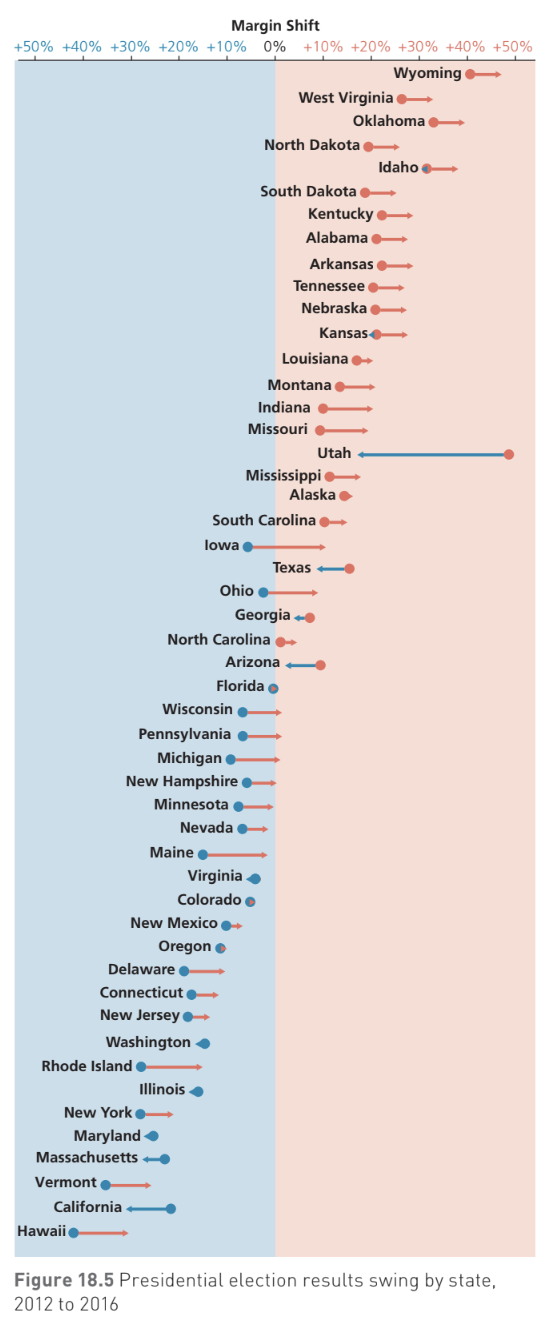
Many previously loyal Democratic white blue-collar workers in Rust Belt states such as Michigan, Ohio, and Wisconsin swung behind Trump, attracted by his promises of more jobs and protective trade policies. His narrow victories in states such as Wisconsin (last won by a Republican in 1984) pushed Trump over the winning line despite losing the popular vote.
Note
The 2016 election revealed the growing divide between the urban, multi-ethnic USA and the largely white small-town and rural USA. Each segment voted in record numbers for 'their' candidate, deepening geographical and cultural polarisation.
The main shifts in voting behaviour centred on less well-educated white voters in Upper Midwest states. In Ohio, white voters supported Trump 62%-33%, a considerable improvement from 2012 when Romney won 57% of the white vote. The biggest shift in a single county occurred in Monroe County, Ohio, where the Republican vote surged from 52% (2012) to 72% (2016).
Some commentators suggested that white voters in the Upper Midwest and Rust Belt might be voting more like white southerners – predominantly Republican. This shift could partly result from the decline of organised labour (trade unions), which traditionally played a crucial role in mobilising white blue-collar voters for Democrats.
The 2020 election context
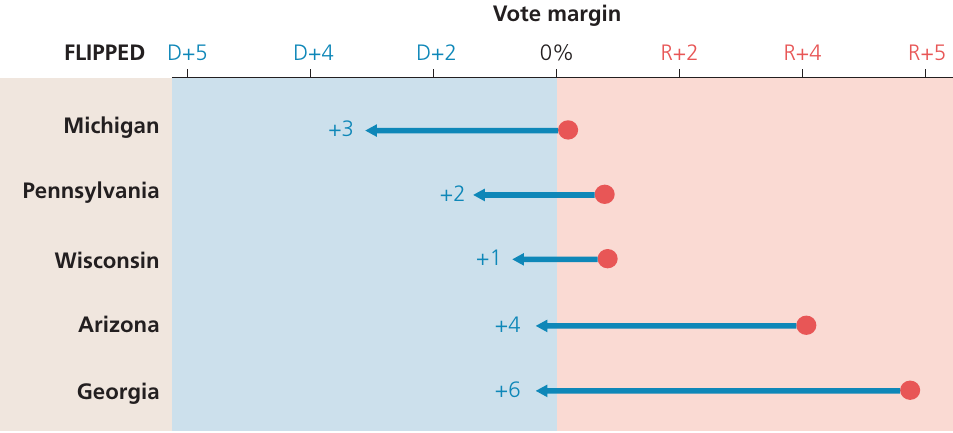
Caution is warranted about classifying 2016 as a truly realigning election. The three Rust Belt states that flipped for Trump in 2016 – Michigan, Pennsylvania, and Wisconsin – reverted to the Democratic column in 2020, though the margins remained small in each case.
Additionally, 2020 revealed that Republicans were continuing to lose ground in both Arizona and Georgia, largely due to demographic changes. These Sun Belt states are becoming more diverse and urbanised, creating challenges for Republican dominance.
Important
Understanding Modern Realignment:
Perhaps it is more accurate to view certain post-war elections as displaying elements of evolving political realignment, even if these shifts can reverse in the short term. Few would dispute that Rust Belt states have become less reliable for Democrats to win. Equally, the Republican grip on some Sun Belt states appears increasingly precarious.
When discussing realigning elections, it's important to recognise that, with the sole exception of 1932, realignment is best understood as an evolving process over two or three elections rather than a single dramatic event. The transformation of voting patterns takes time to work through different levels of elections.
Summary
Key Points to Remember:
-
Primacy factors (voter profile characteristics like race, gender, religion, age, geography, wealth, political ideology, and sexual orientation) and recency factors (issues, candidates, and campaigns) both influence voting behaviour, with primacy factors generally providing more predictable patterns.
-
Race remains the strongest predictor of voting behaviour: African-Americans (87% Democratic), Hispanic voters (65% Democratic), and Asian-Americans (61% Democratic) strongly support Democrats, whilst white voters lean Republican (58% for Trump in 2020).
-
Realigning elections cause lasting shifts in voting patterns. The 1932 election represents the clearest example, creating a Democratic coalition that dominated until the 1960s. The Southern strategy realigned the South from Democratic to Republican between 1964-1972.
-
The 2016 election showed potential realignment with white blue-collar Rust Belt voters shifting Republican, but 2020 results suggested this shift may not be permanent, as Michigan, Pennsylvania, and Wisconsin returned to the Democratic column.