Methods and Tactics Used by Pressure Groups (AQA A-Level Politics): Revision Notes
📚Revision Notes
Methods and Tactics Used by Pressure Groups
The US system of government provides numerous access points for pressure groups to exert influence. With 50 state governments and legislatures alongside the federal government, Congress, and the Supreme Court, pressure groups can choose to work at state or federal level, or both. They may focus their efforts on the executive, the legislature, the judiciary, or all three branches of government.
US pressure groups employ a wide range of methods to influence decision-making. These approaches include electoral campaigning, lobbying, using the courts, grassroots campaigning, and direct action. Each method offers different advantages and levels of effectiveness depending on the group's resources and objectives.
Electoral campaigning
Pressure groups play a significant role in US election campaigns through three main activities: endorsing candidates, making campaign donations, and releasing voting scorecards. These tactics allow groups to shape electoral outcomes and support politicians who align with their policy goals.
Endorsements involve pressure groups openly supporting specific candidates and encouraging their members and the public to vote for them. This public backing can provide valuable credibility and mobilise voters around particular issues. Groups often choose candidates whose voting records or policy positions match their own objectives.
Campaign donations represent a powerful tool for well-funded pressure groups. Since the amount that candidates' official campaigns can raise is limited, pressure groups typically donate money to political action committees (PACs) and Super PACs. These organizations can spend unlimited amounts on campaigns.
Note
Super PACs differ from regular PACs in their spending limits. While traditional PACs have strict contribution limits, Super PACs can raise and spend unlimited amounts of money. However, they are prohibited from coordinating directly with candidates or political parties.
For example, in 2018, the League of Conservation Voters spent $85 million on electoral campaigning, more than any other single-issue group. This substantial investment helped achieve their aim of winning the House of Representatives back for the Democrats, with nearly 60 of their endorsed congressional candidates being elected.
Voting scorecards provide voters with easy-to-understand information about how candidates score on key policies. These may analyze voting records or compare positions with other candidates. Examples include:
- The US Chamber of Commerce releases a 'How they Voted' scorecard for each member of Congress, allowing voters to analyze candidates' records on advancing pro-business policies
- The NRA allocates each candidate a grade from A to F based on their voting record on gun rights
- The League of Conservation Voters releases a 'dirty dozen' list of politicians with the worst environmental records. In 2020, five of the 12 candidates on the federal list were defeated, along with six on the state list
Example
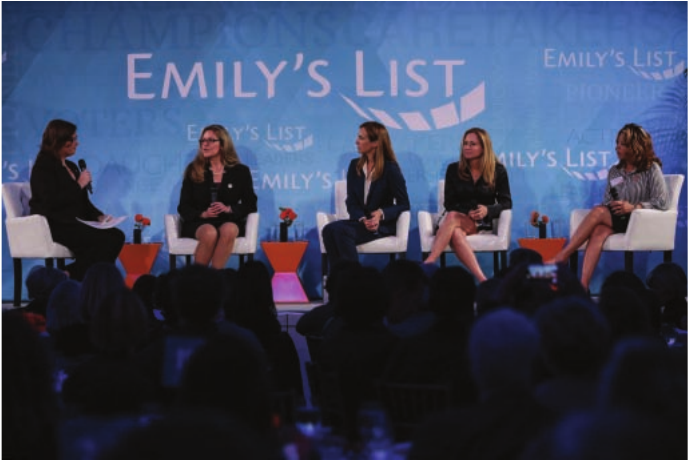
Case Study: EMILY's List
EMILY's List is a prominent US pressure group that aims to 'ignite change by getting pro-choice Democratic women elected to office'. The organization goes further than most pressure groups by actively recruiting candidates for office and supporting their campaigns throughout the entire electoral process, including helping to 'get out the vote'.
Founded in 1985, the group's name is based on the acronym 'Early Money Is Like Yeast', referring to the fact that campaigns receiving crucial early funding are more likely to grow successfully and attract further donations, much like yeast makes bread rise.
Track Record:
- 2016: Endorsed Hillary Clinton but did not achieve a female president
- 2018: $37 million spend led to record numbers of female members of Congress
- 2020: Spent $5.5 million on digital advertising for Kamala Harris and celebrated her historic election as the first female vice president. Seven new EMILY's List candidates were also elected to the House
Lobbying
Lobbying is the process by which pressure groups attempt to influence members of the executive or legislature by meeting with them directly. Pressure groups possess detailed, up-to-date knowledge of their policy areas, making them useful sources of information for politicians and government officials. Through these meetings, groups try to convince the executive and legislators to adopt positions that favor their interests.
Important
The right to lobby is constitutionally protected. The First Amendment guarantees the right of the people to 'petition the government for a redress of grievances'. A 'grievance' means a complaint, which in the context of lobbying refers to an area of government policy that the pressure group or corporation hopes to change.
Insider contacts
Many pressure groups maintain offices in Washington, DC to access the federal government and Congress more easily. They develop relationships with members of Congress who might be persuaded to introduce or support legislation that would advance their cause. Groups may also meet with key government officials connected to their policy area, including cabinet officers and senior figures in federal agencies.
Building relationships with the staff of important players in Congress or the White House can also provide a route to influence, as these staff members may be able to convince their superiors. For example, representatives from investment banks J.P. Morgan and Goldman Sachs had over 350 meetings with federal agencies from 2010 to 2012, as the agencies were writing regulations for the banking sector in response to the financial crisis. Some pressure groups maintain offices in other US states to carry out similar work at state level.
Professional lobbyists
Pressure groups with sufficient financial resources often employ professional lobbying firms. These firms are concentrated on and around 'K-Street' in Washington, DC, in what is known as the 'K-Street corridor of influence'.
Note
Lobbying Spending Patterns:
In 2019, more than $3.47 billion was spent on federal lobbying. Spending typically concentrates on the key political issues of the day. For example, in 2019, companies and business pressure groups lobbied the government regarding Donald Trump's new trade deal with Mexico and Canada, while pharmaceutical companies opposed price controls on medical drugs.
In 2010, the highest-value lobbying year on record, much of the $3.51 billion spent was by healthcare companies and groups attempting to influence the format of Barack Obama's Affordable Care Act.
Evidence suggests that lobbying is effective. One study estimated that lobbying spending by US corporate groups led to $90 million of subsidies for businesses, demonstrating a significant return on investment.
Revolving door syndrome
Lobbying firms actively try to hire lobbyists who have previously worked within the executive branch or Congress. This strategy allows firms to take advantage of ready-made contacts within the executive or the legislature. Lobbyists may later return to political roles, creating a rotation of personnel between government and lobbying firms known as the 'revolving door syndrome'.
A prominent example of a 'revolver' is lawyer Eugene Scalia, who became secretary of labor in 2019. Scalia first worked for George W. Bush's administration before lobbying on behalf of the US Chamber of Commerce, and represented companies such as Chevron, Facebook and Goldman Sachs.
Is professional lobbying elitist?
Congress has attempted to regulate lobbying through legislation such as the Lobbying Disclosure Act 1995 and the Honest Leadership and Open Government Act 2007. Lobbying must be disclosed and there are tight restrictions on 'gifts' from lobbyists to members of Congress. Despite these measures, the lobbying industry faces significant criticism from progressives for being elitist and anti-democratic.
Important
The Elitism Debate:
Critics argue that pressure groups with substantial financial resources are able to buy influence. For example, the US Chamber of Commerce generally spends more on lobbying than any other organization ($77 million in 2019). One of its aims was to convince Congress to pass the United States-Mexico-Canada Agreement, which it achieved after meeting with 36 members of Congress.
However, high spending does not automatically guarantee results. The Chamber could not convince Trump's administration to reverse tariffs on goods from China and the EU, and steel and aluminum imports, despite the negative impact of tariffs on US businesses.
During the 2016 presidential campaign, Trump used populist rhetoric to speak repeatedly about the need to 'drain the swamp' in Washington, DC. However, once president, he showed no inclination to reduce the influence of lobbyists. After just two years in office, Trump had hired 281 lobbyists to work in his government, one former lobbyist for every 14 political appointments. This was four times more lobbyists than Obama appointed in six years. Trump also maintained close ties to several practicing professional lobbyists, allowing them access to his administration.
Example
Case Study: Ballard Partners
Brian Ballard, the founder of Ballard Partners lobbying firm, was named by Politico magazine as 'the most powerful lobbyist in Trump's Washington'. Ballard spent years lobbying the Florida state government on behalf of The Trump Organization and raised millions of dollars for Trump's presidential campaigns.
Impact of Trump's Election:
Once Trump became president, Ballard Partners experienced explosive growth:
- Gained 100 clients in less than two years
- Earned more than $28 million
- Top US companies including Amazon, American Airlines and General Motors all used the firm
Ballard Partners exemplifies the 'revolving door syndrome', as many of its lobbyists have worked for previous government administrations or within Congress.
Using the courts
Many pressure groups attempt to achieve their aims through the courts. This can be a highly productive strategy because the Supreme Court has extensive power to interpret the Constitution and to check the power of the executive. Court-based strategies can produce dramatic changes to policy and law.
Legal challenges
Pressure groups can target an area of law where they wish to see change and support cases that hinge on this legal point. They may lose in the lower courts but then appeal the case all the way up to the Supreme Court, where they hope for a landmark ruling - a transformative change to the law that accomplishes the pressure group's main objective.
Note
Successful Legal Challenge Strategies:
Pressure groups that have successfully used this strategy include:
- The NAACP funded Brown v Topeka (1954), in which the Supreme Court decided that the doctrine of 'separate but equal' was unconstitutional
- The ACLU brought the legal case Obergefell v Hodges (2015), in which the Supreme Court's ruling legalised same-sex marriage across the USA
Legal challenges can also target state laws aimed at eroding a previous Supreme Court ruling. Health provider and non-profit organization Planned Parenthood has brought many cases to defend the abortion provisions of Roe v Wade (1973):
- In Planned Parenthood v Casey (1992), the organization filed a suit against the governor of Pennsylvania for enacting abortion restrictions based on legislation passed by the state legislature. The right to abortion was upheld and one of the restrictions was struck down, although the rest were allowed to stand
- In 2019, the organization brought legal cases against highly restrictive laws passed in states including Alabama, Georgia, Indiana and Ohio
Pressure groups can also hold the executive to account by challenging its actions in the courts. For example, the ACLU mounted 56 legal challenges against Trump's administration from 2017 to 2018, including:
- Trump's ban on immigrants from several Muslim-majority countries was halted by a federal court in 2017. He subsequently modified his ban to include several non-Muslim countries, and it was upheld by the Supreme Court in 2018
- The ACLU challenged Trump's 2017 ban on transgender people in the military. This was initially halted by a federal court, but the Supreme Court allowed it to proceed in 2019 while further legal challenges took place
Amicus curiae briefs
Pressure groups often submit information to court cases hoping to influence the outcome. They do not need to be involved in the case to do this and can involve lawyers to write amicus curiae briefs on their behalf. Amicus curiae ('friend of the court') briefs set out specific evidence or research that the pressure group hopes will influence the justices. These briefs can also be submitted by academic legal experts, the executive, or anyone else who has an interest in the case. Those that are non-governmental, including those written by pressure groups, are known as 'green briefs' because they are printed in green booklets.
Impact of amicus curiae briefs
It is impossible to know exactly how much impact amicus curiae briefs have on the decision-making process of justices, but the number submitted has increased dramatically in recent years.
Note
Growing Use of Amicus Briefs:
The frequency of amicus curiae briefs has surged:
- 1950s: Average of just 1 brief per case
- 2019-20: Record 16 briefs per case
For landmark cases, the numbers are even more striking:
- Brown v Topeka (1954): 6 amicus briefs
- Obergefell v Hodges (2015): Record 148 amicus briefs
Some amicus curiae briefs clearly influence the decision-making process, as justices refer to them in their written opinions on cases. In 2019-20, justices mentioned 10% of the non-governmental 'green briefs' submitted to them.
Example
Example: American Legion v American Humanist Association (2019)
In this case, the Supreme Court ruled that a specific war memorial in the shape of a cross was constitutional. The amicus brief from Jewish War Veterans of the United States of America had a notable impact on the justices' opinions:
- Justice Ruth Bader Ginsburg quoted from the amicus brief to support her dissent against the Court's ruling
- Justice Brett Kavanaugh wrote that he had 'great respect for the Jewish war veterans who in an amicus brief say that the cross on public land sends a message of exclusion'
Although this is evidence that these veterans were heard, the final judgment of Kavanaugh and the majority of the Court went against them.
Is the use of amicus curiae briefs elitist?
Amicus curiae briefs can give a voice to sections of society who might otherwise be overlooked by the Court, such as Jewish war veterans in the example above. However, amicus briefs are more likely to be cited by justices if they are written by legal experts. This favors pressure groups with specialist legal expertise and extensive experience of preparing amicus briefs, such as the ACLU and the National Association of Criminal Defense Lawyers (NACDL). In 2019-20, around 40% of cited green briefs were written by these types of pressure groups.
Important
The Cost Barrier:
Writing an amicus brief is an expensive process, which has led to criticism that wealthy pressure groups can use this method more effectively than others. In an attempt to increase transparency, rules state that financial contributors to the brief must be published.
Some pressure groups have used crowdfunding to fund their amicus briefs. While this offers an opportunity for less wealthy pressure groups, this new method of funding is not without problems. In 2018, the Supreme Court rejected a brief by the US Alcohol Policy Alliance because some of the crowdfunding donors were anonymous.
Grassroots campaigning
A pressure group's 'grassroots' refers to its membership. Beyond paying membership fees and providing revenue for the group, members often play a crucial role in campaigning activities. Pressure groups can mobilize their members to contact members of Congress, federal and state governments, or legislatures by writing, emailing, phoning, or connecting with them via social media. This communications 'blitz' allows groups to demonstrate that an issue has mass support and can be very effective if targeted at politicians who are keen to secure the support of their constituents or the general public.
Members can also organize petitions or fundraising drives. They can share the pressure group's advertising material on social media and use hashtags and likes to generate momentum for fire-brigade campaigns. Members' contacts on social media represent a potential source of new membership and publicity for the pressure group.
Many pressure groups also encourage their members to participate in marches and demonstrations. These range from simply standing outside the Supreme Court or Congress holding signs in protest against a judgment or bill, to more extreme activities known as direct action.
Direct action
Direct action refers to any methods used by a pressure group that go beyond the standard constitutional methods of campaigning. The aim is to put public pressure on the executive to force concessions, whereas conventional constitutional methods, such as petitions and letter-writing campaigns, aim to persuade the executive or legislature to adopt the pressure group's agenda.

Many US pressure groups have used direct action throughout history:
Note
Historical Examples of Direct Action:
Civil rights movement (1950s and 1960s): The movement adopted Indian independence leader Mahatma Gandhi's idea of non-violent protest. African-American protesters used 'sit-ins' in segregated 'white-only' areas and bus boycotts to put pressure on bus companies to desegregate their buses. In 1963, 250,000 people attended the historic 'March on Washington for Jobs and Freedom'.
Anti-war movement (late 1960s and early 1970s): The war in Vietnam motivated many anti-war pressure groups to engage in direct action. Groups such as Students for a Democratic Society and the National Committee for a Sane Nuclear Policy (SANE) organized huge public protests. In 1967, a record 500,000 protested in New York City against the war. As time went on, the anti-war movement used illegal civil disobedience, including marching on the Pentagon and breaking through police lines, and blocking access to recruitment offices. The pressure group Vietnam Veterans against the War organized protests including one where more than 800 veterans threw their medals in front of the Capitol, and another in which the group occupied the Statue of Liberty.
Twenty-first century movements: A wide range of movements such as Black Lives Matter, the Women's March, March for Our Lives, and #MeToo have led large marches and demonstrations across the USA.
Effectiveness of direct action
The effectiveness of direct action has been much debated. It certainly generates publicity and media attention but may alienate policy-makers or the public. This is particularly the case if the direct action is violent, so most groups restrict themselves to non-violent civil disobedience.
Important
The Challenge of Controlling Mass Mobilization:
Leaders cannot always prevent their cause from being linked to violence, as mass mobilizations can spiral out of control. This poses a significant risk to the movement's credibility and public support.
Example
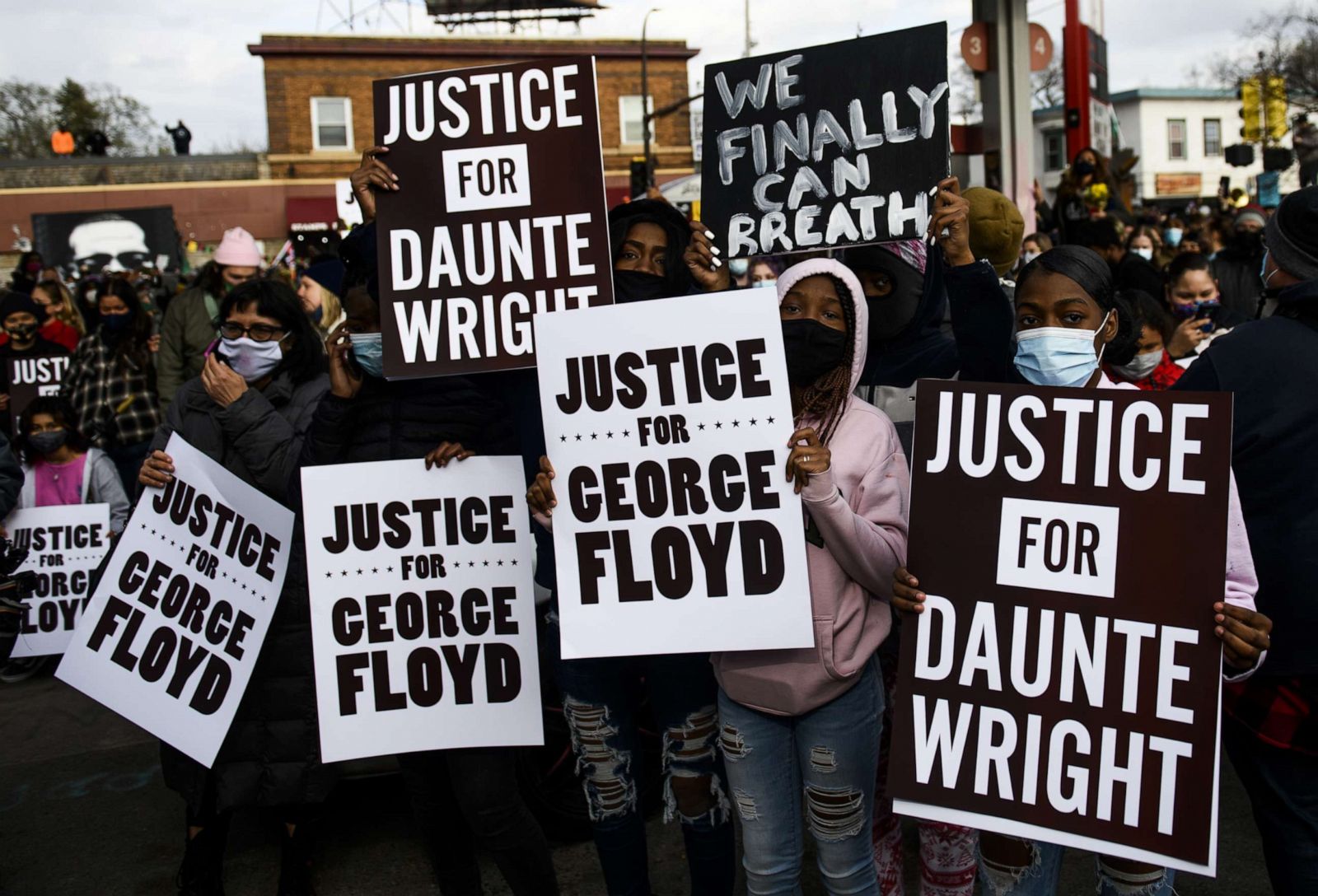
Case Study: Black Lives Matter and the George Floyd Protests
Since 2013, Black Lives Matter has organized huge demonstrations and street protests against systemic racism and police killings of black people. The 2020 murder of George Floyd, an African-American, by a white police officer who knelt on his neck for 9 minutes 29 seconds led protesters to defy the risk of contracting COVID-19 to join large demonstrations in at least 140 cities across the USA. Some were peaceful while others were marred by rioting, looting, arson and violence against the police.
Potential for Backlash:
These spontaneous outbreaks of violence could have alienated public opinion against the Black Lives Matter movement. However, the authorities responded with curfews, tear gas, smoke grenades and rubber bullets, and even arrested a journalist covering the riots. President Trump tweeted 'when the looting starts, the shooting starts' and threatened to send in the military to end riots.
Paradoxical Outcome:
The authorities' response appeared to make publicly visible many of the same attitudes that Black Lives Matter condemned as racist. Celebrities and the public continued to express support, and a top US Air Force general released a clip about the difficulties he experienced as an African-American in the military. A series of statues of Confederate figures were defaced or pulled down, generating international debate about the role of statues in glorifying racist individuals.
On rare occasions, pressure groups deliberately use violence to put pressure on the executive. The organization known as Weathermen was a faction of Students for a Democratic Society that carried out a bombing campaign from 1969 with the aim of destroying 'US imperialism'. Bombing was mainly focused on government sites and aimed to bring down the government through revolutionary means. The group was pursued into hiding by the FBI's anti-terrorist task force.
Important
The Danger of Violence:
Such extreme actions can make it easier for the executive to maintain its policy, as perpetrators of violence are easy to discredit. Violence typically undermines a pressure group's legitimacy and allows opponents to dismiss their cause entirely.
Uniquely, the failed mob insurrection at the Capitol in January 2021 was intended to protect the incumbent executive, although at the expense of democracy. Far-right groups aimed to prevent Congress from certifying the 2020 Electoral College results. Shortly before the attack on the Capitol, President Trump told supporters 'if you don't fight like hell you're not going to have a country anymore', apparently giving executive approval to their plans.
Summary
Key Points to Remember:
-
Pressure groups use five main methods to influence decision-making: electoral campaigning, lobbying, using the courts, grassroots campaigning, and direct action
-
Electoral campaigning involves endorsing candidates, making donations through PACs and Super PACs, and releasing voting scorecards to inform voters
-
Lobbying is constitutionally protected under the First Amendment and involves meeting with officials to share expertise; professional lobbyists with insider contacts can be particularly effective, though this raises concerns about elitism and the 'revolving door syndrome'
-
Using the courts can produce landmark rulings that transform policy, particularly through legal challenges and amicus curiae briefs, though this method also favors wealthy groups with legal expertise
-
Grassroots campaigning mobilizes members to contact officials, organize petitions, and participate in demonstrations, demonstrating mass support for issues
-
Direct action generates publicity but may alienate policy-makers if it becomes violent; non-violent civil disobedience has historically been more effective in maintaining public support while forcing political change