Reducing Addiction (AQA A-Level Psychology): Model Answers
📚Model Answers
Reducing Gambling Addiction: CBT and Aversion Therapy
Sample Answer
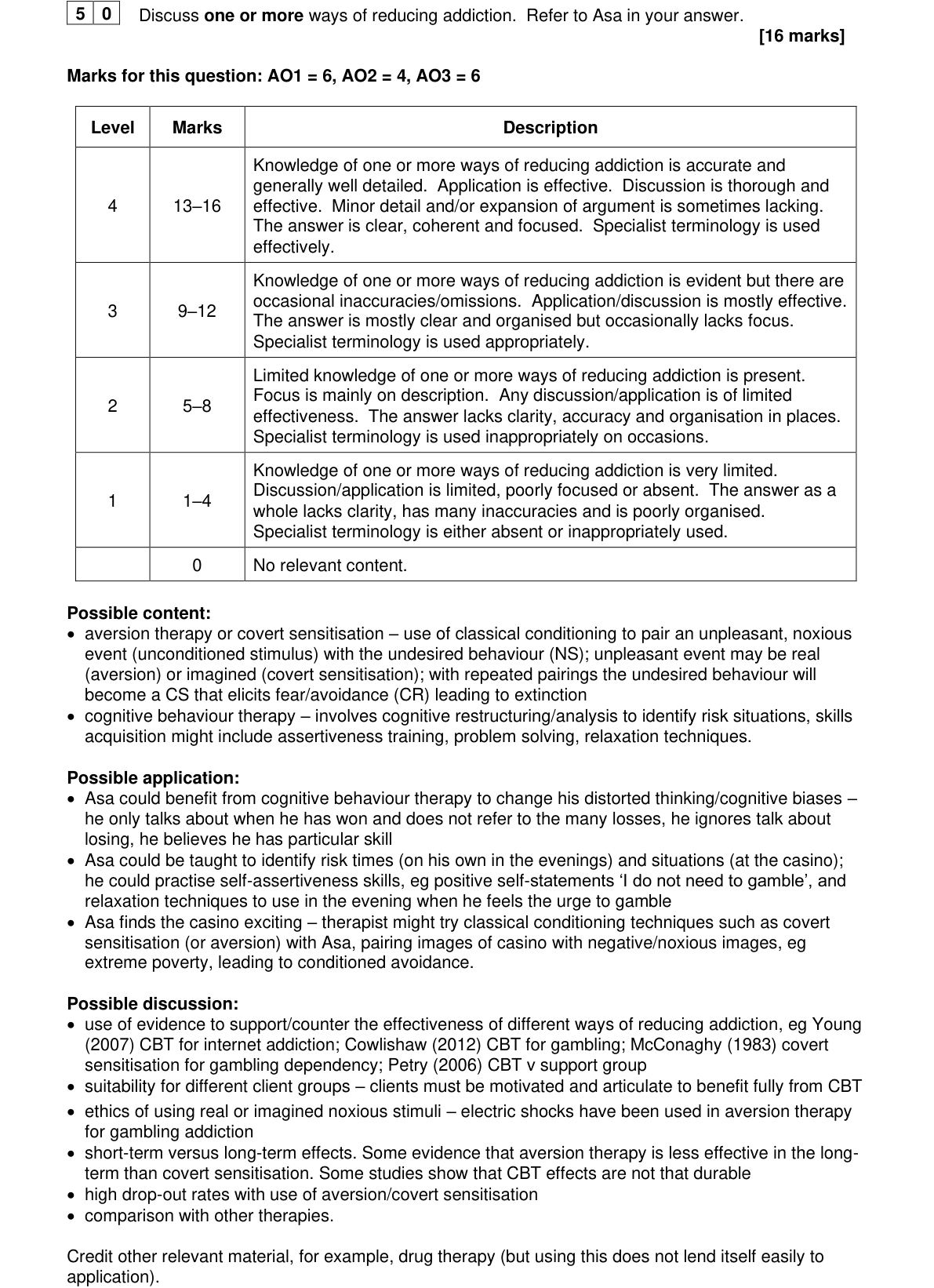
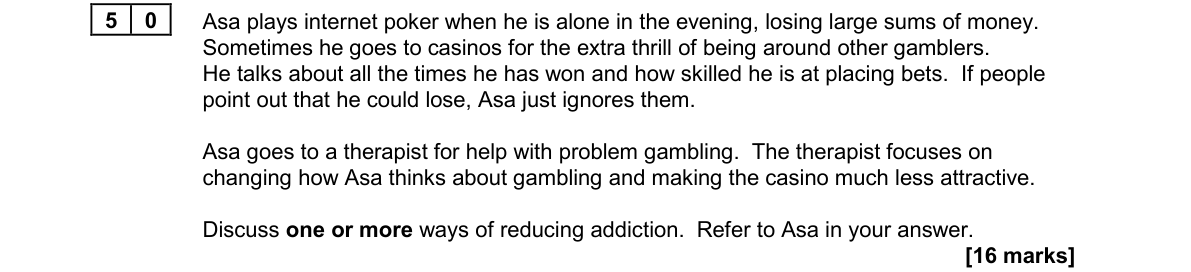
One effective way of reducing Asa's gambling addiction is cognitive behavioural therapy (CBT). CBT is based on the assumption that addictive behaviour is maintained by faulty thinking patterns and irrational beliefs. The therapist works with Asa to identify and challenge his cognitive biases, such as the gambler's fallacy (believing he is "due" a win after losses) or illusion of control (believing his skill determines outcomes in games of chance). Through cognitive restructuring, Asa would learn to replace these distorted thoughts with more rational ones. For example, when Asa thinks about his wins and skill at placing bets, the therapist could help him recognise that he ignores his losses and that poker outcomes involve significant chance. The behavioural component might involve functional analysis to identify triggers (such as being alone in the evening) and developing alternative coping strategies, like finding other activities when he feels the urge to gamble.
CBT is supported by research evidence. Petry (2006) found that CBT combined with support groups was effective in treating gambling addiction, with participants showing reduced gambling behaviour. This suggests CBT could help Asa reduce his casino visits and control his urges. Furthermore, CBT addresses both the cognitive and behavioural aspects of addiction, making it comprehensive. However, CBT requires considerable commitment and motivation from Asa - he must attend regular sessions, complete homework tasks, and actively work to change his thinking patterns. Given that Asa talks about his wins and ignores losses, this suggests he may lack insight into his problem, which could limit CBT's effectiveness. Additionally, CBT focuses mainly on psychological factors and may not fully address any underlying biological vulnerability to addiction that Asa might have.
Another method to reduce Asa's gambling addiction is covert sensitisation, a type of aversion therapy. This classical conditioning technique aims to create an association between gambling (the conditioned stimulus) and an unpleasant response. The therapist would ask Asa to imagine gambling scenarios (such as entering the casino or placing bets) whilst simultaneously imagining very unpleasant consequences, such as vomiting, extreme anxiety, or embarrassing himself in front of others. Through repeated pairings in imagination, the previously pleasurable gambling stimuli become associated with noxious feelings, reducing their appeal. For Asa, the therapist might ask him to vividly imagine the casino environment whilst also imagining feeling intensely nauseous or experiencing the shame of losing large sums of money and disappointing loved ones.
Covert sensitisation has some advantages - it is conducted entirely in imagination, so there are no ethical concerns about causing actual physical discomfort, and Asa could practise the technique at home when he feels tempted to gamble. However, research evidence for aversion therapy's long-term effectiveness is mixed. Some studies suggest it can reduce gambling behaviour in the short term, but the conditioned aversion often extinguishes once therapy ends, leading to relapse. This is because the unpleasant association is only maintained through regular reinforcement in therapy sessions. For Asa, this means that whilst covert sensitisation might make the casino less attractive initially, the effects may fade over time, particularly if he experiences a win that provides powerful positive reinforcement. Additionally, aversion therapy only addresses the symptoms of addiction rather than underlying causes, such as why Asa gambles alone when he is passionate about being around people - this suggests possible loneliness or other psychological issues that aversion therapy would not resolve.
In conclusion, CBT appears more suitable for Asa as it addresses his distorted thinking patterns and could help him develop long-term coping strategies, although its success depends on his motivation. Covert sensitisation could be used as a supplementary technique to reduce immediate cravings, but is unlikely to be sufficient alone due to problems with extinction and relapse.
Note
Examiner's Commentary
This is a Level 4 response. Knowledge of two methods (CBT and covert sensitisation) is accurate and well detailed, with thorough and effective discussion. Application to Asa is clear and consistently maintained throughout, with explicit links to his distorted thinking about wins, casino visits, and gambling alone in the evening. The answer demonstrates excellent use of specialist terminology (cognitive restructuring, gambler's fallacy, functional analysis, classical conditioning, extinction) and includes appropriate research evidence (Petry 2006). Discussion is balanced, addressing strengths and limitations of both methods with a reasoned comparison in the conclusion. Top of Level 4.
Estimated Mark Breakdown
| Criteria | Commentary | Likely Mark Range |
|---|---|---|
| AO1 (Knowledge) - 6 marks | Accurate and well-detailed knowledge of CBT and covert sensitisation with clear theoretical basis and procedures | 6 |
| AO2 (Application) - 4 marks | Effective application to Asa throughout, with explicit links to his distorted thinking and gambling triggers | 4 |
| AO3 (Evaluation/Discussion) - 6 marks | Thorough and effective discussion with research evidence, balanced evaluation, and reasoned comparison | 6 |
Marking Scheme