The Business Cycle (Edexcel A-Level Business): Revision Notes
📚Revision Notes
The Business Cycle
What is the business cycle?
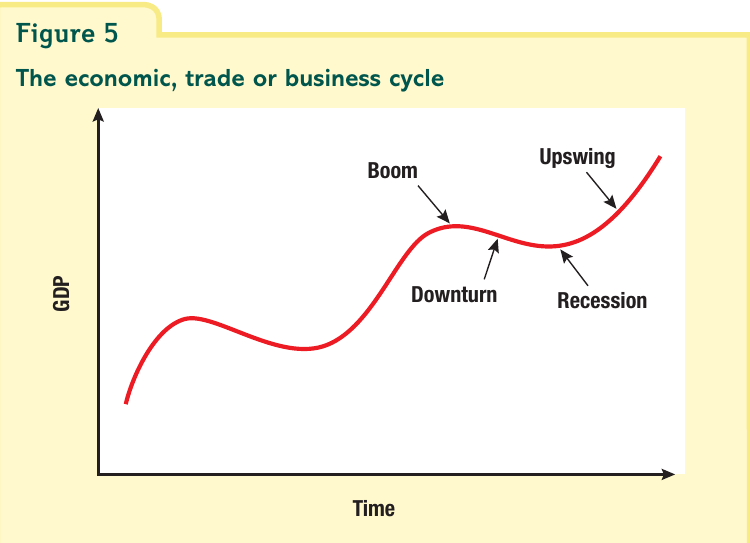
Over time, gross domestic product (GDP) – which measures total output in the economy – is expected to grow. However, this growth is rarely smooth or constant. Instead, GDP experiences regular fluctuations, sometimes rising sharply and at other times falling or growing slowly. These fluctuations are known as the business cycle (also called the economic cycle or trade cycle).
The business cycle consists of four distinct phases that economies move through repeatedly over time.
Note
Understanding the business cycle is essential for businesses to plan effectively and make informed strategic decisions. Each phase brings different opportunities and challenges that require specific responses.
The four phases of the business cycle
Boom
A boom represents the peak of the economic cycle. During this phase:
- GDP is growing rapidly and the economy is performing strongly
- Existing firms expand their operations and new firms enter the market
- Consumer demand rises steadily
- Employment increases and wages rise
- Business profits increase
- Prices may also rise – for example, UK house prices rose sharply during the booms of the 1990s and 2000s
Important
However, booms can create problems such as inflation if demand grows too quickly. Rapid price increases can erode purchasing power and create economic instability.
Downturn
After reaching a peak, the economy enters a downturn. Key characteristics include:
- GDP continues to grow, but at a much slower rate than before
- Demand for goods and services flattens out or begins to decline
- Unemployment starts to rise
- Wage increases slow down
- Many firms stop expanding and profits may fall
- Some firms exit the market
- Price increases slow down
Note
The downturn phase serves as a transition period between the boom and recession. Businesses that recognize this phase early can take proactive steps to protect their position before conditions worsen.
Recession or depression
The bottom of the business cycle is the most challenging phase economically. During a recession or depression:
- GDP becomes flat or even starts to fall
- If GDP falls significantly, this is called a slump or depression
- A less severe decline is termed a recession
- Demand falls, particularly for non-essential goods and services
- Unemployment rises sharply
- Business confidence drops to very low levels
- Bankruptcies increase
- Prices stabilize or may even fall in some sectors
- This period is associated with economic hardship
Important
Understanding severity: The terms "recession" and "depression" describe different levels of economic decline. A recession is typically defined as two consecutive quarters of negative GDP growth, while a depression represents a much more severe and prolonged economic downturn.
Recovery or upswing
When GDP begins rising again, the economy enters a recovery or upswing:
- Businesses and consumers regain confidence
- Economic activity increases
- Demand starts to rise again
- Unemployment begins to fall
- Prices start to rise once more
- The economy moves toward the next boom phase
How the business cycle affects businesses
The cyclical pattern of economic growth has significant impacts on businesses, though the extent of these effects depends on the financial position of each business and the products or services it provides.
Output
During a boom, businesses increase production to meet rising demand. Many expand their capacity to handle higher sales volumes. Businesses selling non-essential products and luxury items benefit most – for example, those in the holiday, restaurant, air transport, jewellery and fashion sectors.
During a recession, output falls as demand drops. Businesses reduce production and cut capacity. However, businesses selling essential items (such as supermarkets) experience smaller declines as consumers still need to purchase necessities.
Note
Industry resilience varies: Not all businesses are affected equally by the business cycle. Those selling necessities tend to be more recession-proof, while luxury goods and services providers face greater volatility in their sales and profits.
Profit
Boom conditions typically boost business profits because:
- Demand is rising consistently
- It becomes easier to raise prices without losing customers
- Sales volumes are high
During periods of economic decline, maintaining profitability becomes much harder. Businesses often cut costs to protect profit margins. Many firms must accept lower profits, and some make losses, particularly those selling non-essential products.
Business confidence and investment
High confidence during recovery and boom phases means:
- Business owners feel optimistic about the future
- They are willing to take more risks
- They launch new products and enter new markets
- Investment in expansion increases
Low confidence during recessions results in:
- Pessimism and anxiety about future trading conditions
- Risk-averse behaviour
- Business contraction rather than expansion
- Reduced investment – for example, firms delay replacing outdated machinery
Important
The confidence multiplier effect: Business confidence creates a self-reinforcing cycle. When businesses are confident, they invest more, creating jobs and boosting demand. This further increases confidence. Conversely, low confidence can deepen recessions as reduced investment leads to job losses and falling demand.
Employment
Boom periods see falling unemployment because:
- Businesses recruit additional workers to meet rising demand
- Competition for skilled staff may intensify
- Some firms struggle to find enough qualified candidates
Recessions cause rising unemployment as:
- Businesses lay off workers to reduce costs
- Fewer jobs are available across the economy
- Workers find it harder to move between jobs
Note
Employment is often considered a lagging indicator – it tends to continue rising even after a recession has technically ended, as businesses remain cautious about hiring until recovery is firmly established.
Business start-ups and closures
During booms, more entrepreneurs start new businesses because:
- Rising demand makes it easier to generate profits
- High business confidence encourages entrepreneurial activity
- Market conditions are favorable for new entrants
During recessions, conditions are unfavorable for start-ups:
- Business closures increase significantly
- Inefficient businesses are most at risk
- Firms with cash-flow problems struggle to survive
- Those selling non-essential products face particular difficulties
- Few entrepreneurs are willing to take the risk of starting new ventures
Economic uncertainty and the business cycle
One significant challenge for businesses is the unpredictability of the business cycle. Economic variables such as inflation, interest rates, and GDP growth cannot be forecast with complete accuracy. This uncertainty:
- Makes strategic decision-making more difficult
- Reduces business confidence
- Forces businesses to deal with unexpected economic events
Example
Practical Challenge: Long-term Investment Decisions
Consider a manufacturing business evaluating whether to build a new factory costing £50 million. The project will take 3 years to complete and must operate profitably for at least 10 years to justify the investment.
The business must consider:
- Will the economy be growing or contracting in 3-5 years?
- What will interest rates be during the construction period?
- Will demand for their products remain strong over the next decade?
Because of this high uncertainty, many businesses abandon marginal investment projects when economic conditions are unpredictable, even if they might be profitable under favorable conditions.
The economist John Maynard Keynes argued that business confidence directly affects investment decisions. When business people are optimistic, they invest more readily. High economic uncertainty tends to reduce confidence, leading to lower investment levels and slower business development.
Important
Keynes' insight on confidence: Keynes recognized that psychological factors play a crucial role in the business cycle. Even if economic fundamentals are sound, low confidence can create a self-fulfilling prophecy where reduced investment leads to the very recession that businesses fear.
Key Takeaways
Summary
Essential Points to Remember:
The business cycle describes regular fluctuations in GDP over time, moving through four phases:
- Boom – rapid growth and expansion
- Downturn – slowing growth
- Recession – negative or flat growth
- Recovery – return to growth
During booms:
- Businesses expand, employment rises, and profits increase
- Prices may also rise due to high demand
- Business confidence is high
During recessions:
- Falling demand and rising unemployment
- Business closures increase
- Profits fall or turn to losses
- Business confidence is low
Key impacts on businesses:
The business cycle affects output, profit, confidence, employment, and business start-ups, though the impact varies by:
- Industry type
- Product category (essential vs. non-essential)
- Business financial position
Industry vulnerability:
- Businesses selling luxury or non-essential items are most affected by the cycle
- Those selling essentials are more resilient and stable
Critical challenge: The unpredictability of the business cycle makes strategic planning difficult and affects investment decisions.
Note
Key Terms Reference:
- GDP (Gross Domestic Product) – total output in the economy
- Boom – peak of the cycle with rapid growth
- Recession – period of economic decline (two consecutive quarters of negative GDP growth)
- Business confidence – optimism or pessimism about future trading conditions
- Lagging indicator – an economic measure that changes after the economy has already begun following a particular pattern