External Influences (Edexcel A-Level Business): Revision Notes
📚Revision Notes
Legislation
Why businesses need legislation
Legislation provides a legal framework for businesses to operate while protecting vulnerable stakeholder groups. Without government regulation, some businesses might exploit workers, consumers, or the environment to maximise profits.
Note
The government must balance regulation carefully. Too much legislation discourages enterprise, deters foreign investment, and stifles economic growth. Too little legislation leaves stakeholders unprotected and vulnerable to exploitation.
Legislation affects businesses in five key areas:
- Consumer protection
- Employee protection
- Environmental protection
- Competition policy
- Health and safety
Consumer protection
Why consumers need protection
Consumers require legal protection to ensure they can purchase quality products at fair prices with accurate information. Without legislation, some businesses would exploit customers through dangerous products, excessive pricing, or misleading claims.
Important
Consumer legislation addresses several key issues to prevent exploitation and ensure fair trading practices. These protections form the foundation of modern consumer rights and business accountability.
Consumer legislation addresses several key issues:
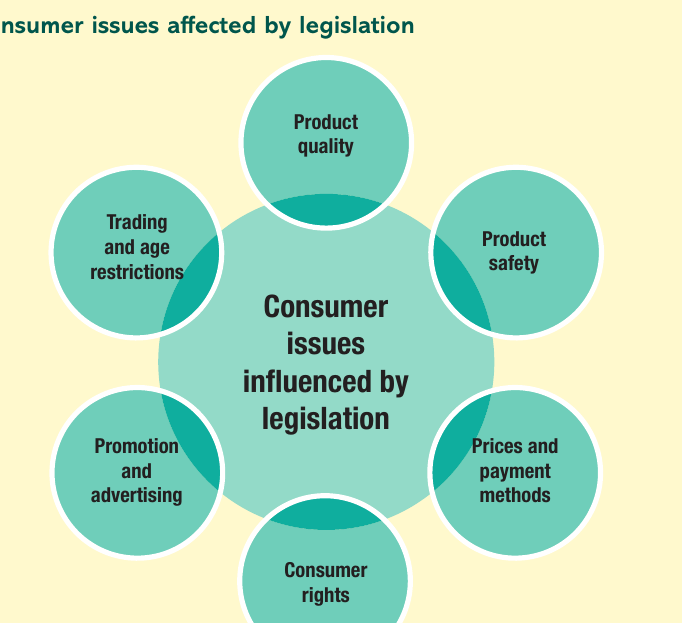
The main areas covered by consumer protection laws include:
- Product quality - goods must meet acceptable standards
- Product safety - products must not pose unnecessary risks
- Pricing and payment methods - fair pricing and transparent payment terms
- Consumer rights - legal protections when purchases go wrong
- Promotion and advertising - truthful and non-misleading marketing
- Trading and age restrictions - appropriate sales practices and age-related controls
How consumer legislation affects businesses
Increased costs
Improving product safety and ensuring accuracy in measurements raises business costs. For example, an electrical manufacturer might need to redesign table lamps if components fail to meet safety standards. Such modifications increase production costs but are legally required.
Example
Practical Impact: Product Safety Compliance
An electrical manufacturer discovers that components in their table lamps fail to meet current safety standards. The business must:
- Halt production of the current design
- Redesign the product with compliant components
- Update manufacturing processes
- Retrain staff on new procedures
- Absorb the additional production costs
While these changes increase expenses, they are legally required and protect both consumers and the company's reputation.
Quality control improvements
Businesses must implement robust quality control procedures to comply with legislation. Companies that package or weigh goods must ensure correct quantities. Selling substandard or damaged products can result in prosecution, forcing businesses to invest in better quality assurance systems.
Customer complaint handling
Many businesses now operate dedicated customer service departments to handle complaints efficiently. These departments resolve issues quickly, preventing problems from escalating into legal disputes. This proactive approach costs money but protects the business from larger legal expenses.
Changes in business practice
Consumer protection legislation encourages businesses to become more market-orientated. Companies must genuinely meet customer needs rather than simply maximising short-term profits. This shift often leads to greater investment in market research and customer feedback systems.
Note
Key UK consumer legislation:
- Sale of Goods Act 1979 - products must be of merchantable quality and fit for purpose
- Food Safety Act 1990 - food must be safe for human consumption and meet hygiene standards
Employee protection
Why employees need protection
Employment legislation ensures minimum standards in the workplace. Without legal protection, businesses might pay low wages, enforce excessive hours, deny employment rights, discriminate unfairly, or dismiss workers unjustly.
Key areas of employment law
Employment contracts
Workers are entitled to a contract of employment - a legally binding agreement between employer and employee. Contracts typically include:
- Start date and employment term
- Job title and duties
- Place and hours of work
- Pay and holiday entitlement
- Pension and sickness absence provisions
- Termination conditions
- Disciplinary, dismissal, and grievance procedures
Discrimination
Businesses must distinguish between legal and unlawful discrimination:
Note
Legal discrimination involves choosing candidates based on experience, qualifications, or ability. This is acceptable and expected in recruitment.
Unfair discrimination involves making decisions based on gender, race, disability, sexual orientation, or age. This is illegal in most countries.
The Equality Act 2010 replaced earlier legislation and prohibits both direct and indirect discrimination on these protected grounds.
Unfair dismissal
The Employment Relations Act 1999 states that employees working for at least one year cannot be unfairly dismissed. Unfair dismissal includes dismissal for:
- Attempting to join a trade union
- Becoming pregnant
- Refusing to work on Sundays
- Being made redundant without proper procedure
Important
Fair dismissal is permitted when employees:
- Cannot perform their job adequately
- Are guilty of misconduct
- Become ineligible to work (e.g., drivers losing licences)
- Are made redundant following proper procedures
- Provide false information on application forms
Employees believing they were unfairly dismissed can appeal to an employment tribunal, which has power to reinstate workers if claims are upheld.
Equal pay
The Equal Pay Act 1970 addresses historical pay discrimination. It mandates that employees doing the same or 'broadly similar' work must receive equal pay and conditions, regardless of gender. The Act was updated in 1983 to allow claims for work of 'equal value'.
How employment legislation affects businesses
Compliance costs
Meeting employment legislation requirements creates significant expenses:
Note
Document verification: Businesses must verify that new employees can legally work in the UK by checking passports, birth certificates, and National Insurance numbers. Checking only certain applicants' documents could constitute discrimination.
Workplace responsibilities: Employers must maintain insurance policies, prevent discrimination and harassment, and manage health and safety, discipline, grievances, bullying, annual leave, and redundancy procedures.
Tax administration: Businesses must notify HMRC when employing someone, deduct tax and National Insurance contributions, provide P60 forms annually and P45 forms when employees leave, and submit annual returns for all employees.
Large businesses employ HR specialists to manage compliance. Smaller firms must allocate these responsibilities to senior staff, diverting time from core business activities.
Higher labour costs
The national minimum wage, introduced in 1999, boosts pay for low-wage workers. The rate is reviewed annually and typically increases, forcing businesses paying minimum wage to meet higher costs by law.
Changing working practices
Employment legislation requires systematic changes:
- Job advertisements must use gender-neutral language (e.g., 'salesperson' not 'salesman')
- Job descriptions and person specifications must not discriminate
- Structured interviews limit interviewer prejudice
- Selection procedures must not disadvantage particular ethnic or cultural groups
Exceptions exist where work is exempt from discrimination legislation, such as single-sex school teaching, welfare services, or specific acting roles.
Loss of flexibility
Some businesses find legislation too rigid. For example, employees working continuously for 26 weeks, or those with children under six (or disabled children under 18), can request flexible working arrangements. Refusals must be justified legally and provided in writing.
Penalties
Non-compliance brings fines, reputational damage, and potentially backdated compensation claims. These costs can be substantial for businesses found guilty of wrongdoing.
Positive effects of employment legislation
Note
Despite compliance costs, employment legislation benefits businesses by:
- Creating a level playing field - preventing unscrupulous businesses from exploiting workers to gain unfair competitive advantages
- Improving worker motivation and welfare
- Raising productivity and reducing absenteeism
- Cutting staff turnover
- Fostering positive organisational culture
- Enhancing business image
- Making recruitment and retention of quality staff easier
Environmental protection
Why environmental protection is needed
Without regulation, business activity harms the environment significantly. Governments increasingly worry about global warming and climate change. Greenhouse gas emissions from power generation, increased car ownership, and air travel contribute to environmental damage.
Specific environmental problems include:
Pollution
Note
Water pollution occurs when businesses dump waste into rivers, streams, lakes, or seas. Chemical leaks and warm water discharge damage aquatic ecosystems.
Air pollution results from businesses discharging particulate waste or gases into the atmosphere, contributing to global warming and health problems.
Noise pollution from factory machinery, loud entertainment venues, and low-flying aircraft near airports disrupts communities.
Destruction of wildlife habitats
Business development often destroys natural habitats. Around half of Earth's forests have been removed, threatening ecological balance. Over half the world's primate species face extinction due to habitat loss, along with tigers, pandas, and countless plant and insect species.
Traffic congestion
Commercial vehicles and employee commuting cause congestion, resulting in delays and accidents. London introduced a congestion charge in 2003 to discourage weekday city centre driving.
Resource depletion
Important
Non-renewable resources like oil, coal, gas, and minerals cannot be replaced. Business development accelerates depletion, leaving nothing for future generations.
Fertile soil faces serious degradation - approximately 40% of agricultural land is seriously damaged through poor farming practices, overgrazing, urban sprawl, and pollution.
Businesses often waste resources through unnecessary packaging and insufficient use of recycled materials.
How environmental legislation affects businesses
Environmental regulation creates both threats and opportunities. Businesses selling pro-environmental and anti-pollution products benefit most - including engineering companies providing emission-reduction equipment, consultancy services advising on compliance, and companies selling environmentally friendly products like sustainably sourced wood.
High-polluting companies facing competition from less-regulated businesses suffer most. UK companies with strict environmental controls might lose market share to developing world producers facing fewer restrictions.
Marketing impacts
Environmental credentials provide powerful marketing tools. Companies like IKEA (sustainable forestry) and Johnson & Johnson (solar energy production) prominently feature environmental policies on websites and packaging.
Example
Real-World Impact: Environmental Reputation
Shell's Arctic oil exploration attracted heavy criticism from environmental pressure groups like Greenpeace. The negative publicity became so damaging that Lego ended its 50-year promotional partnership with Shell in response to customer concerns.
This demonstrates that businesses must respond quickly and positively to environmental concerns to protect their reputation and maintain valuable partnerships.
However, environmental issues create marketing threats. Oil companies face regular criticism from pressure groups like Greenpeace. Such examples demonstrate that businesses must respond quickly and positively to environmental concerns to protect their reputation.
Financial impacts
Some environmental measures reduce costs. Energy-saving initiatives eliminate previous inefficiencies, lowering expenses.
Usually, environmental action increases costs. When entire industries face higher costs, prices rise proportionally and profits remain stable. However, when costs affect some businesses more than others, competitive advantages shift, impacting profitability differently across the sector.
Note
Installing expensive new equipment damages cash flow. Nuclear power and automotive industries must factor in heavy end-of-life costs - decommissioning nuclear plants and recycling old vehicles. These obligations affect investment appraisal methods like payback and discounted cash flow calculations.
Operations management impacts
Pollution controls and environmental measures affect production methods. Changes might involve different materials, altered production processes, modified storage, or new after-sales services.
Asbestos, once widely used, now faces severe restrictions. Electricity generation and chemical industries have introduced cleaner production methods to reduce emissions. The landfill tax encourages businesses to minimise waste production.
Human resources impacts
Environmental compliance requires recruiting and training staff to manage increasing regulations. Large businesses implement environmental policies, including environmental audits measuring annual environmental impact.
Important
Effective policy implementation requires staff awareness and proper training throughout the organisation. Without good procedures and communication, staff interpret policies inconsistently. Clear communication up and down hierarchies proves essential.
Businesses making environmental concerns central to operations use this for staff motivation, attracting environmentally conscious employees over time. However, tension between financial targets (profit) and environmental targets can arise. Since businesses must at least break-even to survive, financial targets often take priority, potentially demotivating environmentally focused staff.
Note
Key environmental legislation:
- Environment Act 1995 - established the Environment Agency to monitor and control pollution
- Environmental Protection Act 1990 - controls pollution from waste disposal into land, water, and air
Competition policy
Why competition policy is needed
Governments must monitor monopolies and markets dominated by few large businesses. Without regulation, businesses might use anti-competitive practices or restrictive practices to reduce market competition.
These practices include:
Important
Increasing prices: Raising prices above competitive market levels. Some manufacturers insist retailers charge fixed prices, limiting competition.
Restricting consumer choice: Manufacturers might refuse supplying retailers who stock rival products, reducing consumer options.
Raising barriers to entry: Dominant firms spend heavily on advertising to squeeze competitors from markets. Temporary price reductions make market entry difficult for new businesses. Once new entrants disappear, prices rise again.
Market sharing: When dominant firms collude to share markets, choice restricts and prices increase. Collusion between businesses to divide markets harms consumers.
The Competition and Markets Authority (CMA)
The CMA, formed in 2014, replaced the Office of Fair Trading and Competition Commission. It protects consumers from restrictive practices by:
- Investigating mergers potentially restricting competition
- Conducting market studies where competition and consumer problems may exist
- Investigating potential breaches of UK or EU anti-competitive agreement prohibitions
- Bringing criminal proceedings against individuals committing cartel offences
- Enforcing consumer protection legislation against practices restricting consumer choice
- Cooperating with sector regulators and encouraging competition power use
- Considering regulatory references and appeals
How competition policy affects businesses
Positive effects
Competition policy frustrates businesses whose restrictive practices become illegal. However, since competition policy promotes competition, many businesses benefit.
Note
When dominant firms erect barriers to entry, smaller firms struggle breaking into markets. Outlawing such barriers creates opportunities for more businesses.
Competitive business environments benefit the economy. Competition encourages innovation and improves efficiency as businesses fight for survival. UK businesses become more likely to develop new products, reduce costs, and succeed in overseas markets. This generates more revenue and profit from exports while raising UK income and employment.
Negative effects
Some businesses view competition policy as constraining their activities. CMA investigations into proposed mergers or takeovers slow processes, causing delays and costing significant money.
Example
Real-World Impact: Merger Investigations
In 2014, a proposed merger between soft drinks companies Britvic and AG Barr faced a four-month investigation delay by the CMA.
Similarly, when the European Union approved a Lafarge-Holcim cement producer merger in 2014, it came with strict conditions: Lafarge had to sell all German and Romanian activities while Holcim unloaded Slovak business and most French activities.
These examples show how competition policy can significantly impact merger timelines and business strategy.
Health and safety
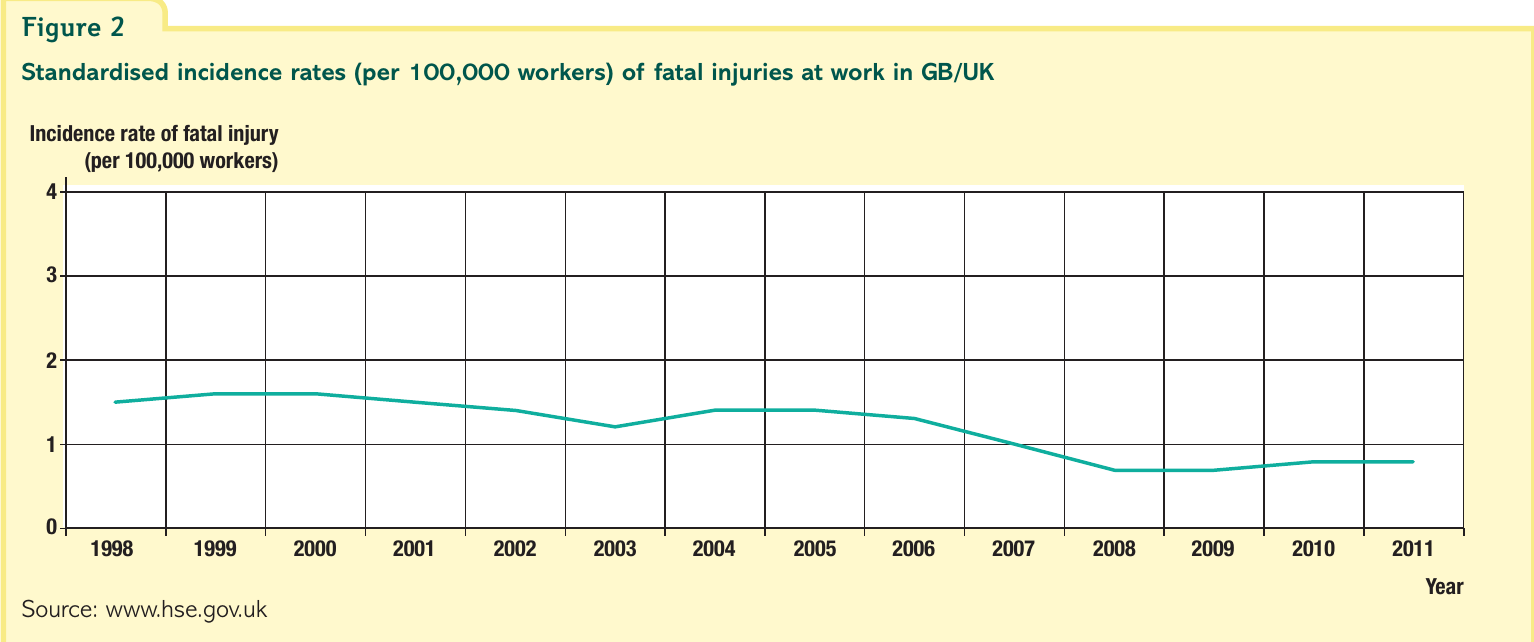
Workplaces can be dangerous environments. Figure 2 shows trends in fatal workplace injuries:
Note
The graph demonstrates that fatal injury rates declined from approximately per workers in 1998 to around - per by 2011, showing significant safety improvements over this period.
Why health and safety legislation is needed
Government legislation forces businesses to provide safe and healthy workplaces by:
- Providing and maintaining adequate safety equipment and protective clothing (fire extinguishers, protective overalls, hard hats, ear plugs, safety goggles)
- Ensuring workers have sufficient space
- Guaranteeing hygienic environments with adequate toilet and washing facilities
- Maintaining appropriate workplace temperatures and reasonable noise levels
- Providing protection from hazardous substances
- Protecting against violence, bullying, threats, and workplace stress
- Providing adequate rest breaks
Note
UK health and safety laws have existed for over 100 years, with regular regulation updates. Businesses may follow codes of practice protecting workers. UK regulations are influenced by EU health and safety directives.
How health and safety legislation affects businesses
Costs
The Health and Safety at Work Act 1974 requires businesses to prepare written general policy statements on health and safety. Businesses must provide training, information, instruction, and supervision ensuring worker health and safety. Meeting these requirements raises costs.
Large businesses employ health and safety officers solely responsible for ensuring legal compliance. Smaller firms attach health and safety duties to senior staff job descriptions.
Health and safety inspectors have rights to enter business premises ensuring measures are properly implemented.
Penalties
Non-compliance can be serious. Employee safety might be compromised, leading to accidents - sometimes fatal. Businesses face fines for failing to comply.
Example
Real-World Case: BW Biddle (2014)
BW Biddle, a Lincolnshire metal recycling business, was fined $70,000 plus $18,000 costs for breaching Section 2(1) of the Health and Safety at Work Act 1974.
The incident: An employee suffered broken ribs on both sides when a conveyor belt reactivated during maintenance because the electricity source hadn't been isolated.
The lesson: This case demonstrates the serious financial and human costs of failing to implement proper safety procedures, even for what might seem like routine maintenance tasks.
Benefits
Note
Despite imposed costs, health and safety legislation provides considerable benefits:
- Good health and safety records improve business image, making attracting and retaining quality staff easier, especially in industries with hostile working conditions
- Genuinely committed businesses make workers feel protected and secure
- Protected workers become better motivated and more loyal
- Workers become more productive
- Absence through workplace injuries reduces
- Staff turnover might decrease
Note
Key health and safety legislation:
- Health and Safety at Work Act 1974 - raised workplace health and safety standards; requires written policy statements
- Working Time Regulations Act 1998 - clarifies working hours and break entitlements; maximum 48-hour working week
Summary of key UK business legislation
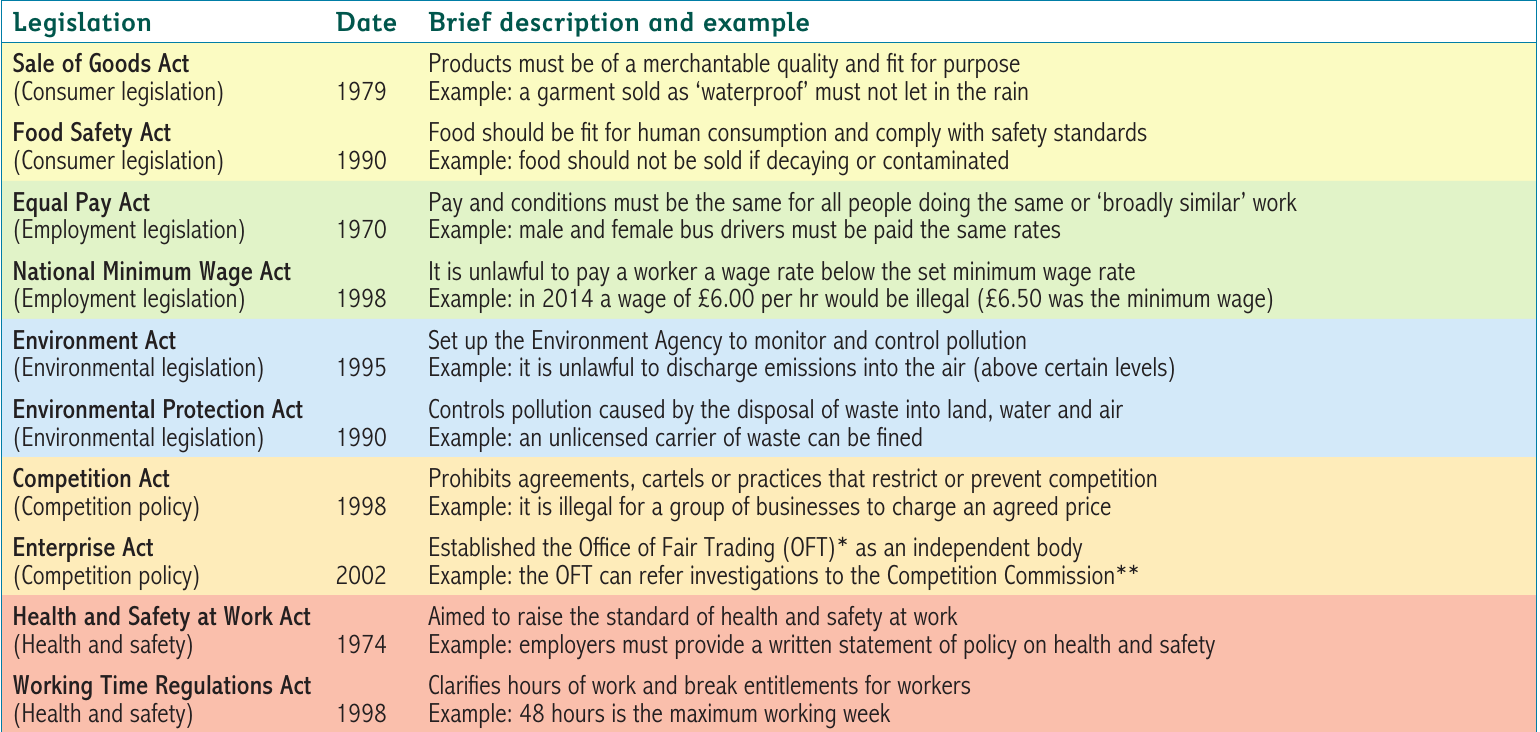
The table summarises major legislation across five categories:
Consumer legislation:
- Sale of Goods Act 1979 - products must be merchantable quality and fit for purpose
- Food Safety Act 1990 - food must be fit for consumption and meet safety standards
Employment legislation:
- Equal Pay Act 1970 - equal pay and conditions for same/similar work
- National Minimum Wage Act 1998 - unlawful to pay below minimum wage
- Equality Act 2010 - prohibits discrimination
Environmental legislation:
- Environment Act 1995 - established Environment Agency
- Environmental Protection Act 1990 - controls pollution from waste disposal
Competition policy:
- Competition Act 1998 - prohibits anti-competitive agreements
- Enterprise Act 2002 - established independent regulatory bodies (now CMA)
Health and safety:
- Health and Safety at Work Act 1974 - raised workplace safety standards
- Working Time Regulations Act 1998 - clarified working hours and breaks
Remember!
Summary
Key Takeaways:
-
Legislation balances stakeholder protection with business freedom - too much regulation stifles enterprise; too little leaves stakeholders vulnerable
-
Consumer protection increases business costs but improves quality control, customer service, and market orientation
-
Employment legislation creates compliance costs and raises wages but also levels the playing field, improves motivation, and reduces staff turnover
-
Environmental legislation affects marketing, finance, operations, and HR - creating both opportunities for green businesses and challenges for high polluters
-
Competition policy promotes innovation and efficiency but can delay mergers and impose conditions on business activities
-
Health and safety legislation raises costs through compliance requirements but reduces accidents, improves business image, and increases productivity