Capacity Utilisation (Edexcel A-Level Business): Revision Notes
📚Revision Notes
Capacity Utilisation
What is capacity utilisation?
Capacity utilisation measures how effectively a business uses its available resources. When a business operates at full capacity, it produces the maximum possible output and cannot increase production further without acquiring additional resources. At this point, capacity utilisation reaches 100 per cent.
Most businesses do not always operate at full capacity. When production falls below maximum output, the business has spare capacity (also called excess, surplus or unused capacity). For example, a coach with 52 seats carrying only 30 passengers operates below full capacity, with 22 spare seats representing unused capacity.
Note
While many businesses aim to operate close to full capacity (around 90 per cent), some deliberately maintain spare capacity. This provides flexibility to handle unexpected orders from regular customers without disappointing them or risking their loyalty.
Calculating capacity utilisation
Businesses calculate capacity utilisation by comparing actual output against maximum possible output. The formula is:

Example
Worked Example 1: Output in units
A printing operation can print 10,000 leaflets in a time period but only prints 9,000.
This means the printing operation has 10 per cent unused capacity.
Example
Worked Example 2: Time-based capacity
A printing operation can work ten hours per day, six days per week using shifts. Last week it operated for only 48 hours.
The operation has 20 per cent spare capacity.
Important
Exam tip: If you know capacity and capacity utilisation percentage, you can calculate current output by rearranging the formula. For example, if capacity is 120,000 units per month and utilisation is 91 per cent, current output = units.
Under-utilisation of capacity
A business under-utilises capacity when it produces significantly below its maximum potential output. This commonly occurs when demand falls due to increased competition or during periods of seasonal variation.
Causes of under-utilisation
Businesses experience under-utilisation for several reasons. A drop in demand, often caused by new competitors entering the market, forces businesses to reduce production. Seasonal demand patterns also create predictable periods of under-utilisation. For instance, toy manufacturers experience peak sales before Christmas but operate well below capacity in January and February when consumer demand falls sharply.
Drawbacks of under-utilisation
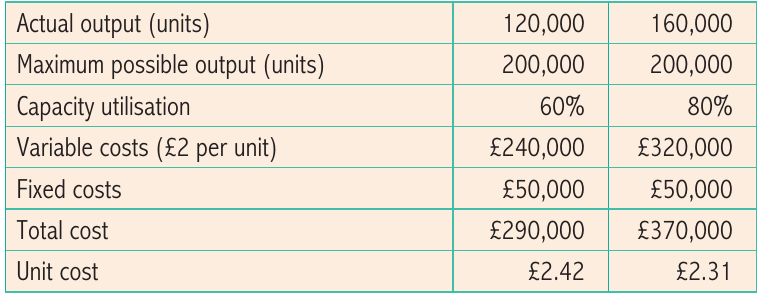
Operating with spare capacity creates significant inefficiencies that damage business performance. The most serious problem is increased unit costs (average costs per unit produced). Table 1 demonstrates this relationship clearly.
Important
When capacity utilisation increases from 60 per cent to 80 per cent, unit costs fall from $2.42 to $2.31. This occurs because fixed costs of $50,000 spread across more units of output. Since fixed costs remain constant regardless of production volume, higher output means each unit bears a smaller share of these costs. This explains why businesses prioritise raising capacity utilisation.
Under-utilisation also damages workforce morale. Employees may perceive the business as struggling to win orders, creating job insecurity. Workers who become accustomed to light workloads may resent sudden increases in work intensity when orders pick up, potentially causing resistance and tension.
Benefits of under-utilisation
Despite these drawbacks, operating below capacity offers some advantages. Businesses with spare capacity respond more effectively to sudden demand increases. Companies unable to meet immediate customer needs risk losing sales to more flexible competitors who can accommodate demand fluctuations quickly.
Note
Spare capacity also reduces work-related stress for both employees and managers. A more comfortable workload creates a relaxed working environment, potentially reducing sickness absence and staff turnover. This can improve long-term productivity and workplace satisfaction.
Over-utilisation of capacity
Many businesses prefer operating near full capacity because lower average costs improve competitiveness. However, over-utilisation occurs when a business runs at or above 100 per cent capacity, stretching resources uncomfortably. For example, employees working excessive overtime without adequate rest periods, or machinery running continuously without scheduled maintenance breaks.
Drawbacks of over-utilisation
Constant operation at full capacity strains resources significantly. The workforce experiences increased stress and fatigue, raising the risk of accidents and absence. Machinery pushed to breaking point becomes unreliable, particularly problematic for businesses using flow production techniques where production line breakdowns halt entire operations, causing expensive losses.
Important
Over-utilisation also reduces flexibility. Businesses cannot accept lucrative new orders because they lack capacity to fulfil them. This limitation prevents growth and may damage reputation if potential customers perceive the business as unable to meet their needs.
Critical activities like staff training and machinery maintenance get neglected when operating at full capacity. While this saves money short-term, long-term consequences include skill gaps in the workforce and equipment failures that cause costly disruption.
Benefits of over-utilisation
Operating at full capacity reduces average costs because fixed costs spread across maximum output. This improves competitiveness by enabling lower prices and increases profit margins on sales.
Staff motivation may improve when employees feel secure in their jobs. A busy operation creates opportunities for workers to increase earnings through overtime, boosting satisfaction. The company's image benefits from appearing successful and in-demand, which increases customer confidence when placing orders.
Important
Exam tip: When analyzing capacity utilisation problems, distinguish between long-term and short-term issues. Businesses facing seasonal under-utilisation require different solutions than those experiencing permanent demand decline. Recognizing this distinction demonstrates evaluation skills.
Ways of improving capacity utilisation
Businesses can adopt various strategies to optimize capacity utilisation, depending on whether they face under-utilisation or over-utilisation.
Reduce capacity through rationalisation
Rationalisation involves cutting excess capacity by eliminating unnecessary resources. This strategy suits businesses with persistent under-utilisation.
Businesses can reduce staffing levels by making redundancies, employing more part-time and temporary workers, and offering early retirement packages. Selling unused fixed assets like machinery, vehicles, warehouses and factory buildings releases capital and cuts ongoing costs.
Note
Leasing arrangements offer flexibility. Major retailers like Debenhams lease unused floor space to other businesses, generating rental income while retaining the option to reclaim space if demand recovers. Manufacturing businesses similarly sub-let parts of factories to other companies.
Moving to smaller, cheaper premises reduces fixed costs permanently. Alternatively, businesses can mothball resources by leaving machinery unused but maintained, ready for reactivation if demand increases. This preserves capacity options while cutting operational costs.
Increase sales
Higher sales volume requires increased production, automatically raising capacity utilisation. Businesses invest in promotional activities and marketing campaigns to boost demand. However, this strategy only succeeds if additional revenue exceeds promotional costs. Businesses must carefully evaluate whether increased sales justify marketing expenditure.
Increase usage during off-peak periods
Many businesses experience dramatic capacity utilisation variations throughout the day or year. Train operators run near 100 per cent capacity during rush hours but drop to 10 per cent late at night. These businesses benefit from encouraging off-peak usage through pricing incentives.
Note
Rail companies offer discounted railcards for off-peak travel, shifting demand away from peak periods. This smooths capacity utilisation across the day, improving efficiency without requiring additional resources.
Outsourcing
Outsourcing (or sub-contracting) means hiring external businesses to perform work previously done in-house. This strategy suits operations with consistently low capacity utilisation rates.
For example, a business running delivery vans only four hours daily could sell the fleet and contract a specialist delivery company. The delivery company operates vans more intensively throughout the day, achieving better capacity utilisation and lower unit costs. The original business eliminates underutilized assets and staff, reducing fixed costs.
Specialist outsourcing providers offer additional advantages. Their expertise and economies of scale enable more efficient operations. Bulk purchasing power secures lower equipment prices, and specialized industry knowledge improves service quality.
Note
Alternatively, businesses can accept outsourcing contracts from other companies. A soap manufacturer with spare capacity might produce products for rival brands, effectively using outsourcing to increase demand rather than reduce capacity.
Redeployment

Redeployment involves moving resources from areas with excess capacity to areas facing capacity constraints. Banks commonly redeploy employees to different branches experiencing temporary staff shortages. This flexible approach optimizes resource utilisation across the entire organization without redundancies or new hiring.
Key terms
- Capacity utilisation – the extent to which a business uses its available productive resources, expressed as a percentage of maximum possible output
- Full capacity – the point where a business cannot increase output without acquiring additional resources
- Excess or surplus capacity – when a business possesses more resources (labour and capital) than needed to produce current output levels
- Under-utilisation – operating below full capacity with unused resources available
- Over-utilisation – running at full capacity with resources stretched uncomfortably, potentially causing strain and inefficiency
- Rationalisation – reducing resource inputs (particularly labour and capital) to eliminate excess capacity
- Mothballing – leaving equipment or space unused but maintained for potential future use if demand recovers
- Outsourcing – contracting external businesses to perform work previously done internally
Summary
Key Points to Remember:
- Capacity utilisation formula: – the fundamental formula for measuring resource efficiency
- Higher capacity utilisation reduces unit costs because fixed costs spread across more output units, improving competitiveness and profitability
- Under-utilisation increases unit costs but provides flexibility to respond to demand increases and reduces workforce stress
- Over-utilisation reduces costs but strains resources, increases accident risk, and limits ability to accept new orders
- Rationalisation, outsourcing and redeployment represent effective strategies for improving capacity utilisation by matching resources to actual demand levels