Implications of Poor Stock Control (Edexcel A-Level Business): Revision Notes
📚Revision Notes
Implications of Poor Stock Control
Getting stock levels right is critical for business success. Holding either too much or too little stock creates operational and financial problems that can damage competitiveness and profitability.
Understanding the risks of poor stock control
Effective stock management requires businesses to maintain optimal inventory levels. When stock levels are incorrectly managed, whether through excess or shortage, the business faces significant challenges that impact costs, operations, and customer satisfaction.
Note
The key to successful stock control lies in finding the right balance. Too much stock creates waste and ties up capital, while too little stock leads to lost sales and production disruptions. Both extremes can seriously damage business performance.
Holding too much stock
Businesses that hold excessive stock levels face multiple cost burdens that reduce profitability and tie up valuable resources.
Storage expenses
Stock requires physical space, which generates ongoing costs. Raw materials, components, and finished goods all need storage facilities. Beyond the basic space requirement, businesses must pay for heating, lighting, and potentially security staff to protect inventory outside operating hours.
Note
Some products demand specialised storage conditions that significantly increase costs. For example, food items require expensive refrigerated facilities to prevent spoilage. Additionally, businesses typically need insurance coverage against fire, theft, and damage, adding further to storage expenses.
Opportunity cost
Money invested in stock holdings generates no returns while sitting in storage. This represents a significant opportunity cost, as the capital could be deployed elsewhere in the business to generate profits.
Example
Worked Example: Understanding Opportunity Cost
Imagine a business holds $50,000 worth of excess stock in a warehouse. If that money could instead be invested in new machinery that generates a 15% annual return, the opportunity cost would be:
Opportunity cost = $50,000 × 0.15 = $7,500 per year
This represents $7,500 in potential profits lost simply because the money is tied up in unnecessary inventory rather than being used productively.
Every pound spent on unnecessary stock is a pound unavailable for growth-generating investments.
Spoilage and deterioration
Many products deteriorate over time, particularly perishable goods like food items. Even non-perishable products can become problematic if held too long. Finished goods may become outdated as consumer preferences change or new models are released, making them difficult or impossible to sell at full price. This results in write-offs or forced discounting that damages profit margins.
Administrative and financial burdens
Managing large stock holdings creates substantial administrative work. Businesses incur costs when placing and processing orders, handling inventory movements, and managing stock records. There are also financial costs associated with failing to anticipate price changes, potentially missing opportunities to buy at lower prices.
Unsold inventory risk
Market conditions can change unexpectedly. An unforeseen reduction in demand leaves businesses with unsold stock that may need to be heavily discounted or written off completely.
Important
This risk increases with higher stock levels, as the business has more capital exposed to market fluctuations. A sudden market downturn can turn valuable inventory into worthless stock overnight, creating significant financial losses.
Shrinkage through theft
Large stock holdings can encourage employee theft. When businesses maintain very high inventory levels, employees may perceive that small amounts of missing stock will go unnoticed relative to total holdings. This can lead to increased theft rates and inventory shrinkage.
Holding too little stock
While businesses may try to avoid the costs of excess stock, maintaining insufficient inventory creates equally serious problems.
Inability to meet demand spikes
Businesses with minimal stock cannot respond to unexpected increases in customer demand. This leads to lost sales and, more seriously, lost customers who may turn to competitors after being disappointed repeatedly.
Important
Customer loyalty is difficult to rebuild once trust is broken through poor availability. A customer who experiences repeated stock-outs is likely to switch to a competitor permanently, representing not just a single lost sale but the loss of all future purchases from that customer.
Production disruptions
When stock deliveries are delayed and inventory levels are low, production may need to halt completely. This creates costly situations where labour and machinery sit idle while waiting for materials to arrive. The business continues to incur fixed costs without generating any output or revenue.
Vulnerability to supply shortages
Low stock levels leave businesses exposed to supply chain disruptions. Unexpected material shortages can stop production immediately when there are no buffer stocks to draw upon. This inflexibility can be particularly damaging in industries with complex supply chains.
Increased ordering costs
Maintaining very low stock levels requires placing orders more frequently. This raises total ordering costs through repeated administration and potentially higher per-unit purchasing costs. Additionally, businesses miss out on bulk purchasing discounts available when ordering larger quantities, increasing the cost of goods sold.
Just-in-time (JIT) management of stock
Just-in-time (JIT) is a stock management approach where materials and components arrive precisely when needed for production, minimising inventory holdings. JIT forms a key element of lean production and the Kaizen continuous improvement philosophy.
Origins and development
JIT was developed in the Japanese shipbuilding industry during the 1950s and 1960s. Shipbuilders recognised that holding one month's supply of steel tied up enormous amounts of capital without adding value. As competition intensified, they demanded that steel suppliers deliver orders 'just in time' – sometimes just hours before the steel was needed. This reduced working capital requirements and improved financial performance.
The approach was then extended throughout entire production processes. Raw materials arrived JIT to be made into parts, parts arrived JIT to be assembled into products, and products were completed JIT to be sold. The system spread to other Japanese industries, particularly automotive manufacturing, before being adopted by Western businesses.
JIT in practice: the JCB example
Example
Worked Example: JIT Implementation at JCB
JCB's Rochester plant demonstrates JIT principles effectively:
Pre-production: Every excavator manufactured on the production line is already sold before production begins. This eliminates the risk of unsold inventory.
Component delivery: Supplies such as engines from Perkins arrive on the day they are needed, not weeks in advance.
Raw materials: Steel plate and other materials arrive just hours before use in production.
Result: This system requires exceptional organisational skills and completely reliable suppliers, but delivers significant benefits when implemented successfully, including minimal working capital tied up in stock and virtually no storage costs.
Advantages and disadvantages of JIT
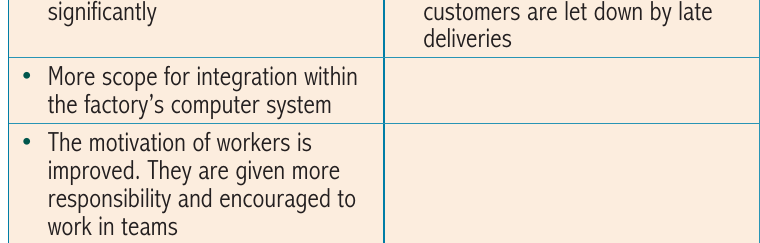
| Advantages | Disadvantages |
|---|---|
| Improves cash flow by releasing capital tied up in stock | Requires complete reliability and flexibility from suppliers |
| Reduces waste from obsolete and damaged stock | Increases ordering and administration costs |
| Frees factory space for productive use | Loses advantages of bulk purchasing discounts |
| Significantly reduces stockholding costs | Vulnerable to supply chain disruptions and machinery breakdowns |
| Improves supplier relationships and control | Difficult to cope with sharp increases in demand |
| Reduces supplier base, simplifying management | Risk of reputation damage from late deliveries to customers |
| Enables better integration within factory computer systems | Places heavy reliance on supplier performance |
| Improves worker motivation through increased responsibility and teamwork | Requires significant cultural and operational changes |
Important
JIT delivers major benefits but depends completely on reliable, flexible suppliers and sophisticated coordination. A single supplier failure can halt entire production processes, making supplier selection and relationship management critical to JIT success.
Kanban systems in JIT
Many businesses using JIT employ Kanban systems to control material flow. Kanban is a Japanese term meaning signboards or cards. These systems use physical signals, such as plastic markers or coloured ping-pong balls, to trigger specific actions:
-
Conveyance kanbans inform employees in earlier production stages that particular parts must be taken from stock and sent to specific destinations.
-
Production kanbans tell employees they can begin production and add their output to stock.
-
Vendor kanbans instruct external suppliers to deliver parts to designated locations.
Note
Kanbans trigger resource movement or production only when needed. When used correctly, they become the sole means of authorising movement, preventing stock build-up in factories. This makes Kanban systems essential for successful JIT implementation.
Waste minimisation
Poor stock control frequently results in wasted inventory, particularly with perishable goods. Perishable stocks physically deteriorate after a certain time and must be discarded. Examples include fresh produce, meat, cakes, flowers, ready-mix concrete, airline meals, stored blood, vaccines, and biological medicines.
Stock can also become obsolete when it has a limited lifespan. Examples include newspapers, magazines, seasonal items like Valentine's Day cards, and event-specific merchandising for concerts or sports fixtures. Businesses handling these products must implement rigorous stock control measures.
Strategies to minimise waste
Refrigeration and proper storage: Perishable goods must be stored in refrigerated units. Refrigeration extends product life, especially during warm weather, reducing waste from premature spoilage.
Note
Temperature control is crucial for many perishable items. Even small variations in storage temperature can significantly reduce shelf life and increase waste rates. Businesses must invest in reliable refrigeration systems and regular temperature monitoring.
Accurate demand forecasting: Businesses must forecast demand patterns carefully for perishable goods. Overestimating demand leads to unsold stock and waste. Many businesses use complex quantitative techniques incorporating historic demand data, shelf life information, lead times, and storage costs to predict demand accurately.
Stock rotation systems: Adopting the FIFO (first in, first out) method ensures older stock is used before newer deliveries. This stock rotation technique prevents products from exceeding their use-by dates while sitting in storage.
Important
FIFO is essential for perishable goods management. Failing to implement proper stock rotation can result in newer stock being used while older stock expires in storage, creating unnecessary waste and financial losses.
Computerised stock control: Computer systems can automate stock management by recording all stock movements and automatically ordering when re-order levels are reached. In supermarkets, checkout systems record every purchase and immediately update stock levels. Most large businesses rely on computerised stock control for accuracy and efficiency.
Adjustable pricing strategies: When stock levels remain high as sell-by dates approach, businesses can reduce prices to stimulate purchases. Dynamic pricing helps clear perishable inventory before it becomes waste.
Rapid transportation: Perishable goods need quick delivery to market. Faster transportation ensures products reach customers in optimal condition with maximum remaining shelf life. Some perishable products, such as food and flowers, are transported by air to minimise transit time.
Creative disposal methods: Businesses can find innovative ways to use products past their sell-by dates. Food products might be donated to charities or sold as animal feed. Newspapers and magazines are typically recycled, recovering some value rather than simply discarding them.

Competitive advantage from lean production
JIT stock control is typically a central component of lean production strategies. Lean production aims to minimise resource use throughout operations. Businesses employ various techniques including Kaizen, cell production, flexible manufacturing, teamworking, empowerment, and multi-skilling to eliminate waste.
Lean producers use less time, fewer materials, less labour, less space, and fewer suppliers than traditional manufacturers. This reduction in waste and resource consumption lowers production costs, creating competitive advantages.
Benefits of lean production
Increased productivity: Eliminating waste and streamlining processes allows businesses to produce more output from the same inputs.
Reduced costs and shorter lead times: Lower resource consumption and faster processes reduce costs throughout operations while speeding delivery to customers.
Fewer defective products: Quality improvement techniques reduce error rates and defects, lowering waste and rework costs.
Improved reliability and faster design: Simplified processes and better supplier relationships improve reliability while accelerating product development.
Note
These improvements enable businesses to charge lower prices while maintaining profitability, offer superior quality and reliability, and compete effectively in global markets. Lean production creates sustainable competitive advantages by embedding efficiency throughout the organisation.
Summary
Key Points to Remember:
-
Poor stock control damages business performance – both excess and insufficient stock create serious operational and financial problems.
-
Excess stock ties up capital – money invested in unnecessary inventory generates no returns and represents opportunity cost that could have been used for profit-generating investments.
-
JIT requires excellent supplier relationships – just-in-time systems deliver major benefits but depend completely on reliable, flexible suppliers and sophisticated coordination.
-
Waste minimisation needs multiple strategies – effective approaches include refrigeration, accurate forecasting, FIFO stock rotation, computerised control, dynamic pricing, and rapid transportation.
-
Lean production creates competitive advantage – reducing waste and resource use throughout operations lowers costs, improves quality, and enables businesses to compete more effectively in global markets.