Production (Edexcel A-Level Business): Revision Notes
📚Revision Notes
Production
Production is a fundamental business activity that transforms inputs into outputs. Understanding different production methods helps businesses choose the most appropriate approach for their products, market demands, and operational capabilities.
What is production?
Production occurs when resources such as raw materials or components are transformed into finished products. This process uses the factors of production: land, labour, capital, and enterprise.
Production can be classified into three industry sectors:
- Primary industry: Extracting raw materials from natural resources (e.g., farming, mining, fishing)
- Secondary industry: Manufacturing and construction activities that transform raw materials into finished goods (e.g., furniture making, car manufacturing)
- Tertiary industry: Service sector activities that provide intangible products (e.g., banking, insurance, car repairs)
Note
Modern business uses the term 'production' broadly to include any activities that bring a product or service into being. A bank might refer to its range of accounts and financial products in the same way a manufacturer describes physical goods.
Methods of production
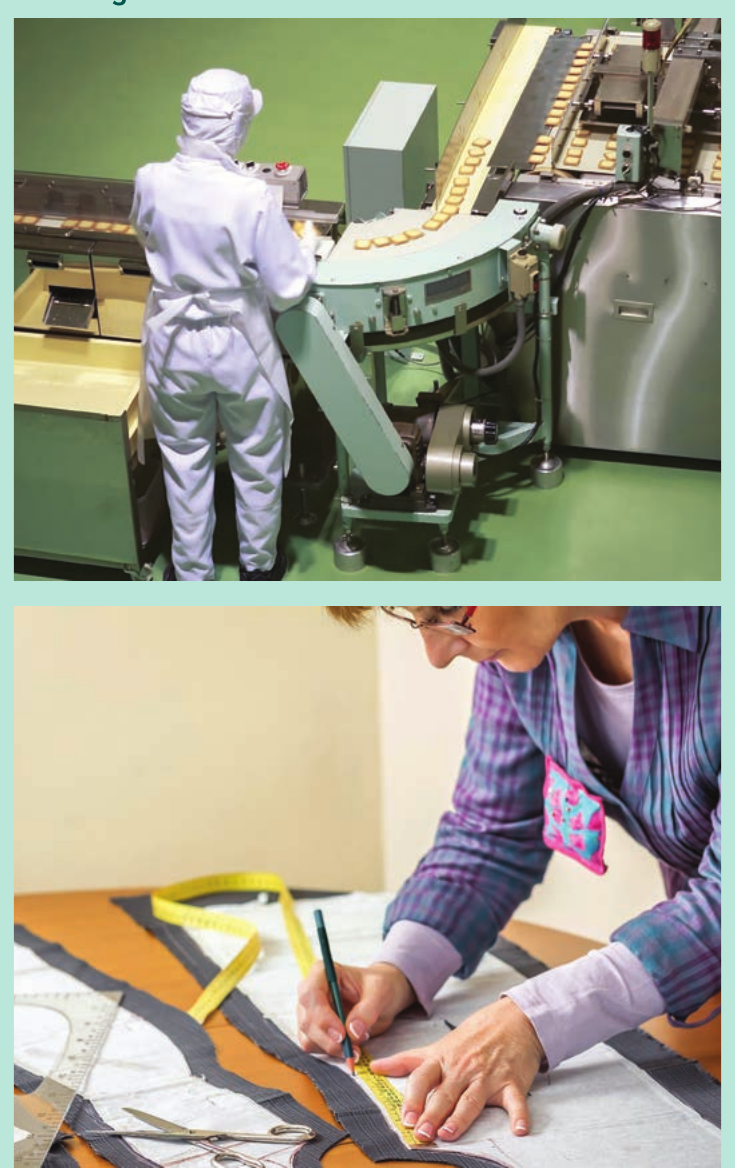
Businesses use different production methods depending on factors such as demand levels, product complexity, customization requirements, and available resources. The four main methods are job, batch, flow, and cell production.
Job production
Job production involves manufacturing a single item or project at a time. Each product is treated as a unique 'job' that must be completed before moving to the next order.
Characteristics of job production:
- Production organized around completing one job at a time
- Typically used for one-off orders or small quantities
- Workforce consists of highly skilled workers or specialists
- Production tends to be labour intensive rather than capital intensive
- Limited use of automated machinery
- Common in both manufacturing and service industries
- Often adopted by businesses in their start-up phase
Example
Examples of Job Production:
Small scale:
- Custom birthday cakes tailored to client specifications
- Dental treatments customized for individual patients
- House extensions designed for specific properties
- Bespoke furniture crafted to customer requirements
Large scale:
- Shipbuilding projects (cruise liners, naval vessels)
- Major infrastructure projects (e.g., Crossrail underground railway)
- Specialized machinery manufacturing for unique industrial applications
Advantages and disadvantages of job production:
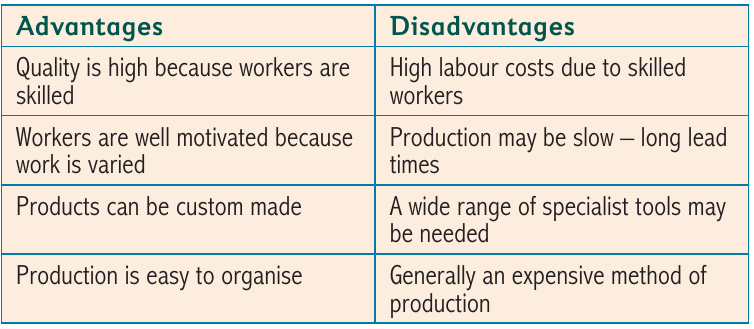
Job production allows businesses to create exactly what customers want, leading to high-quality, customized products. Workers often feel motivated because their work is varied and requires skill. However, this method is expensive due to high labour costs and slow production times. Businesses using job production need a wide range of specialist tools and equipment, which adds to costs.
Batch production
Batch production is used when demand is regular but not continuous. Products are made in groups or 'batches', with each batch undergoing the same series of operations before moving to the next stage.
Characteristics of batch production:
- Production divided into distinct operations
- Each operation performed on all items in a batch before proceeding
- Some standardization within each batch
- Flexibility to vary specifications between batches
- Commonly used in manufacturing, particularly food processing and component production
Example
Worked Example: Bread Production Process
A baker producing bread in batches would follow these sequential operations:
| Stage | Operation |
|---|---|
| 1 | Blend ingredients in mixing container until dough forms |
| 2 | Knead the dough for required time |
| 3 | Leave dough to rise |
| 4 | Divide dough into individual loaves |
| 5 | Bake the loaves |
| 6 | Allow loaves to cool |
After completing all operations on one batch, the baker can adjust ingredients or tin shapes to produce a different batch (e.g., brown bread instead of white bread).
Advantages and disadvantages of batch production:
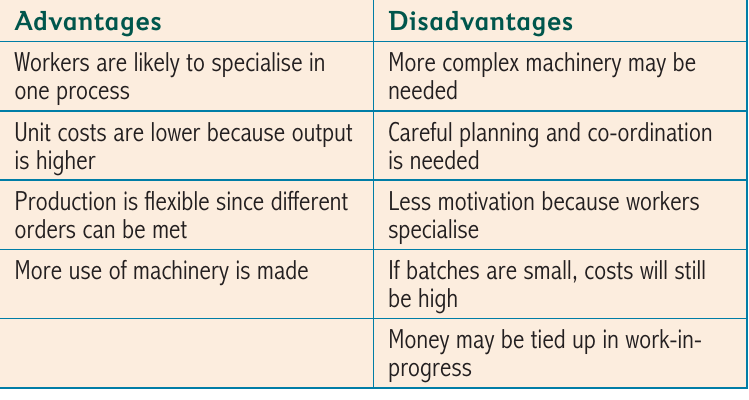
Batch production allows businesses to achieve lower unit costs than job production because output volumes are higher. The method provides flexibility to meet different customer orders while making better use of machinery. However, it requires careful planning and coordination to manage multiple batches efficiently. Worker motivation may decline because employees often specialize in repetitive operations. If batch sizes are small, costs remain relatively high, and capital can become tied up in work-in-progress (partially completed goods).
Flow production
Flow production (also called mass production) organizes production as a continuous sequence of operations. Products move from one operation to the next, typically on a conveyor belt system, until completion.
Key features of flow production:
- Production of large quantities
- Standardized or simplified products
- Semi-skilled workforce, each specializing in one operation
- Significant investment in machinery and equipment
- Large stocks of raw materials and components maintained
Types of flow production:
- Continual flow production: Products pass continuously through processes (e.g., textile manufacturing, paper production)
- Repetitive flow production: Large quantities of identical products manufactured repeatedly (e.g., toy parts, metal cans, cars)
Flow production is used for diverse products including newspapers, breakfast cereals, cement, and vehicles. Car manufacturing represents the classic example, with vehicles progressing along assembly lines through sequential operations.
Advantages and disadvantages of flow production:
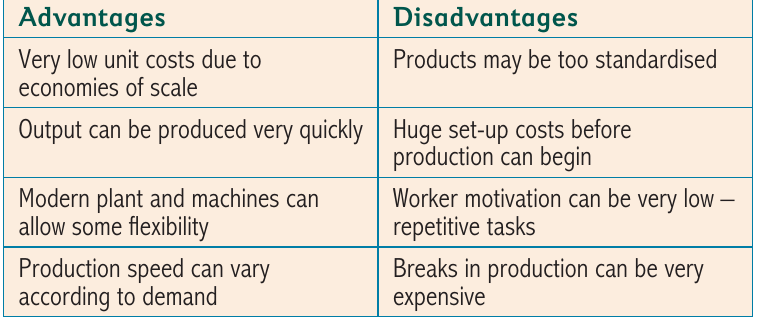
Flow production achieves very low unit costs through economies of scale. Modern equipment can produce output quickly and, increasingly, with some flexibility. Production speed can be adjusted to match demand levels. However, this method requires huge initial investment before production begins. Products tend to be standardized, limiting customer choice. Worker motivation often suffers due to repetitive, monotonous tasks. Any production breakdown becomes extremely expensive because the entire line stops.
Important
Developments in Flow Production
Since the 1990s, manufacturers have adapted flow production to address traditional problems. Japanese companies introduced techniques like just-in-time manufacturing to reduce stock-holding costs. Some vehicle manufacturers incorporated customization into flow processes by producing different variants (colours, engine sizes, trim levels) on the same production line, combining elements of job production with flow efficiency.
Cell production
Cell production (or cellular manufacturing) represents an alternative approach to traditional flow production. Instead of linear production lines, the workplace is divided into self-contained 'cells'.
How cell production works:
- Each cell occupies a defined area on the factory floor
- Cells focus on producing a 'product family' – groups of products requiring similar operations
- Machines are grouped together within each cell
- Teams of workers see production through from start to finish
- Cells may handle additional responsibilities: design, scheduling, maintenance, problem-solving
Example
Worked Example: Furniture Cell Production
A cell manufacturing kitchen furniture parts might:
- Receive raw materials (e.g., wood) into the cell
- Perform operations at various workstations (turning on lathe, routing, shaping)
- Assemble completed parts
- Transfer finished items to stock
All manufacturing tasks are shared by the cell team, promoting collaboration and ownership.
Note
Advantages of cell production:
- Reduced floor space requirements compared to linear production lines
- Improved product flexibility
- Shorter lead times
- Less movement of materials and resources
- Reduced work-in-progress
- Encourages teamworking and employee engagement
- Potentially safer working environment
- More efficient maintenance
Productivity
Productivity measures how efficiently a business uses resources to generate output. It is the amount of output produced with a given quantity of inputs in a specific time period.
Important
Improving productivity is crucial because it reduces costs and increases profitability. Higher productivity means producing more output with the same resources, or the same output with fewer resources.
Labour productivity
Labour productivity measures output per worker in a given time period.
Formula:
Example
Worked Example: Calculating Labour Productivity
A factory producing mobile homes employed 40 workers in 2014 and produced 1,200 units during the year.
Solution:
Result: The factory produced 30 homes per worker during the year.
Measurement challenges:
- Which workers should be included? (shop floor workers only, or also management, maintenance, clerical staff?)
- How to treat part-time workers and long-term sick employees?
- How to measure productivity in multi-product facilities where workers contribute to several products?
Capital productivity
As businesses become increasingly capital intensive, measuring the productivity of machinery and equipment becomes more important.
Capital productivity measures output per unit of capital employed in a given period.
Formula:
Example
Worked Example: Calculating Capital Productivity
A factory used 10 sewing machines and produced 900 garments in one day.
Solution:
Result: Each sewing machine produced 90 garments per day on average.
The difference between production and productivity
Important
It is essential to distinguish between these related but different concepts:
- Production refers to the level or volume of output produced
- Productivity measures the rate or efficiency of production – how much output is generated per unit of input
A business might increase production by hiring more workers, but this doesn't necessarily improve productivity. Productivity only increases when more output is achieved with the same (or fewer) resources.
Factors influencing productivity
Businesses continuously seek to improve productivity to reduce costs and increase profitability. Key factors that influence productivity include:
Training and skills development: Better-trained workers complete tasks more quickly and accurately, reducing waste and rework.
Quality of equipment: Modern, well-maintained machinery operates more efficiently than outdated equipment, producing more output per hour.
Working methods: Improved processes and efficient workflows eliminate unnecessary steps and reduce production time.
Employee motivation: Motivated workers are more productive, showing greater commitment to quality and efficiency.
Technology and automation: Investment in new technology can significantly boost productivity by automating repetitive tasks and reducing human error.
Management and organization: Effective planning, clear communication, and good coordination ensure resources are used efficiently.
Labour intensive vs capital intensive production
Production methods can be classified based on the relative importance of labour versus capital:
Labour intensive production relies primarily on human workers rather than machinery. Characteristics include:
- High proportion of total costs spent on wages
- Significant involvement of skilled workers
- Common in job production and some batch production
- Examples: hairdressing, construction, bespoke tailoring
Capital intensive production depends heavily on machinery, equipment, and technology. Characteristics include:
- High initial investment in plant and equipment
- Lower proportion of costs spent on labour
- Common in flow production and some batch production
- Examples: car manufacturing, oil refining, chemical processing
Note
The choice between labour and capital intensive production depends on factors including product type, scale of production, labor costs, technology availability, and customer requirements.
Summary
Key Points to Remember:
-
Production transforms resources into finished products or services, occurring across primary, secondary, and tertiary industries.
-
Four main production methods serve different business needs: job production (one-off items), batch production (groups of similar products), flow production (continuous mass production), and cell production (team-based product families).
-
Each production method has distinct advantages and disadvantages: job production offers customization but high costs; batch production provides flexibility but requires coordination; flow production achieves low unit costs but reduces variety; cell production improves motivation but requires reorganization.
-
Productivity measures efficiency: labour productivity (output per worker) and capital productivity (output per unit of capital) indicate how effectively resources generate output.
-
Don't confuse production with productivity: production is the volume of output; productivity is the rate or efficiency of production per unit of input.
Key formulas: