Productivity and Efficiency (Edexcel A-Level Business): Revision Notes
📚Revision Notes
Productivity and Efficiency
What is productivity?
Productivity measures how much output a business can generate from its available resources. It focuses on the relationship between inputs (resources used) and outputs (goods or services produced).
Important
Key distinction: Productivity differs from production. Production refers to the total level of output created, while productivity measures the rate of production—how much output is produced per unit of input in a given time period.
Productivity improves when a business generates more output using the same amount of resources.
Measuring productivity
Businesses commonly measure productivity for specific resources over time. The two main types are labour productivity and capital productivity.
Labour productivity
Labour productivity = Total output ÷ Number of workers
This measures output per worker during a specific time period.
Example
Worked Example: Calculating Labour Productivity
A factory producing mobile homes employed 40 workers in one year. They manufactured 1,200 homes in total.
Labour productivity = 1,200 ÷ 40 = 30 homes per worker per year
Important
Measurement challenges:
- Which workers should be counted? Should the calculation include maintenance staff, managers, and administrative workers, or only direct production workers?
- How should part-time workers be treated?
- How should long-term sick employees be handled?
- In multi-product facilities, how do you account for workers contributing to several different products?
Capital productivity
Capital productivity measures output generated per unit of capital equipment.
Capital productivity = Total output ÷ Amount of capital employed
This calculation is becoming increasingly important as businesses rely more heavily on machinery and equipment.
Example
Worked Example: Calculating Capital Productivity
A factory uses 10 sewing machines. In one day, 900 garments are produced.
Capital productivity = 900 ÷ 10 = 90 garments per machine per day
Factors influencing productivity
Businesses aim to improve productivity over time because higher productivity leads to lower costs and increased profit. Several key factors can boost productivity levels.
Specialisation and division of labour
Specialisation occurs when individuals, businesses, regions or nations focus on producing a limited range of goods or services. For example, Coca-Cola specialises in soft drinks, while Toyota focuses on manufacturing cars.
Within businesses, departments specialise in different functions (marketing, production, finance, human resources). Workers also specialise through the division of labour—concentrating on specific, limited tasks rather than completing entire products.
Note
For example, in construction: architects design buildings, bricklayers build walls, electricians install wiring, and roofers complete the roof. This specialisation allows workers to develop expertise in their specific area, increasing overall productivity.
Education and training
Government investment in education improves labour quality by providing better school equipment and teaching standards. This creates a more skilled workforce.
Businesses can directly enhance worker productivity through training programmes. Well-trained employees work more efficiently and make fewer errors.
Motivation of workers
Motivated workers demonstrate higher productivity levels. Businesses can use various approaches:
Financial incentives: Piece rates pay workers based on output quantity, directly linking effort to earnings.
Non-financial incentives: Some workers respond better to alternative motivators. Job rotation involves employees changing roles periodically. When workers are trained for multiple tasks, their work becomes more varied and interesting, potentially boosting motivation and productivity.
Working practices
Working practices are the methods and systems employees use while performing their work. Changes to these practices can significantly affect productivity.
Note
For example, modifying factory layout—repositioning workstations or reorganising production flow—can improve productivity by reducing the distance workers must travel or eliminating unnecessary movements.
Labour flexibility
Flexible labour means workers can perform different jobs and switch between tasks at short notice.
Multi-skilling: Supermarkets often train most staff to operate checkouts. During busy periods, workers from other departments can switch to checkout operation, preventing long customer queues.
Flexitime: Workers choose their working hours within set limits. This allows businesses to extend operating hours. For example, a call centre might remain open from 7:00 AM to 8:00 PM using flexitime arrangements.
Shift work: Factories can operate 24 hours daily using multiple shifts (e.g., 08:00-16:00, 16:00-00:00, 00:00-08:00), maximizing equipment usage and overall productivity.
Capital productivity
Introducing new technology typically increases productivity because modern equipment operates more efficiently than older machinery. Productivity also rises when production becomes more capital intensive (using more machinery relative to labour).
Productivity and competitiveness
Higher productivity enables businesses to produce more output using the same resource levels. This reduces unit costs, allowing businesses to charge lower prices than competitors.
Note
Competitive advantages:
- Lower prices attract more customers
- Increased market share
- Potential to threaten rival businesses' survival
National competitiveness: When UK businesses improve productivity, they become more competitive in international markets. This boosts exports and strengthens economic performance, potentially raising living standards.
Important
Limitation: Improved productivity alone doesn't guarantee international success. Other factors matter, particularly exchange rates. If the pound strengthens, UK export prices rise in foreign currencies, potentially offsetting productivity gains.
What is efficiency?
Efficiency focuses on optimizing the use of all business resources—materials, labour, and capital. Businesses want to use their resources as effectively as possible.
Cost-based measurement: Businesses typically use costs as an efficiency indicator. Production achieves maximum efficiency when average costs are minimised.
Note
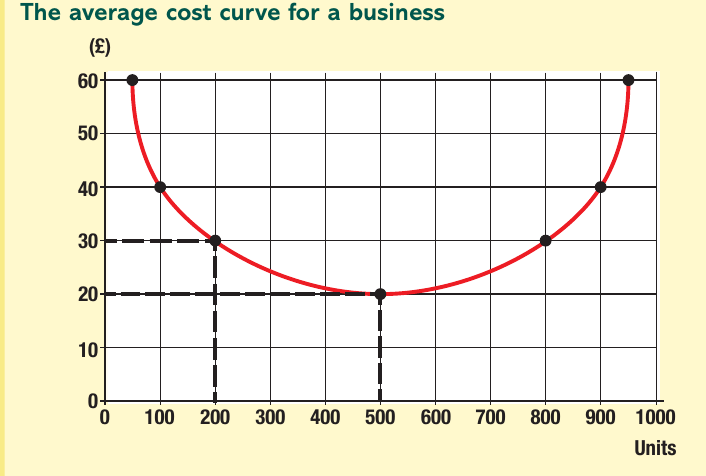
The average cost curve shows how costs per unit change with output levels. Average costs initially fall, reach a minimum point, then rise again.
In this example, efficiency is maximised at 500 units of output, where average cost reaches its lowest point of £20 per unit. All resources are being used as effectively as possible at this production level.
At 200 units, average cost is £30—higher than the minimum. This indicates inefficiency, as resources are not being used optimally.
Factors influencing efficiency
Businesses can improve efficiency by reducing average costs. Multiple strategies can achieve this goal.
Standardisation
Standardisation involves using uniform resources, activities, processes, or products. It applies to tools, components, equipment, procedures, and documentation.
Example
Example: Standardisation in Construction
A construction company building an apartment block benefits from installing identical kitchen and bathroom units in all flats. This enables:
- Bulk purchasing discounts
- Using the same tools and procedures for all installations
- Reduced training time for workers
- Lower overall costs
Standardisation generally improves efficiency through standard components (nuts, screws, bolts, pipes, wire) and standard measurements, terminology, procedures, and equipment.
Important
Drawback: Standardisation reduces flexibility, making customisation more difficult and design changes more challenging.
Outsourcing
Outsourcing means contracting work currently done internally to external specialists who can complete it at lower cost or with greater flexibility.
Note
Example: A call centre might outsource staff catering to a specialist catering company that operates more efficiently and at lower cost than in-house provision.
Relocating
Moving the entire business to a new location represents a major decision but can substantially reduce costs. Relocation benefits may include:
- Lower rental costs
- Reduced wage expenses
- Better transport links
- Access to larger labour pools
Many businesses have relocated to countries like China, Thailand, and India, where labour costs are significantly lower than in the UK.
Downsizing
Downsizing involves reducing business capacity by laying off workers and closing unprofitable divisions.
Advantages:
- Cost savings and increased profit
- Creates a leaner, more competitive operation
- Removes unprofitable or inefficient business parts
- Profitable divisions no longer subsidise loss-making ones
Drawbacks:
- Loss of skills, experience, and knowledge
- Some businesses have had to rehire redundant staff as expensive consultants
- Negative impact on remaining workers' morale
Delayering
Delayering reduces staff by removing specific organizational levels, particularly management positions. Traditional hierarchical structures contain multiple management layers. Delayering eliminates some layers, creating a flatter structure.
Note
In the late 1980s, typical organizations had seven layers, with some reaching fourteen. By 2000, this had fallen to fewer than five layers.
Advantages:
- Savings from reducing expensive management positions
- Improved communication across the organization
- Better staff motivation through empowerment and increased decision-making responsibility
New technology investment
New technology often improves efficiency significantly. Modern machinery typically operates faster, more accurately, and can perform more complex tasks than older equipment or manual labour. Computer-controlled machines can undertake highly complex operations.
Information and communications technology has helped most businesses enhance efficiency across various operations.
Lean production
Lean production is an approach developed by Toyota focusing on using fewer resources in production. Lean producers minimize everything: factory space, materials, stocks, suppliers, labour, capital, and time.
Note
Benefits of lean production:
- Raises productivity
- Reduces costs and shortens lead times
- Decreases defective products
- Improves reliability and accelerates product design
Lean production uses various practices designed to reduce waste and improve productivity and quality, including Kaizen, just-in-time production, cell production, empowerment, and teamworking.
Kaizen
Kaizen is a Japanese term meaning continuous improvement. It reflects the Japanese philosophy that everything can be improved.
Workers constantly generate ideas to improve quality, reduce waste, or increase efficiency. Individual improvements may be very small, but accumulate substantial impact over time.
Just-in-time production (JIT)
JIT involves minimising or eliminating stock holdings. This approach reduces all costs associated with holding inventory, including storage costs, insurance, deterioration, and tied-up capital.
Labour intensive vs capital intensive production
A crucial production decision for operations managers is determining the optimal combination of capital and labour.
Labour intensive production uses a larger proportion of labour relative to capital. Example: postal services employ substantial workforces for sorting and delivery.
Capital intensive production employs more machinery relative to labour. Example: chemical production uses extensive automated equipment with only small workforces overseeing processes.
Factors affecting the labour-capital mix
Nature of the product: Mass-market products with high demand (like newspapers) are mass-produced using extensive machinery. In contrast, services in modern economies like the UK are generally labour intensive.
Relative factor prices: Rising labour costs may encourage businesses to use more capital instead. In countries like China and India where labour costs are low, labour intensive methods are preferred. In developed economies like the UK where labour is expensive, manufacturing tends to be capital intensive.
Firm size: As businesses grow and production scale increases, they typically employ more capital relative to labour. For example, Morgan Cars (small UK sports car manufacturer) uses labour intensive production, while Honda's large Derby factory uses capital intensive methods.
Note
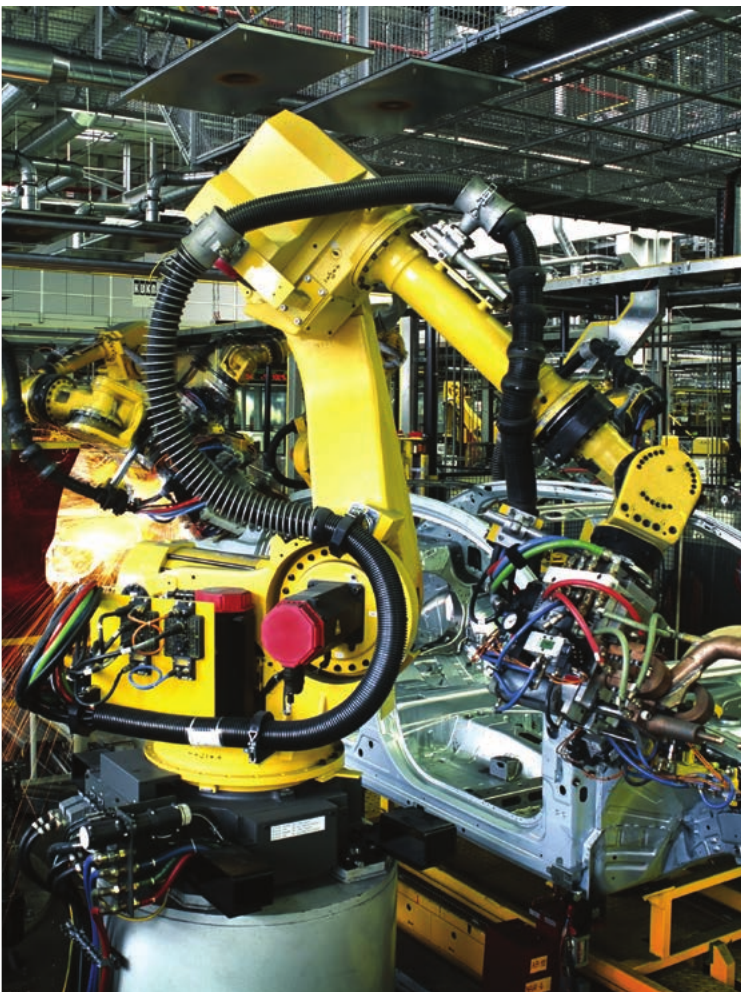
Industrial robotic arms illustrate capital intensive production, where machinery dominates the production process with minimal human labour.
Benefits and drawbacks comparison
Capital intensive strategies
Benefits:
- Generally more cost-effective for large-scale production
- Machinery provides greater precision and consistency than manual work
- Equipment can operate 24/7 without breaks
- Machinery is easier to manage than people
Drawbacks:
- Requires huge initial investment costs
- Equipment breakdowns cause expensive delays
- Often inflexible—much machinery is highly specialized
- Can pose threats to workforce and reduce morale
Labour intensive strategies
Benefits:
- More flexible than capital—workers can be retrained for different tasks
- More economical for small-scale production
- Cheaper for large-scale production in low-wage countries
- People bring creativity, problem-solving abilities, and continuous improvement ideas
Drawbacks:
- People are more difficult to manage than machines—they have feelings and react to situations
- Workers can be unreliable—illness, absence, or sudden departure
- People require breaks and holidays
- Workers sometimes need motivation to maintain or improve performance
Remember!
Summary
Key points:
- Productivity measures output per resource unit—it differs from production (total output). Higher productivity means more output from the same resources, reducing costs.
- Labour productivity = Output ÷ Workers. Capital productivity = Output ÷ Capital employed. Both measurements help businesses track resource efficiency.
- Improve productivity through: specialisation and division of labour, education and training, worker motivation, better working practices, labour flexibility, and capital investment.
- Efficiency focuses on minimizing average costs. The average cost curve shows efficiency is maximized at the lowest point (minimum average cost).
- Boost efficiency through: standardisation, outsourcing, relocating, downsizing, delayering, new technology, lean production, Kaizen, and JIT.
- Choose between labour and capital intensive production based on product type, relative factor costs, and firm size. Each approach has distinct advantages and limitations.
Key terms:
- Productivity, labour productivity, capital productivity, efficiency, specialisation, division of labour, standardisation, outsourcing, downsizing, delayering, lean production, Kaizen, just-in-time (JIT), labour intensive, capital intensive
Essential formulas:
- Labour productivity = Total output ÷ Number of workers
- Capital productivity = Total output ÷ Amount of capital employed