Ethics (Edexcel A-Level Business): Revision Notes
📚Revision Notes
Ethics
What is business ethics?
Ethics refers to the principles and norms that shape how individuals and organisations behave. In business, ethics concerns the moral standards applied to commercial decisions and activities. While business ethics at company level covers trade-offs between profit and ethical behaviour, at the international level ethics becomes more complex. Different countries have varying laws and cultural norms, meaning what is considered ethical in one nation may not be viewed the same way in another.
Note
The complexity of international business ethics stems from navigating multiple legal systems and cultural frameworks simultaneously. What is perfectly acceptable business practice in one country might be considered unethical or even illegal in another.
When multinational corporations (MNCs) operate internationally, they must navigate the institutional framework of both their home country and any host countries. This can create tension. A firm might be acting legally in its home country but be seen as unethical abroad, or vice versa.
Corruption means using public power for personal gain. The most common form of corrupt practice is bribery, but identifying what counts as a bribe can be difficult. For example, gift-giving between business colleagues is standard practice in many Asian and Arab cultures, yet in North America and Europe it may be viewed as inappropriate or illegal. In the UK, employees can face prosecution for offering or accepting bribes.
To address these challenges, many international businesses develop written codes of conduct. These documents provide clear guidance to help employees make ethical decisions when faced with difficult situations.
Stakeholder conflicts
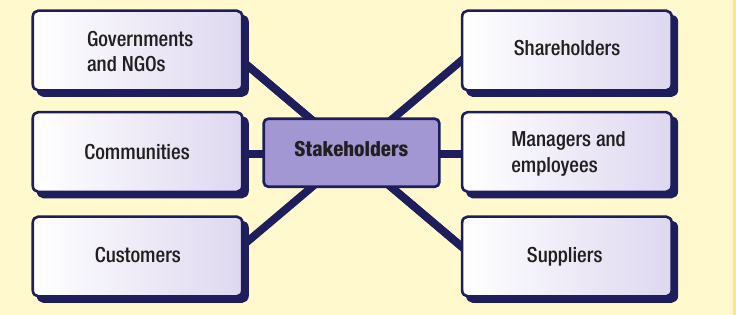
A stakeholder is any individual or group that affects, or is affected by, an organisation's decisions and activities. In international firms, stakeholders include a diverse range of parties with different and sometimes conflicting interests.
Types of stakeholder conflicts
Ethical conflicts can arise across various areas of business operations. Understanding these potential conflicts helps firms anticipate and manage stakeholder concerns effectively.
Consumer-related conflicts:
- Conflicts of interest occur when firms manipulate markets. Energy companies, for instance, might use misleading measures to report profit margins, making price increases appear justified when consumers are actually paying more than necessary.
- Product safety issues arise when contaminated or dangerous products reach consumers through supply chains, such as tainted meat products.
- Misleading advertising damages consumer trust and can lead to poor purchasing decisions based on false information.
Employee-related conflicts:
- Employee safety concerns ensuring healthy and safe working conditions. Failures in this area can result in serious injury or death, as seen in industrial disasters like the Deep Water Horizon oil spill in the Gulf of Mexico (2010).
- Employee redundancies create tension when companies reduce staff numbers to regain profitability or choose to outsource work for cost savings.
- Pay and conditions disputes arise when there are disagreements about fair compensation and working standards.
Shareholder-related conflicts:
- Management versus shareholder interests can diverge when executives make decisions that don't align with owner expectations.
- Short-term versus long-term returns create tension between shareholders wanting immediate dividends and businesses needing to retain profits for future investment. Companies must convince shareholders that reinvesting earnings for long-term growth ultimately serves their interests better than maximising short-term dividend payments.
Community and country-related conflicts:
Important
Critical Case Study: The Bhopal Disaster
Safety concerns emerge when business operations compromise public wellbeing. The Union Carbide chemical leak in Bhopal, India, poisoned over 300,000 people and caused 5,200 deaths, illustrating the catastrophic consequences of such failures. This remains one of the worst industrial disasters in history.
- Environmental damage occurs when business activities pollute or harm the natural environment. Mining operations, for example, can devastate local wildlife and degrade air and water quality.
- Resource depletion happens when extraction objectives conflict with a country's long-term interests. Resources may be depleted faster than they can be replenished, or extraction may severely damage the environment. The pollution associated with extracting rare earth elements like yttrium and lanthanum demonstrates this problem.
Pay and working conditions
Pay and working conditions present major ethical challenges in global supply chains. UK law provides comprehensive protection for employees through detailed regulations covering pay, holiday entitlement, sickness leave, health and safety, discrimination, and dismissal procedures. However, many countries lack equivalent legal frameworks.
Working conditions in LEDCs
Globalisation has led many MNCs to locate manufacturing operations in less economically developed countries (LEDCs), primarily because labour costs are significantly lower. The absence of protective legislation in some LEDCs means working conditions can be extremely poor.
Sweatshops are factories characterised by:
- Poor ventilation and cramped working spaces
- Exposure to dangerous chemicals
- Inadequate building safety standards
- Payment below a living wage (the minimum income needed for basic necessities)
- Predominantly female workforce with limited legal protection
Important
The Dhaka Factory Collapse (2013)
The 2013 factory collapse in Dhaka, Bangladesh, killed over 1,000 people and highlighted the dangers of poorly constructed manufacturing buildings. Such conditions could not legally exist in the UK due to strict workplace environment controls. This tragedy became a turning point in global awareness of manufacturing ethics.
The competitive pressure argument
The global marketplace for manufacturing is highly competitive, which allows below-living-wage practices to continue. Lower wages mean reduced investment in manufacturing operations, allowing MNCs to increase revenues. However, this practice has faced growing international criticism in recent years.
Some clothing manufacturers outsource production to overseas factories to boost profits. When these factories fail to pay decent wages, public criticism can be severe. Some companies attempt to mitigate negative attention by publishing annual lists of their supplier factories and conducting ethical practice audits. This illustrates conflicting interests between businesses and their employees, and between businesses and consumers who disapprove of such practices.
Ethical Trading Initiative principles
The Ethical Trading Initiative is a British NGO focused on multinational employment practices. Supported by major retailers like Marks & Spencer, The Body Shop and Inditex, it promotes the following standards:
Note
Ethical Trading Initiative Core Standards:
- Employment must be freely chosen
- Freedom of association and collective bargaining must be respected
- Working conditions must be safe and hygienic
- Child labour must not be used
- Living wages must be paid
- Working hours must not be excessive
- No discrimination should be practised
- Regular employment should be provided
- No harsh or inhumane treatment should be allowed
These principles provide a framework for MNCs to ensure ethical practices throughout their supply chains.
Executive pay considerations
Pay can also create ethical issues between different organisational levels. Managers must balance stakeholder interests while being stakeholders themselves, creating potential conflicts of interest. Executive pay becomes particularly contentious when those in power set their own compensation, raising questions about fairness and appropriate balance of interests.
Environmental considerations
Companies today consider environmental impacts for multiple reasons, including stakeholder concerns, increasing government regulation, and potential cost reductions. Businesses must evaluate host government and consumer environmental concerns, as well as how environmental issues will affect operations in the short, medium and long term.
However, corporate environmental commitments can conflict with actual practices. For instance, HSBC participates in climate partnerships and forest stewardship schemes, yet reports suggest the bank has funded unsustainable logging in Malaysia. NGO Global Witness estimates that over three decades, HSBC generated approximately $120 million in revenue from loans and services to logging operations that denuded over 90% of old growth forests on Sarawak island.
Emissions and climate change
Climate change represents a major international issue. Since emissions cross borders, addressing them requires coordination among many institutions and stakeholders. The US Department of Energy's Carbon Dioxide Information and Analysis Centre reports global industrial emissions at 1,450 gigatonnes since 1751. Research suggests that two-thirds of greenhouse gas emissions have been caused by just 90 companies worldwide.
Note
UK legislation strictly governs business environmental output. The Climate Change Act 2008 requires all UK quoted companies to report greenhouse gas emissions. However, similar legislation often does not exist or is not enforced in LEDCs where many MNCs base manufacturing operations. Since these operations create local employment, environmental protection may not be a priority concern for host governments.
Highly urbanised areas developing around industry in LEDCs can suffer from severe air pollution and waste disposal problems. The Bhopal chemical leak in India, mentioned earlier, particularly affected people living in slum settlements surrounding the plant.
Waste disposal challenges
UK government legislation regulates how companies dispose of waste, but such regulations are often missing or poorly enforced in LEDCs. Multiple barriers prevent effective waste disposal in developing countries, including:
- Lack of proper infrastructure for efficient waste removal
- Poor road networks preventing lorry access
- Limited funding for waste management systems
- Weak enforcement of existing regulations
Important
The Growing E-Waste Crisis
Environmental consequences of poor waste disposal are severe. The UN's Step Initiative estimated that by 2017, enough e-waste (discarded electrical products) would exist to fill a 24,000 kilometre line of 40 tonne lorries. This waste contains toxic elements that deteriorate over time, and much is being illegally dumped in LEDCs, creating enormous environmental concerns.
Example
Case Study: The Trafigura Toxic Waste Scandal
In 2010, a Dutch court reportedly fined Trafigura, a Swiss commodities-trading firm, one million euros for dumping toxic waste in the Ivory Coast.
What happened:
- The waste should have been processed in the Netherlands
- A Dutch firm demanded a higher price for processing
- The unprocessed waste was taken to the Ivory Coast instead
- This action risked local people's health
Outcome: This case demonstrates how cost considerations can lead firms to bypass proper waste disposal procedures, shifting environmental and health risks to vulnerable communities in LEDCs.
Supply chain considerations
Global businesses operate global supply chains, bringing numerous ethical challenges. The increasing complexity of international sourcing and logistics creates situations where ethical problems can easily arise.
Conflict minerals
Many mobile phones contain components sourced from conflict zones. Some of the world's rarest and most valuable minerals come from the Democratic Republic of the Congo (DRC). Reports indicate that in some DRC mines, illegal armed groups enslave workforces, including very young children, and commit human rights abuses. Yet firms buying these minerals may be reluctant to investigate their supply chains more closely due to the costs involved.
The Organisation for Economic Co-operation and Development (OECD) has developed guidelines designed to minimise the use of conflict minerals in supply chains.
Exploitation of labour
Evidence from national courts and International Labour Organisation (ILO) documentation suggests labour exploitation is common worldwide. In 2014, the ILO, part of the United Nations, estimated approximately 21 million people were being exploited by employers.
Modern slavery often begins when someone in an LEDC seeking work contacts a recruiter. The recruiter charges fees to find employment, then the employing firm repays the recruiter but demands the new employee pay them back. This practice, called bonded labour, binds workers to employers until they repay the substantial debt plus interest.
Note
Examples of bonded labour worldwide:
- In 2014, NGO Verite found approximately 30% of workers in Malaysia's electronics industry were forced to work
- According to Freedom Fund NGO, most workers in Thailand's seafood industry are bonded labourers
- UK media highlighted concerns about migrant worker treatment on World Cup construction projects in Qatar
Businesses are taking steps to eliminate exploited labour from supply chains. The British Retail Consortium has established guidelines for members' supply chains that ban bonded labour and set minimum working conditions.
Child labour
Many businesses outsourcing production overseas rely on local suppliers following local traditions and norms, which may not meet developed economy standards. The ethical dilemma surrounding child labour is particularly complex.
While child labour is unacceptable in Britain, it has been commonplace in countries like Bangladesh until recently. However, stopping child labour without providing alternative support can have unintended negative consequences. When Bangladesh was forced to stop employing children in factories or face trade sanctions, reports suggested up to 7,000 young girls moved from factory work into prostitution.
Important
The Complexity of Child Labour Ethics
Different perspectives on child labour:
From a western-centric viewpoint, child labour is clearly unethical. In 1973, Convention 138, ratified by 135 countries, banned all forms of child labour. However, Convention 182 in 1999 changed this to cover only the worst examples.
Some argue that stopping child labour in developing countries can actually harm families. Where a child's earnings provide a key income source, losing that income can be devastating. Additionally:
- Formal education systems may not exist for children to join
- As seen in Bangladesh, prohibition may force children into worse situations
- Families may face severe economic hardship without the child's contribution
Alternative approaches:
MNCs don't have to passively accept child labour as normal. They can:
- Choose to locate in areas where child labour is not acceptable
- Take proactive approaches like IKEA, supporting families by providing working mothers with good wages and providing education for their children
Example
IKEA's Proactive Approach to Child Labour
Rather than simply avoiding the issue, IKEA has taken a constructive approach to addressing child labour in their supply chains:
Strategy:
- Provide good wages to working mothers in supplier communities
- Invest in education programmes for children
- Support families economically so children don't need to work
Result: This approach addresses the root economic causes of child labour while maintaining ethical supply chains and supporting local communities.
Marketing considerations
Companies must consider numerous ethical issues when marketing products internationally. These considerations depend on the type of business, product type, and specific market characteristics. Cultural and social factors often require marketing elements to be adapted for different markets.
Misleading product labelling
Businesses should ensure product labels are not misleading, allowing consumers to make fully informed purchasing decisions and use products safely. In the UK, the Trade Descriptions Act, enforced by the Trading Standards Authority, requires labels to be accurate. Labels cannot contain false information about:
- Price, quantity or size
- Materials the product is made from
- Product capabilities or functions
- Celebrity or expert endorsements
- Potential hazards or safety concerns
However, the Trade Descriptions Act only applies within the UK. Businesses must be aware of local legislation in each market and ensure compliance. When no law governs labelling, firms face an ethical question: should they follow the highest standards from all countries where they operate, minimum standards, or no standards at all?
Note
The United Nations Economic and Social Council has published guidance on food labelling, requiring labels to be truthful and non-misleading. However, consumers may struggle to distinguish between labels that are "truthful and non-misleading" versus "truthful but misleading." Cultural differences also affect how labels are interpreted.
Example
Understanding Misleading Labels
Consider this statement on a food product: "Contains only 1 gram of sodium."
Why this is misleading:
- The statement is technically true
- However, it implies the product is low in salt (sodium chloride)
- In reality, the product is actually very high in salt content
- Sodium is only one component of salt; the full salt content is much higher
Key lesson: Labels can be truthful in one sense while still misleading consumers about the actual nutritional content or health implications of a product.
Inappropriate promotional activities
Product and business promotion includes advertising, publicity and direct marketing. These activities can be considered inappropriate if they are illegal or offensive.
In 2013, the Chinese government alleged that GlaxoSmithKline (GSK), a British pharmaceutical firm, engaged in "illegal marketing activities" to increase drug sales. These activities reportedly included:
- Generous entertainment and all-expenses-paid conferences for doctors
- Gift-giving and cash payments
- Activities that exceeded acceptable business practices
Important
Cultural Context: The Guanxi System
Promotional activities in China can follow the cultural tradition of guanxi, which involves using personal connections in business through gift-giving, doing favours and socialising. In England, such practices might be deemed unethical or illegal. However, many businesses acknowledge these cultural aspects as part of their business context when operating globally with China and other countries.
This highlights the challenge of operating across different ethical frameworks: what is considered corruption in one culture may be seen as normal business practice in another.
Summary
Key Points to Remember:
-
Ethics involves the principles and norms governing behaviour, and these vary significantly across different countries and cultures
-
Stakeholders (shareholders, employees, customers, suppliers, communities, governments and NGOs) often have conflicting interests that businesses must balance
-
Working conditions in LEDCs often fall far below UK standards, with sweatshops, below-living wages, and poor safety creating major ethical challenges
-
Environmental considerations include emissions, waste disposal and resource depletion, with regulations varying significantly between developed and developing countries
-
Supply chain issues such as bonded labour, child labour and conflict minerals require careful management and monitoring by international businesses
-
Marketing ethics involve ensuring honest labelling and culturally appropriate promotional activities across different markets
-
International businesses must navigate complex ethical dilemmas that arise from operating across different legal, cultural and economic contexts