Adapting the Marketing Mix and Ansoff's Matrix (Edexcel A-Level Business): Revision Notes
📚Revision Notes
Adapting the Marketing Mix and Ansoff's Matrix
When businesses expand internationally, they face important decisions about how to adapt their marketing strategies for different markets. This note explores the key frameworks and approaches used by businesses operating in global markets.
Note
Understanding international marketing approaches is essential for businesses seeking global growth. The strategies covered here – from standardisation to localisation – represent fundamental choices that affect costs, sales, and competitive positioning in foreign markets.
International marketing approaches
Businesses entering global markets must decide how much to standardise or adapt their products for different countries. Three main approaches exist, each with distinct advantages and trade-offs.
Ethnocentric approach
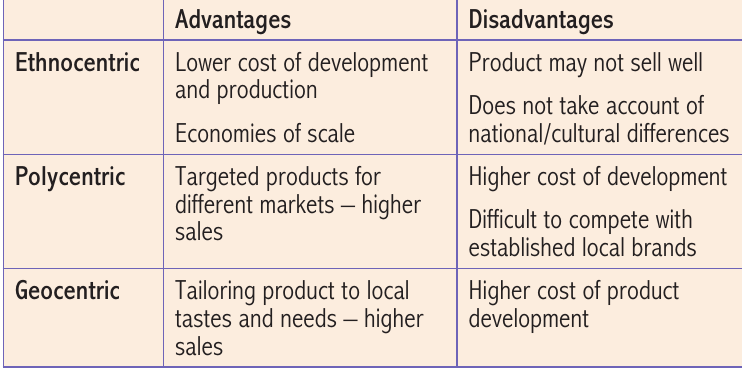
An ethnocentric approach involves selling the same standardised product across all international markets with minimal adaptation. This strategy treats all markets similarly, using a "one size fits all" model.
The main benefit of this approach is cost efficiency. By producing identical products for all markets, businesses can achieve economies of scale – cost savings that come from increased production volumes. Development costs are also lower because the business only needs to create one version of the product.
Example
Example: Global Technology Products
A technology company might sell the same laptop model worldwide with only minor modifications (such as power adapter variations). This standardised approach allows them to manufacture millions of identical units, significantly reducing the cost per unit through economies of scale.
However, this approach carries significant risks. Products may fail to sell well because they don't account for national or cultural differences in consumer tastes, preferences, or needs. What works in one market may be completely unsuitable for another.
Polycentric approach
A polycentric approach recognises that different markets have different needs. Under this strategy, businesses develop targeted products specifically designed for each market they operate in.
This approach typically leads to higher sales because products are better matched to local consumer preferences. When customers feel that products have been designed with their specific needs in mind, they are more likely to purchase them.
The drawback is higher development costs. Creating multiple versions of products for different markets requires more investment in research, design, and production. Additionally, businesses may find it difficult to compete with established local brands that already have strong market positions and customer loyalty.
Geocentric approach
A geocentric approach (sometimes called a localisation strategy) involves tailoring products to meet local tastes, needs, and cultural requirements in each market. This represents the most extensive adaptation strategy.
Like the polycentric approach, this strategy aims to maximise sales by ensuring products fit local preferences. This practice is known as glocalisation – combining global brand presence with local product adaptation.
Example
Example: McDonald's Glocalisation
McDonald's offers different menu items in different countries to reflect local preferences:
- Teriyaki McBurger in Japan
- McAloo Tikki (a vegetarian potato-based burger) in India
- McSpaghetti in the Philippines
This allows McDonald's to maintain its global brand while respecting local tastes and cultural preferences.
The main disadvantage is the substantial cost of product development and adaptation. Each market requires its own product versions, marketing materials, and sometimes even different supply chains.
Important
Key Trade-off in International Marketing
Businesses face a fundamental tension between cost efficiency (favouring standardisation) and market effectiveness (favouring adaptation). The ethnocentric approach minimises costs but risks poor sales, while the geocentric approach maximises local appeal but increases development expenses significantly.
The marketing mix (4Ps) in global markets
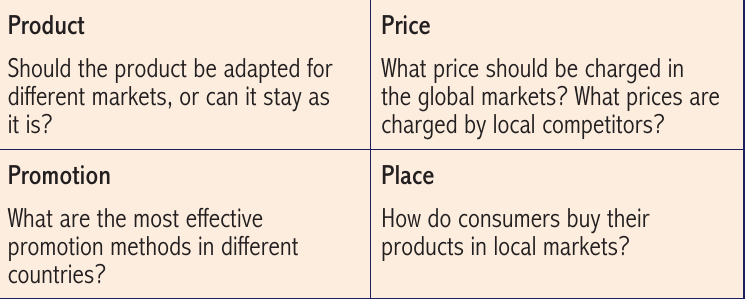
The marketing mix – often called the 4Ps – provides a framework for making strategic marketing decisions. When operating internationally, businesses must carefully adapt each element of the mix to suit local market conditions.
Product decisions
Businesses must decide whether their products need modification for international markets. This connects directly to the three approaches discussed above. Key questions include:
- Can the product be sold as-is, or does it require adaptation?
- Do local tastes, preferences, or cultural norms require product changes?
- Are there regulatory or safety standards that differ from the home market?
For example, food and beverage companies often adapt flavours, ingredients, or portion sizes. Clothing retailers might adjust sizing standards or style preferences. Technology companies may need to modify products for different electrical systems or language requirements.
Price decisions
Pricing in global markets cannot follow a simple universal approach. Businesses must consider numerous local factors that affect what customers can afford and what competitors charge.
Important pricing considerations include:
- Local income levels – What customers in different countries can afford varies significantly. A price that seems reasonable in a wealthy market might be unaffordable in a developing economy.
- Local costs – Rent, wages, taxes, and transportation costs differ between countries.
- Competitor pricing – Local and international competitors set price expectations in each market.
- Currency fluctuations – Exchange rates can affect profitability and pricing decisions.
Example
Example: Apple iPhone Pricing
An Apple iPhone typically costs less in the United States than in Russia. This reflects several factors:
- Different local costs (wages, rent, taxes)
- Varying income levels in each market
- Import duties and taxes
- Currency exchange considerations
Businesses must balance maintaining brand positioning with ensuring affordability in each local market.
Promotion decisions
When promoting products internationally, businesses face cultural and linguistic challenges that require careful consideration.
Language differences are the most obvious barrier. Marketing messages, slogans, and brand names must be translated accurately – and cultural translation matters as much as literal translation. A slogan that works brilliantly in one language might be meaningless or even offensive in another.
Cultural factors also influence which promotional methods are most effective. Media consumption habits vary between countries. The role of social media, television advertising, print media, and outdoor advertising differs significantly across markets. Religious and cultural sensitivities must also be respected.
Place (distribution) decisions
The place element refers to how products reach customers. Distribution strategies must reflect local shopping habits and infrastructure.
Businesses need to understand:
- How do consumers in this market typically shop? (Large supermarkets, small local shops, online, markets?)
- What distribution channels exist and which are most effective?
- What is the state of infrastructure (roads, warehouses, internet connectivity)?
Example
Example: Tesco's Fresh & Easy Stores
Tesco's Fresh & Easy stores in the United States serve as a cautionary example of misunderstanding local shopping preferences. The smaller store format didn't align with how many American consumers prefer to shop – typically using larger supermarkets and buying in bulk.
This demonstrates that understanding local shopping habits is crucial for distribution success, even for experienced international retailers.
Note
Adapting the 4Ps: Key Principles
Each element of the marketing mix requires careful consideration in international markets:
- Product: Balance standardisation with local adaptation
- Price: Reflect local income levels, costs, and competitive dynamics
- Promotion: Ensure cultural and linguistic appropriateness
- Place: Align with local shopping habits and infrastructure
Successful global marketing means adapting each element thoughtfully rather than applying a one-size-fits-all approach.
Ansoff's Matrix for global expansion
Ansoff's Matrix is a strategic planning tool that helps businesses identify growth opportunities. It becomes particularly valuable when considering international expansion, as it clarifies the relationship between products (existing or new) and markets (existing or new).
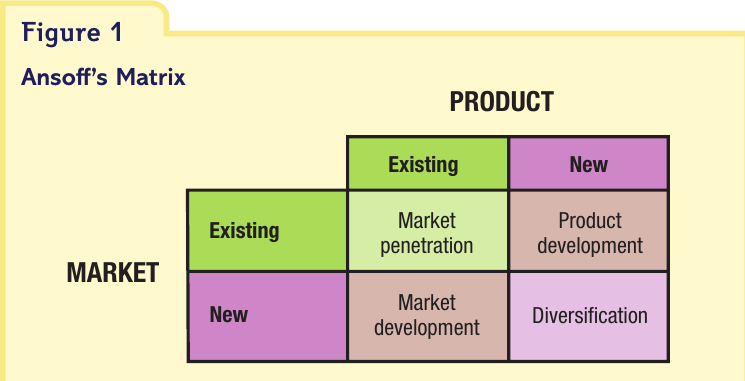
The matrix presents four distinct growth strategies. An important principle is that risk increases the further a business moves away from its existing products and markets (the top-left corner of the matrix). This risk becomes especially pronounced in international markets where businesses may have less expertise in local conditions, consumer preferences, and competitive dynamics.
Important
The Risk Principle in Ansoff's Matrix
Risk increases progressively as businesses move away from what they know:
- Lowest risk: Market penetration (existing products, existing markets)
- Medium risk: Market development OR product development (one new dimension)
- Highest risk: Diversification (new products AND new markets)
In international expansion, this risk is amplified because businesses must navigate unfamiliar cultural, regulatory, and competitive environments.
Market penetration
Market penetration involves selling existing products in existing markets. In a global context, this means a business adapts or modifies products for markets where it already operates.
Example
Example: McDonald's in Japan
McDonald's already has an established presence in Japan. When it develops and launches products specifically for Japanese consumers – like the Teriyaki McBurger – while continuing to operate in the same market, this represents a market penetration strategy.
The business is strengthening its position in a market it already understands, leveraging existing distribution channels, brand recognition, and customer relationships.
This strategy carries the lowest risk because the business operates in familiar territory. It already understands the market, has established distribution channels, and knows its customers.
Market development
Market development involves taking existing products into new geographic markets. This strategy focuses on finding new customers for products that have already been developed and proven successful elsewhere.
However, market development is rarely straightforward. Customers in different regions – even within the same country – often have different tastes, preferences, and shopping habits. Successful market development requires deep understanding of local customs, needs, and behaviours.
Even when products remain largely the same, some modifications are usually necessary. These might include:
- Language changes on packaging and labels
- Adjustments to portion sizes
- Modifications to meet local regulations
- Subtle changes to flavours or ingredients
Example
Example: Pret a Manger's International Expansion
Pret a Manger's expansion into France and the United States demonstrates market development with glocalisation. While the company retained its core model:
- Fresh food prepared daily
- Prompt service
- Convenient locations
It adapted products to suit local preferences. In France, this meant offering more traditional French pastries. In the US, it involved larger portion sizes and different sandwich varieties.
This represents refining an existing product concept to fit new overseas markets while maintaining the brand's core identity.
Product development
Product development means creating new products for existing markets. In the context of international business, this might involve developing new product lines for markets where the business already operates.
This strategy allows businesses to leverage their existing market knowledge and customer relationships while expanding their product range. For instance, a clothing retailer operating in several European countries might develop a new sportswear line for all those existing markets.
The business benefits from understanding customer preferences, having established distribution channels, and possessing brand recognition in these markets. This reduces risk compared to entering entirely new markets.
Diversification
Diversification represents the highest-risk strategy, involving new products in new markets. Businesses venture into unfamiliar territory on both dimensions – they must develop products they haven't made before and sell them to customers they don't yet understand.
While diversification can open up significant growth opportunities, it requires substantial investment and carries considerable uncertainty. Businesses lack both product expertise and market knowledge, making success harder to achieve.
Important
Why Diversification is Risky in International Markets
Diversification combines two major challenges:
- Product uncertainty: Developing unfamiliar products without proven expertise
- Market uncertainty: Operating in unfamiliar markets without local knowledge
In international contexts, this means businesses must simultaneously:
- Learn new product categories and production processes
- Understand different consumer preferences and behaviours
- Navigate unfamiliar regulatory environments
- Compete against established local players
- Build distribution networks from scratch
This dual uncertainty makes diversification the most challenging growth strategy.
Wider strategic considerations for global marketing
Effective global marketing strategy extends well beyond the 4Ps and Ansoff's Matrix. Businesses must also consider a broader range of economic, operational, regulatory, and technological factors that influence international success.
Economic factors
Supply and demand conditions in local markets affect what products succeed and at what prices. Understanding local market dynamics is essential for effective positioning and pricing strategies.
Price and income elasticity of demand varies between markets. In wealthier markets, consumers may be less sensitive to price changes. In developing economies, even small price increases might significantly reduce demand.
Note
Economies of Scale in Global Operations
One major benefit of international growth is the opportunity to achieve economies of scale – reducing unit costs through larger-scale operations. This might come from:
- Purchasing raw materials or components in larger quantities
- Spreading fixed costs (like head office expenses) across more units sold
- Sharing research and development costs across multiple markets
- Using more efficient production technologies that only become cost-effective at higher volumes
These cost savings can provide competitive advantages in pricing and profitability.
Operational factors
Recruitment and staffing present challenges in new markets. Businesses need to assess whether they can find employees with the necessary skills and experience. Local labour laws and employment practices may differ significantly from the home market.
Questions to consider include:
- Are qualified workers available locally?
- What are local salary expectations and employment costs?
- How do local labour laws affect hiring, contracts, and termination?
- Will expatriate managers be needed initially?
Regulatory and ethical factors
Legislation varies between countries. Product safety standards, labelling requirements, advertising regulations, and consumer protection laws all differ. Businesses must ensure compliance in each market they enter.
Regulatory considerations include:
- Product safety and quality standards
- Labelling and packaging requirements
- Advertising and marketing restrictions
- Environmental regulations
- Import/export restrictions and tariffs
Important
Ethical Considerations in International Business
Ethical standards become more complex in international operations. What is considered acceptable business practice in one country might be viewed differently elsewhere.
Businesses must balance:
- Local customs and practices with their own ethical standards
- Legal compliance in multiple jurisdictions
- Stakeholder expectations across different cultures
- Corporate values with practical realities in diverse markets
Companies need clear ethical guidelines that can be applied consistently while respecting cultural differences.
Technological factors
The internet has transformed global marketing, making it easier and cheaper to reach international customers. E-commerce reduces the need for physical distribution networks. Digital marketing allows targeted advertising across borders. Social media enables direct customer engagement worldwide.
However, internet access and usage patterns vary significantly between markets. Businesses must understand how consumers in each market use digital channels. In some markets, mobile-first strategies are essential, while in others, desktop computing remains dominant. Social media platforms that are popular in one country may be blocked or unused in another.
Summary
Key Points to Remember
Three main international marketing approaches exist:
- Ethnocentric (standardised products) – lowest cost, but may not meet local needs
- Polycentric (targeted products for different markets) – better local fit, higher costs
- Geocentric (locally tailored products) – best local adaptation, highest costs
The 4Ps must be adapted for global markets:
- Product: May require modification for local tastes, regulations, or cultural norms
- Price: Must reflect local costs, incomes, and competitive dynamics
- Promotion: Requires cultural and linguistic adaptation
- Place: Depends on local shopping habits and infrastructure
Ansoff's Matrix identifies four growth strategies:
- Market penetration (existing products, existing markets) – lowest risk
- Market development (existing products, new markets) – medium risk
- Product development (new products, existing markets) – medium risk
- Diversification (new products, new markets) – highest risk
Risk increases with distance from existing operations: The further a business moves from its existing products and markets, the greater the risk – particularly in international expansion where local knowledge may be limited.
Glocalisation combines global scale with local adaptation: Successful international businesses often maintain global brand presence while adapting products to meet local tastes, needs, and cultural preferences. This approach balances the cost efficiency of standardisation with the market effectiveness of localisation.