Assessing a Country as a Production Location (Edexcel A-Level Business): Revision Notes
📚Revision Notes
Assessing a Country as a Production Location
When businesses expand globally, they must carefully evaluate potential locations for their production facilities. This is a major strategic decision involving significant financial commitment and long-term consequences. Unlike simply exporting to a new market, establishing production abroad requires substantial investment in factories, equipment, and infrastructure.
Note
Understanding the Difference
Establishing production facilities overseas is fundamentally different from exporting. While exporting involves shipping finished products to foreign markets, setting up production abroad requires:
- Building or purchasing manufacturing facilities
- Investing in equipment and machinery
- Creating long-term infrastructure
- Hiring and training local workforce
- Committing to a long-term presence in the country
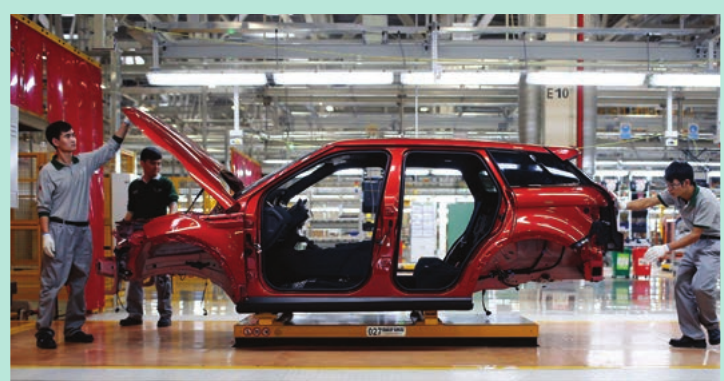
Businesses like Jaguar Land Rover, Renault, and Dyson have all established production facilities overseas. In 2014, JLR opened its first Chinese factory in Jiangsu, partnering with Chery Automobile. This decision was driven by strong sales growth in China (which represented 25% of JLR's total sales) and the need to avoid Chinese import duties. The \£1 billion investment demonstrates the scale of commitment required when locating production internationally.
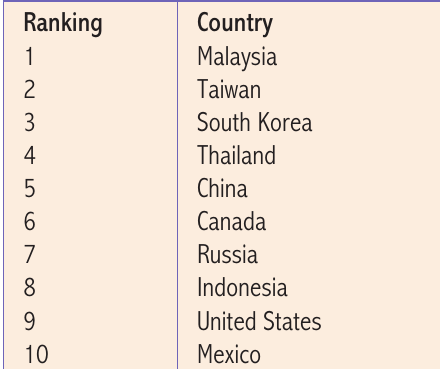
According to a 2014 report by Cushman & Wakefield, Malaysia ranked as the most attractive manufacturing location globally. The ranking considered three weighted factors: costs (40%), risks (20%), and conditions (40%). Asian countries dominated the top rankings due to their competitive production costs and relatively low risk profiles.
Key factors to consider
Costs of production
Production costs are often the primary driver of location decisions. Businesses seek competitive advantages by minimizing costs, particularly in labour-intensive industries. Main production costs include labour, energy, raw materials, and land.
Labour costs vary significantly across countries. For example, when Dyson relocated production from the UK to Malaysia in 2003, wages in Malaysia were \£3 per hour compared with \£9 in the UK—a 30% reduction in production costs. This contributed to profits more than doubling from \£18 million to \£40 million within one year.
Important
The Impact of Wage Inflation
Traditionally low-cost countries are experiencing significant wage inflation. China's labour costs have risen substantially, prompting businesses to seek alternatives in countries like Burma, Bangladesh, and Cambodia. However, these alternative locations may have weaker infrastructure and political instability, creating new challenges for businesses.
Energy costs increasingly influence location decisions. In 2014, BASF (the world's largest chemical producer) expanded in the USA rather than Germany because US natural gas prices were approximately one-quarter of European prices, thanks to the growing shale gas industry. Energy-intensive industries like steel and chemical production are particularly sensitive to these cost differences.
Example
Case Study: BASF's US Expansion
BASF invested $5.7 billion in US operations between 2009 and 2014, building a formic acid plant in Louisiana. The decision was driven by significantly lower energy costs—in 2015, US natural gas prices were roughly 25% of European prices. This demonstrates how production costs can override traditional factors like proximity to headquarters.
Skills and availability of labour force
While low labour costs attract businesses, the quality of human capital is equally important. Businesses cannot afford the consequences of poor-quality output due to inadequate skills or training.
Skill levels matter: A business must verify that the local workforce possesses the necessary skills to maintain quality standards. In countries where labour is cheaper, workers may be unskilled or poorly educated, requiring substantial investment in training. This additional cost can offset initial wage savings.
Important
Quality Concerns and Reshoring
Between 2012 and 2015, many businesses moved production back from the Far East to the West—a process called reshoring. According to Civitas research, quality issues in Chinese factories were a major driver. The quality of work may be good initially but can decline in later production runs, creating significant problems for businesses that prioritize consistent quality standards.
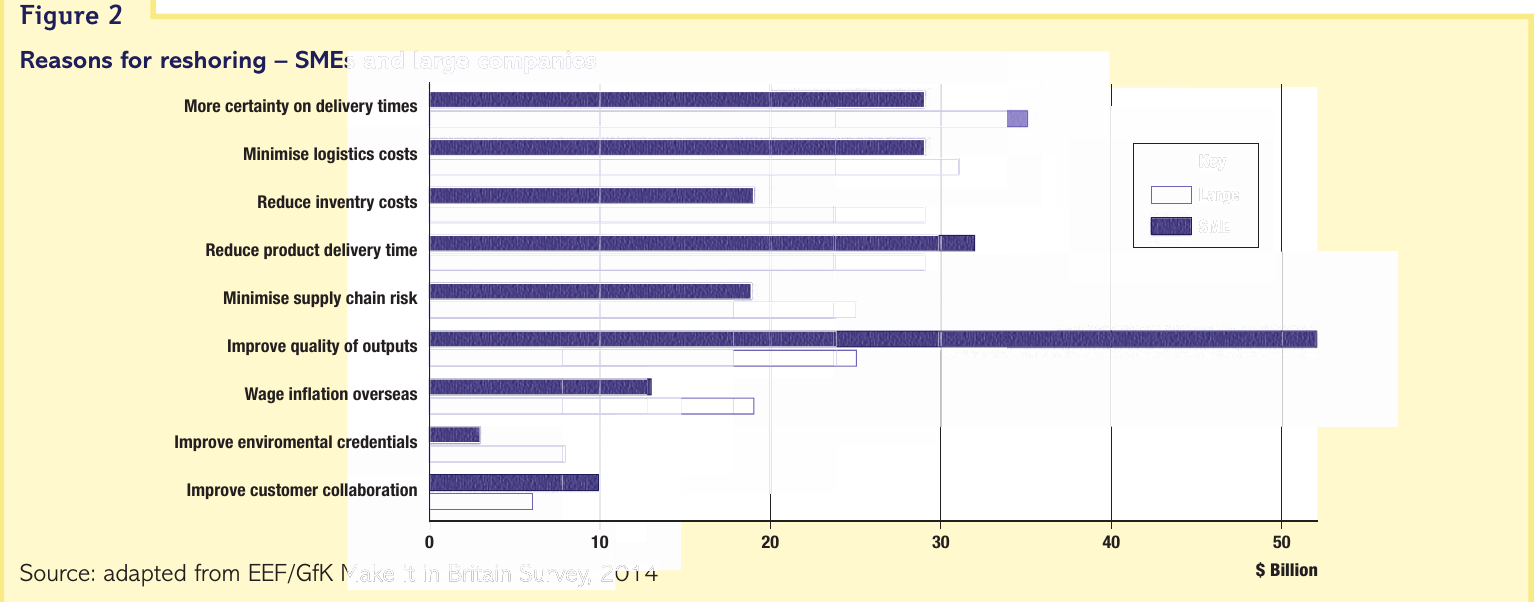
The chart shows that improving quality of outputs is the primary reason for reshoring for both SMEs and large companies. Other significant factors include delivery certainty, reduced logistics costs, and shorter delivery times.
Labour availability: Businesses must ensure sufficient workers are available near the production site, both immediately and for future expansion. In 2014, some businesses faced recruitment difficulties in China due to the country's one-child policy, which created a worker shortage. Additionally, many workers increasingly prefer not to work in factories, especially for exporters with more demanding quality standards.
Infrastructure
Infrastructure quality is critical for supporting large-scale production facilities. Poor infrastructure can increase costs, cause delays, and limit operational effectiveness. Businesses should evaluate several key infrastructure categories:
Transport infrastructure:
- Roads: Poorly constructed or inadequately maintained roads (sometimes unsealed in developing countries) slow transportation of finished goods and raw materials. Natural disasters like flooding can disrupt supply chains.
- Railways: Undeveloped or non-existent railway networks create problems for transporting bulky or heavy goods in large quantities.
- Ports and airports: Modern facilities are essential for shipping goods internationally and enabling business personnel to travel efficiently.
Digital infrastructure:
- Broadband networks: Access to fast, reliable broadband is increasingly vital for business operations. Some countries have slow or unreliable networks that can hamper productivity.
Note
The Importance of Social Infrastructure
Social infrastructure significantly impacts a business's ability to attract and retain skilled managers and senior staff. Two key considerations are:
Education: Lack of investment in education affects human capital quality and may discourage managers and senior staff from relocating. Families moving to the location need access to quality schools that meet international standards.
Healthcare: The quality of hospitals and general health services impacts human capital and may deter senior employees from relocating if standards are significantly lower than their home country. Access to quality medical care is a critical factor for expatriate workers and their families.
Commercial services: Businesses need access to supporting services including printers, IT support, banks, insurance providers, advertising agencies, cleaners, maintenance companies, and component manufacturers. Some countries cannot guarantee these facilities, which may prove prohibitive for certain businesses.
Before selecting an overseas location, businesses should identify their specific infrastructure requirements and determine whether potential countries can meet them both currently and in the future.
Location in a trade bloc
Locating production facilities inside a trade bloc enables businesses to avoid trade barriers such as tariffs and quotas. Output from a factory located within a trade bloc can be sold to any member country without attracting tariffs, making products more price-competitive.
Example
Example: Japanese Car Manufacturers in the UK
Nissan, Honda, and Toyota established car factories in the UK primarily to avoid EU trade barriers. Although the businesses are Japanese-owned, cars manufactured in the UK can be sold throughout the EU (France, Germany, Italy, and other member states) without tariffs.
This location strategy provides tariff-free access to a market of over 500 million consumers, making it particularly valuable for businesses that want to serve large trade blocs while maintaining lower production costs than might be available in the bloc's traditional manufacturing centres.
Government incentives
Governments actively compete to attract foreign direct investment (FDI) because of its benefits, including employment creation, income generation, technology transfer, and economic development. They offer various incentives to make their countries attractive production locations.
Financial incentives include:
- Tax breaks: Reduced or zero tax rates for initial periods
- Lower corporation tax rates: Ongoing reduced tax rates
- Interest-free loans: Government-backed financing
- Cheap land and preferential premises rates: Reduced property costs
Note
UK Support for Foreign Direct Investment
The UK has the highest level of FDI in Europe and offers extensive guidance and support services through UK Trade & Investment (UKTI). This government department provides:
- Detailed industry-specific information (aerospace, communications, financial services, nuclear power, food and drink, railways, creative industries, electronics and IT hardware)
- Direct access to industry experts
- Specialist advisory services
This comprehensive support makes the UK an attractive destination for businesses considering European production locations.
Tax policy importance: According to 2014 PwC research, approximately 63% of 1,344 surveyed CEOs worldwide considered tax policy an important location factor. Recognizing this, the UK government lowered corporation tax to 20% in April 2015—the lowest rate in the G20 (the 20 most advanced economies).
Developing country incentives: Governments in Kenya, Tanzania, Uganda, and Rwanda offer extensive tax incentives including corporation tax holidays and reductions in VAT and customs duties to attract international investment.
Ease of doing business
The commercial environment—often called the 'ease of doing business'—varies significantly across countries. Operating in countries with excessive restrictions or bureaucracy creates frustration and increases costs. Key considerations include:
Business operational factors:
- Starting and closing businesses
- Contract enforcement efficiency
- Bureaucracy levels (e.g., obtaining construction permits)
- Trade credit availability
- Tax collection efficiency
- Insolvency resolution processes
Note
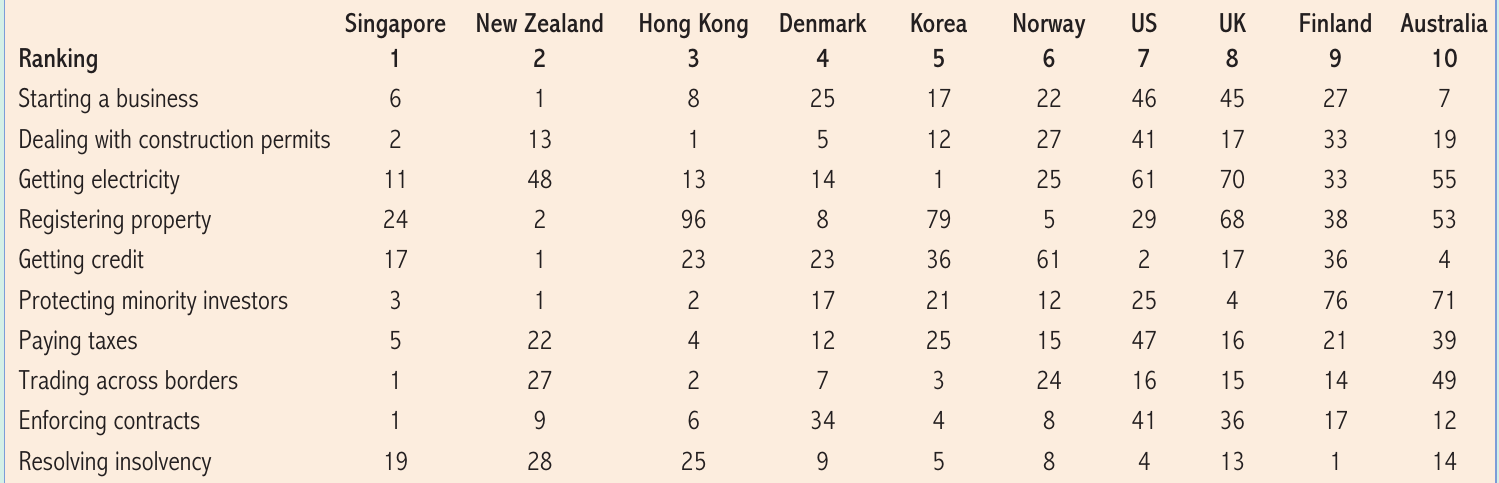
The table shows Singapore ranking first globally for ease of doing business in 2015, while the UK ranks eighth. Singapore excels in starting businesses, dealing with construction permits, and trading across borders. The UK scores particularly well in protecting minority investors.
These rankings provide valuable guidance for businesses evaluating overseas locations and incentivize governments to implement measures improving their rankings—particularly if they prioritize attracting FDI.
Political stability
Political instability makes some countries too dangerous or financially risky for business operations. Examples of regions often avoided due to political tensions include Libya, Yemen, Ukraine, Syria, Pakistan, Iraq, Afghanistan, Somalia, and parts of Latin America.
Important
Critical Political Risks
Kidnapping risk: Western business personnel are common targets for kidnappers seeking ransoms. Latin America, particularly Mexico, is reported as especially dangerous, with estimated kidnappings ranging from 5,000 to 10,000 annually (though statistics are unreliable).
Corruption and bribery: In some countries, corruption is an accepted feature of business operations. Most Western businesses avoid such locations to maintain ethical standards and comply with anti-corruption legislation. However, according to the Institute of Business Ethics' 2013 media monitoring, bribery, corruption, and facilitation payments remained the most commonly recorded issues.
Human rights concerns: Businesses increasingly avoid locations with poor human rights records to prevent consumer boycotts and shareholder disapproval. Corporate social responsibility considerations make such locations reputationally risky.
Natural resources
Some business activities require proximity to specific natural resources, constraining location choices.
Mining operations: Mines can only be established where proven mineral deposits exist. Until 2014, when commodity prices were high, Africa attracted significant mining investment. For example, Rio Tinto acquired a Mozambique coal mining project for $2.7 billion in 2011. However, falling commodity prices subsequently reduced foreign business interest in the region.
Resource-intensive production: Businesses using substantial natural resources locate near their sources. Steel producers, for example, may site plants near iron ore or coal mines because transporting these bulky, heavy materials is expensive.
Example
Case Study: ArcelorMittal in South Africa
ArcelorMittal, a Luxembourg-based multinational steel producer, operates in over 60 countries worldwide. It is South Africa's largest steel company, with several mines and steel works producing long and flat steel for various industries.
The proximity to iron ore and coal sources reduces transportation costs significantly, demonstrating how natural resource availability can be a decisive factor in location decisions for resource-intensive industries.
Likely return on investment
Businesses evaluate multiple location options before making final decisions. SWOT analysis and PESTLE analysis help assess location suitability, while quantitative techniques evaluate financial costs and benefits.
Quantitative methods for location assessment
Businesses use three main investment appraisal techniques to evaluate potential locations financially: payback method, average rate of return, and discounted cash flow.
Example
Example Scenario
Consider a business evaluating two potential locations with the following financial projections:
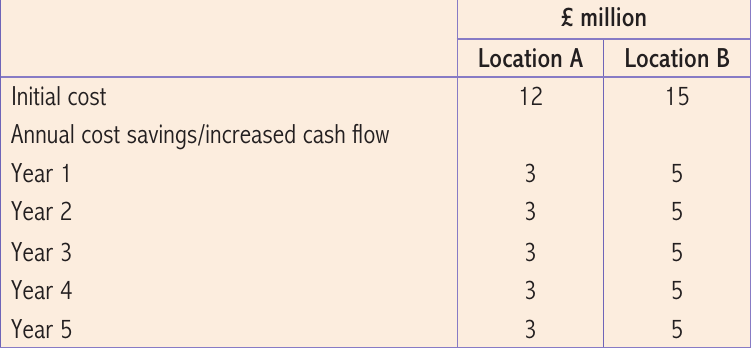
- Location A: Initial cost of \£12 million with annual savings of \£3 million
- Location B: Initial cost of \£15 million with annual savings of \£5 million
Both scenarios assume the business will relocate again after five years, so no cost savings beyond five years are considered.
Payback method
The payback method calculates how long it takes to recoup the initial investment.
Location A:
Location B:
Conclusion: Location B is preferred as it recovers the investment one year faster.
Note
Advantages of Payback Method:
- Simple to calculate and understand
- Focuses on liquidity and risk
- Useful for businesses concerned about cash flow
Disadvantages:
- Ignores profitability after payback period
- Doesn't consider time value of money
- May favor short-term returns over long-term profitability
Average rate of return (ARR)
The ARR method divides the net return by the initial investment, expressed as a percentage.
Example
Worked Example: Calculating ARR
Location A:
- Total cost savings over 5 years: \£15 million
- Initial cost: \£12 million
- Net return: \£15m - \£12m = \£3 million
Location B:
- Total cost savings over 5 years: \£25 million
- Initial cost: \£15 million
- Net return: \£25m - \£15m = \£10 million
Conclusion: Location B is preferred with double the rate of return.
Note
Advantages of ARR:
- Considers total profitability over the entire period
- Easy to compare with other investments
- Provides a percentage return that's familiar to managers
Disadvantages:
- Ignores time value of money
- Uses accounting profit rather than cash flows
- May not reflect actual returns accurately
Discounted cash flow (DCF)
The DCF method recognizes that future cash flows are worth less than current cash flows. Money available in the future must be discounted back to present value, just as invested money grows through compound interest.
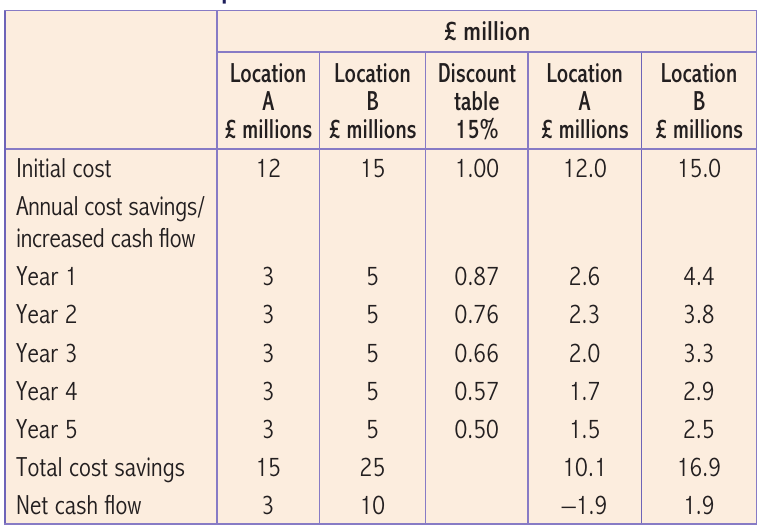
Using a 15% discount rate, future cash flows are adjusted to their present value. The discount factor decreases the further into the future the cash flow occurs.
Example
Worked Example: DCF Calculation
Location A calculation:
- Discounted cost savings total: \£10.1 million
- Initial investment: \£12.0 million
- Net present value: -\£1.9 million (unprofitable)
Location B calculation:
- Discounted cost savings total: \£16.9 million
- Initial investment: \£15.0 million
- Net present value: +\£1.9 million (profitable)
Conclusion: Location B is preferred as it shows positive NPV. Location A would result in a financial loss when the time value of money is considered.
Important
Critical Point About Discount Rates
Whatever discount rate is used, Location B would always be preferred in this scenario. However, at much higher discount rates (significantly above 15%), even Location B might show negative cash flows, suggesting that neither location would be profitable.
This highlights the importance of choosing an appropriate discount rate that reflects the business's cost of capital and the risk associated with the investment.
Note
Advantages of DCF:
- Accounts for time value of money
- Most theoretically sound method
- Provides clear accept/reject decision (positive NPV = accept)
Disadvantages:
- Complex to calculate and understand
- Requires estimating appropriate discount rate
- Difficult to explain to non-financial stakeholders
- Small changes in assumptions can significantly affect results
Exam guidance
Note
Approaching Location Assessment Questions
When answering questions on assessing countries as production locations, remember:
- This topic concerns establishing production facilities, not simply exporting or selling in different markets
- The financial commitment is substantial—you're evaluating where to build factories, not where to sell products
- Consider both quantitative factors (costs, financial returns) and qualitative factors (quality, stability, infrastructure)
- Link your analysis to the specific business context provided in the question
Use appropriate command word responses:
- Explain: Provide reasons why a factor matters with clear cause-and-effect relationships
- Assess: Weigh up different factors, considering which are most important for the specific business scenario
- Evaluate: Make a judgment about the best location decision, considering all factors and their relative importance
Summary
Key Points to Remember
Key factors for assessing production locations:
- Costs (labour, energy, raw materials, land) – often the primary driver but not the only consideration
- Labour quality and availability – skills matter as much as cost; quality issues led to widespread reshoring
- Infrastructure – roads, railways, ports, airports, broadband, education, healthcare, and commercial services
- Trade bloc location – enables tariff-free access to member countries
- Government incentives – tax breaks, lower corporation tax, cheap land, advisory services
Three quantitative methods for evaluation:
- Payback – time to recoup initial investment (simpler but ignores later profitability)
- Average Rate of Return (ARR) – percentage return on investment over time
- Discounted Cash Flow (DCF) – accounts for time value of money (most sophisticated)
Critical considerations:
- Political stability is essential – avoid countries with high risks of kidnapping, corruption, or poor human rights
- Natural resources constrain choices for certain industries (mining, steel production)
- Ease of doing business affects operational efficiency and costs
- Production location decisions require substantial financial commitment and long-term strategic thinking
Remember: Choosing a production location is fundamentally different from choosing an export market. The investment is larger, the commitment longer, and the risks greater. A thorough assessment using both qualitative and quantitative methods is essential.